

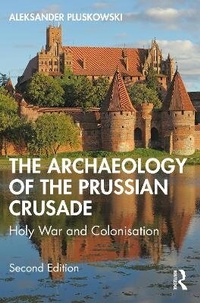
The Archaeology of the Prussian Crusade
Holy War and Colonisation
2nd Edition
Published on 28. June 2022
Book
Paperback/Softback
468 pages
978-1-032-12035-5 (ISBN)
Description
The Archaeology of the Prussian Crusade explores the archaeology and material culture of the crusades against the Prussian tribes in the 13th century, and the resulting society created by the Teutonic Order which endured into the 16th century.
It provides an updated synthesis of the material culture of this unique, hybrid society in the south-eastern Baltic region, encompassing the full range of archaeological data, from standing buildings through to artefacts and ecofacts, integrated with written and artistic sources. The work is sub-divided into broadly chronological themes, beginning with a historical outline, then exploring the settlements, castles, towns and landscapes of the Teutonic Order's theocratic state, the character and tempo of religious transformation and concluding with the roles of the reconstructed and ruined monuments of medieval Prussia in the modern world, particularly within the context of Polish culture.
This remains the first work on the archaeology of medieval Prussia in any language, and is intended as a comprehensive introduction to a period and area of growing interest. This book represents an important contribution to promoting International awareness of the cultural heritage of the Baltic region, which has been rapidly increasing over the last few decades.
It provides an updated synthesis of the material culture of this unique, hybrid society in the south-eastern Baltic region, encompassing the full range of archaeological data, from standing buildings through to artefacts and ecofacts, integrated with written and artistic sources. The work is sub-divided into broadly chronological themes, beginning with a historical outline, then exploring the settlements, castles, towns and landscapes of the Teutonic Order's theocratic state, the character and tempo of religious transformation and concluding with the roles of the reconstructed and ruined monuments of medieval Prussia in the modern world, particularly within the context of Polish culture.
This remains the first work on the archaeology of medieval Prussia in any language, and is intended as a comprehensive introduction to a period and area of growing interest. This book represents an important contribution to promoting International awareness of the cultural heritage of the Baltic region, which has been rapidly increasing over the last few decades.
More details
Edition
2nd edition
Language
English
Place of publication
London
United Kingdom
Publishing group
Taylor & Francis Ltd
Target group
College/higher education
Postgraduate and Undergraduate
Product notice
Paperback (trade)
Unsewn / adhesive bound
Illustrations
89 s/w Abbildungen, 89 s/w Photographien bzw. Rasterbilder
89 Halftones, black and white; 89 Illustrations, black and white
Dimensions
Height: 233 mm
Width: 153 mm
Thickness: 24 mm
Weight
860 gr
ISBN-13
978-1-032-12035-5 (9781032120355)
Copyright in bibliographic data and cover images is held by Nielsen Book Services Limited or by the publishers or by their respective licensors: all rights reserved.
Schweitzer Classification
Other editions
Additional editions
E-Book
06/2022
2nd Edition
Routledge
€53.99
Available for download
Book
06/2022
2nd Edition
Routledge
€230.65
Shipment within 10-20 days
E-Book
06/2022
2nd Edition
Routledge
€53.99
Available for download
Previous edition
Book
12/2012
1st Edition
Routledge
€78.27
Article exhausted; check for reprint
Person
Aleksander Pluskowski is Professor in Medieval Archaeology at the University of Reading.
Content
Preface and acknowledgements to the first edition; Preface to the second edition; Terminology and glossary; 1. Introduction: hitorical framework and sources; 2. Pre-Christian Prussia: early medieval Baltic society; 3. The ravages of holy war: crusade and colonisation in the thirteenth century; 4. A land of red castles: consolidating the Teutonic Order's state in the fourteenth century; 5. From colonisation to urbanisation: towns and international trade; 6. Converting Prussia: the Christianisation of the Teutonic Order's state; 7. From forest to field: the changing environment of medieval Prussia; 8. The end of holy war: from the decline of a crusader state in the fifteenth century to constructing memories of medieval Prussia in the twentieth century; 9. Conclusion: holy war and colonisation; Further reading; Bibliography; Index.