

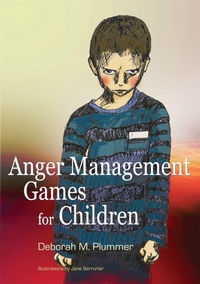
Anger Management Games for Children
Published on 15. March 2008
Book
Paperback/Softback
160 pages
978-1-84310-628-9 (ISBN)
Description
Praise for the author:
'Deborah Plummer uses imagination and empowerment to move children and adults from discouragement to success.'
- The Canadian Child and Adolescent Psychiatry Review
'Deborah Plummer shows a fundamental respect for a child's integrity whilst making sure her language and ideas accessible to a wide range of people.'
- Afasic News
This practical handbook helps adults to understand, manage and reflect constructively on children's anger. Featuring a wealth of familiar and easy-to-learn games, it is designed to foster successful anger management strategies for children aged 5-12.
The book covers the theory behind the games in accessible language, and includes a broad range of enjoyable activities: active and passive, verbal and non-verbal, and for different sized groups. The games address issues that might arise in age-specific situations such as sharing a toy or facing peer pressure. They also encourage children to approach their emotions as a way to facilitate personal growth and healthy relationships.
This is an ideal resource for teachers, parents, carers and all those working with anger management in children.
'Deborah Plummer uses imagination and empowerment to move children and adults from discouragement to success.'
- The Canadian Child and Adolescent Psychiatry Review
'Deborah Plummer shows a fundamental respect for a child's integrity whilst making sure her language and ideas accessible to a wide range of people.'
- Afasic News
This practical handbook helps adults to understand, manage and reflect constructively on children's anger. Featuring a wealth of familiar and easy-to-learn games, it is designed to foster successful anger management strategies for children aged 5-12.
The book covers the theory behind the games in accessible language, and includes a broad range of enjoyable activities: active and passive, verbal and non-verbal, and for different sized groups. The games address issues that might arise in age-specific situations such as sharing a toy or facing peer pressure. They also encourage children to approach their emotions as a way to facilitate personal growth and healthy relationships.
This is an ideal resource for teachers, parents, carers and all those working with anger management in children.
Reviews / Votes
Anger Management Games for Children is a practical guide with clear and explicit theoretical underpinnings that would be useful for all those supporting the emotional development of primary school aged children... As a psychologist it was refreshing to see a solution-focused approach being used to anger management, with an emphasis on facilitators reflecting on their practice and their own emotional needs... This is an incredibly useful and practical resource for those setting out to successfully use games in anger management work with children. -- Debate Adults are encouraged to use the games mindfully, making sure they are aware of the possible effects exploring sensitive issues with vulnerable children. Ideas for reflection after each activity prompt children to make sense of the feelings generated by the game they have played. The games are simple to play and clearly explained, with symbols indicating the time required and the recommended age. The games range from five to 60 minutes' duration, and mostly require no extra resources, which make them an invaluable resource for any adult who works with children aged 5-12. -- The Sign There are many good ideas here that can be dipped in and out or added to your current repertoire ideas. -- NASEN Special This handbooks is designed to help adults understand and manage children's anger. It includes games and activities that encourage children aged between five and 12 to express their emotions in a healthy way. -- Children and Young People Now Deborah M Plummer's practical guide is packed full of easy-to-learn games that will help teachers to understand and manage children's anger. -- Junior Education Education Plus This book is divided into two parts. The first explores the theory around anger, with chapters on understanding anger: why games are used to support healthy anger management; structuring the emotional environment when a child is already angry, and self-reflection and self-care for workers.I really enjoyed the common sense approach the author uses in this section. She explains anger as a normal, healthy human emotion, and clearly describes the chemistry involved in experiencing and expressing anger. -- Children & Young People Now
More details
Language
English
Place of publication
London
United Kingdom
Target group
Professional and scholarly
Product notice
Paperback (UK-trade)
Dimensions
Height: 247 mm
Width: 173 mm
Thickness: 9 mm
Weight
300 gr
ISBN-13
978-1-84310-628-9 (9781843106289)
Copyright in bibliographic data and cover images is held by Nielsen Book Services Limited or by the publishers or by their respective licensors: all rights reserved.
Schweitzer Classification
Other editions
Additional editions
Deborah Plummer
Anger Management Games for Children
E-Book
03/2008
Jessica Kingsley Publishers
from
€30.99
Available for download
Persons
Deborah M. Plummer has over 30 years' experience of facilitating groups and working individually with both children and adults. Formerly a clinical lead therapist working within the NHS, she also has extensive experience as a senior lecturer in aspects of health psychology and counselling. She ran workshops and short courses on the uses of imagery, games and story-telling in the promotion of well-being. Deborah is now retired.
Content
Part One: Theoretical and Practical Background. 1. Introduction. 2. Understanding Anger 3. Why Use Games to Support Healthy Anger Management? 4. Structuring the Emotional Environment. 5. When a Child is Already Angry. 6. Self-Reflection and Self-Care. Bibliography. References. Part Two: Games for Anger Management. 7. Non-Competitive Ways to Choose Groups and Group Leaders. 8. Warm-Ups and Ice-Breakers. 9. Lighting the Fuse: Exploring Anger and Triggers to Anger. 10. When I'm Angry: Responses and Consequences. 11. You and Me: Empathy. 12. You and Me Together: Respect, Cooperation and Negotiation. 13. In the Driving Seat: Being in Control, Managing Stress and Tolerating Frustration. 14. Got It! Solving Problems. 15. Off We Go: Setting Goals and Being Prepared. 16. Wind-Downs and Celebrations. Useful Resources. Subject Index. Author Index. Acknowledgements.