

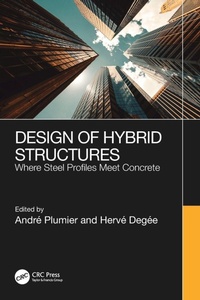
Design of Hybrid Structures
Where Steel Profiles Meet Concrete
1st Edition
Published on 30. January 2025
Book
Paperback/Softback
340 pages
978-0-367-71208-2 (ISBN)
Description
Well-designed hybrid structures can combine the different performance strengths materials. This guide focuses on design approaches for concrete structures reinforced in an unconventional way by steel profiles. It explains force transfer mechanisms of steel profiles and oncrete interfaces, and an analysis of the characteristics of hybrid structures, including slendercomponents. Several types of hybrid designs are addressed: walls and columns with several embedded steel profiles, connections strengthened by steel profiles between steel and composite or reinforced concrete components, including the specific case of shear keys connecting deep beams or flat slabs to columns. The transition zones in partly reinforced concrete and partly composite columns are also covered.
Design of Hybrid Structures draws on the European SMARTCOCO research project of experimentation and numerical modelling, giving practical guidance for designers and introducing the subject for researchers and graduate students.
Design of Hybrid Structures draws on the European SMARTCOCO research project of experimentation and numerical modelling, giving practical guidance for designers and introducing the subject for researchers and graduate students.
More details
Language
English
Place of publication
London
United Kingdom
Publishing group
Taylor & Francis Ltd
Target group
College/higher education
Professional and scholarly
Academic, Postgraduate, and Professional
Illustrations
204 s/w Abbildungen, 24 farbige Abbildungen, 7 s/w Photographien bzw. Rasterbilder, 7 Farbfotos bzw. farbige Rasterbilder, 197 s/w Zeichnungen, 17 farbige Zeichnungen, 15 s/w Tabellen
15 Tables, black and white; 17 Line drawings, color; 197 Line drawings, black and white; 7 Halftones, color; 7 Halftones, black and white; 24 Illustrations, color; 204 Illustrations, black and white
Dimensions
Height: 234 mm
Width: 156 mm
Thickness: 19 mm
Weight
535 gr
ISBN-13
978-0-367-71208-2 (9780367712082)
Copyright in bibliographic data and cover images is held by Nielsen Book Services Limited or by the publishers or by their respective licensors: all rights reserved.
Schweitzer Classification
Other editions
Additional editions
Book
05/2023
1st Edition
CRC Press
€129.99
Shipment within 15-20 days
E-Book
05/2023
1st Edition
CRC Press
€65.99
Available for download
E-Book
05/2023
1st Edition
CRC Press
€65.99
Available for download
Persons
Andre Plumier, Honorary Professor at the University of Liege, obtained his PhD on welding residual stresses and their effect on stability. He has participated in twenty research projects in earthquake engineering and hybrid structures. He conceived the dogbone, a detail for the ductility of steel structures. He was one expert building up the Eurocode 8 for seismic design (2004), to the revision of which he now officially contributes. Active as support in projects involving hybrid details and seismic assessment and retrofitting, he has also given seminars on seismic design.
Herve Degee started as research associate at the University of Liege working on stability issues in steel and steel-concrete structures in normal and seismic conditions. Since 2014, he is professor at Hasselt University (Belgium) where he is heading the Structural Testing Laboratory (ACB (2)). He has been participating to about 20 European research projects and is very active in the standardization at national and European level, being a member of various working groups for Eurocodes 3, 4, 6 and 8.
Herve Degee started as research associate at the University of Liege working on stability issues in steel and steel-concrete structures in normal and seismic conditions. Since 2014, he is professor at Hasselt University (Belgium) where he is heading the Structural Testing Laboratory (ACB (2)). He has been participating to about 20 European research projects and is very active in the standardization at national and European level, being a member of various working groups for Eurocodes 3, 4, 6 and 8.
Content
1. Hybrid structure in the real world. 2. Load introduction and force transfer mechanisms at steel profile-concrete interface. 3. Analysis of hybrid steel concrete structures and components. 4. Hybrid walls and columns. 5. Transition between composite and reinforced concrete members. 6. Connections of reinforced concrete beams or flat slabs to steel columns by shear-keys.