

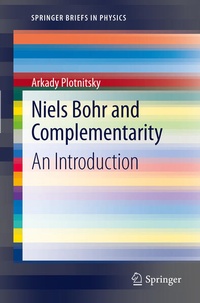
Niels Bohr and Complementarity
An Introduction
Published on 5. September 2012
Book
Paperback/Softback
XXI, 199 pages
978-1-4614-4516-6 (ISBN)
Description
This book offers a discussion of Niels Bohr's conception of "complementarity," arguably his greatest contribution to physics and philosophy. By tracing Bohr's work from his 1913 atomic theory to the introduction and then refinement of the idea of complementarity, and by explicating different meanings of "complementarity" in Bohr and the relationships between it and Bohr's other concepts, the book aims to offer a contained and accessible, and yet sufficiently comprehensive account of Bohr's work on complementarity and its significance.
More details
Series
Edition
2012 ed.
Language
English
Place of publication
New York
United States
Target group
Professional and scholarly
Research
Illustrations
2 s/w Abbildungen
XXI, 199 p. 2 illus.
Dimensions
Height: 235 mm
Width: 155 mm
Thickness: 13 mm
Weight
347 gr
ISBN-13
978-1-4614-4516-6 (9781461445166)
DOI
10.1007/978-1-4614-4517-3
Schweitzer Classification
Other editions
Additional editions
E-Book
09/2012
1st Edition
Springer
€64.19
Available for download
Person
Arkady Plotnitsky is a professor of Theory and Cultural Studies at Purdue University, where he is also a director of the Theory and Cultural Studies Program, and a co-director of the Philosophy and Literature Program. He has published extensively on philosophy of physics and mathematics, continental philosophy, British and European Romanticism, Modernism, and the relationships among literature, philosophy, and science. His most recent books are Epistemology and Probability: Bohr, Heisenberg, Schrödinger and the Nature of Quantum-Theoretical Thinking (2009), Reading Bohr: Physics and Philosophy (2006), and a co-edited (with Tilottama Rajan) collection of essays Idealism Without Absolute: Philosophy and Romantic Culture (2004).
Content
Preface.- Acknowledgements.- List of Abbreviations.- Chapter 1. 1900-1962. From Planck to Bohr.- Chapter 2. 1913. "On the Constitution of Atoms and Molecules": Quantum Jumps and Epistemological Leaps.- Chapter 3. 1925. "Atomic Theory and Mechanics": From the Old Quantum Theory to Heisenberg's Quantum Mechanics.- Chapter 4. 1927. "The Quantum Postulate and the Recent Development of Atomic Theory" (The Como Lecture): Complementarity vs. Causality.- Chapter 5. 1929. "The Quantum of Action and the Description of Nature": New Complementarities and a New Interpretation.- Chapter 6. 1931. "The Space-Time Continuity and Atomic Physics" (the Bristol Lecture): Quantum Phenomena and the Double-Slit Experiment.- Chapter 7. 1933. "On the Question of Measurability of Electromagnetic Field Quantities": Complementarity and Quantum Field Theory.- Chapter 8. 1935. "Can Quantum-Mechanical Description of Physical Reality Be Considered Complete?": The EPR Experiment and Complementarity.- Chapter 9. 1937-1938. "Complementarity and Causality" and "The Causality Problem in Atomic Physics" (The Warsaw Lecture): The Knowable and the Unthinkable.- Chapter 10. 1954-1962. "The Unity of Knowledge": New Harmonies.- Bibliography.- Name Index.- Subject Index.