

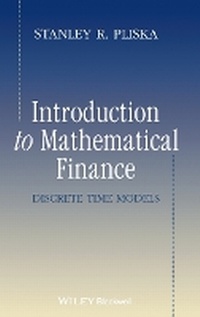
Introduction to Mathematical Finance
Discrete Time Models
1st Edition
Published on 15. April 1997
Book
Hardback
272 pages
978-1-55786-945-6 (ISBN)
Description
The purpose of this book is to provide a rigorous yet accessible introduction to the modern financial theory of security markets. The main subjects are derivatives and portfolio management. The book is intended to be used as a text by advanced undergraduates and beginning graduate students. It is also likely to be useful to practicing financial engineers, portfolio manager, and actuaries who wish to acquire a fundamental understanding of financial theory. The book makes heavy use of mathematics, but not at an advanced level. Various mathematical concepts are developed as needed, and computational examples are emphasized.
Reviews / Votes
"I believe that this is an excellent text for undergraduate or MBA classes on Mathematical Finance. The bulk of the book describes a model with finitely many, discrete trading dates, and a finite sample space, thus it avoids the technical difficulties associated with continuous time models. The major strength of this book is its careful balance of mathematical rigor and intuition." Peter Lakner, New York UniversityMore details
Language
English
Place of publication
New York
United States
Target group
College/higher education
Professional and scholarly
Product notice
sewn/stitched
Cloth over boards
Dimensions
Height: 240 mm
Width: 161 mm
Thickness: 19 mm
Weight
583 gr
ISBN-13
978-1-55786-945-6 (9781557869456)
Copyright in bibliographic data and cover images is held by Nielsen Book Services Limited or by the publishers or by their respective licensors: all rights reserved.
Schweitzer Classification
Person
Stanley Pliska is the founding editor of the scholarly journal Mathematical Finance. He is noted for his fundamental research on the mathematical and economic theory of security prices, especially his development of important bridges between stochastic calculus and arbitrage pricing theory as well as his discovery of the risk neutral computational approach for portfolio optimization problems. He is currently teaching and researching in the areas of interest rate derivatives and dynamic asset allocation.
Content
Preface v
Acknowledgments x
1 Single Period Securities Markets 1
2 Single Period Consumption and Investment 33
3 Multiperiod Securities Markets 72
4 Options, Futures, and Other Derivatives 112
5 Optimal Consumption and Investment Problems 149
6 Bonds and Interest Rate Derivatives 200
7 Models with Infinite Sample Spaces 238
Appendix: Linear Programming 250
Bibliography 254
Index 257
Acknowledgments x
1 Single Period Securities Markets 1
2 Single Period Consumption and Investment 33
3 Multiperiod Securities Markets 72
4 Options, Futures, and Other Derivatives 112
5 Optimal Consumption and Investment Problems 149
6 Bonds and Interest Rate Derivatives 200
7 Models with Infinite Sample Spaces 238
Appendix: Linear Programming 250
Bibliography 254
Index 257