

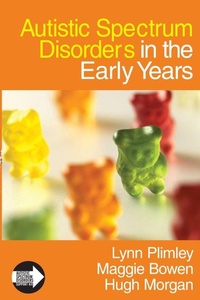
Autistic Spectrum Disorders in the Early Years
1st Edition
Published on 31. January 2007
Book
Paperback/Softback
112 pages
978-1-4129-2315-6 (ISBN)
Description
'An extremely helpful, compact guide for anyone working in early years education... provides clear information for all professionals who work with children from birth to five with autistic spectrum disorders... A short, accessible and reader-friendly book that addresses the key issues' - Nursery Education
Looking at the early years of a child's life, this book provides information on the services that are available for those from birth to five years, and addresses issues related to identification, assessment, teaching and learning and family support.
It is illustrated with case studies provided by parents and practitioners.
The following areas are discussed:
o the Code of Practice for SEN & the SEN and Disability Discrimination Act
o identification and assessment
o good practice examples of multi-agency collaboration and provision
o partnership with parents
o social skills and behaviour
o alternative intervention and home-based programmes
o the transition from pre-school to school.
Professionals in Health, Social Services and Education, pre-school playgroups, nursery staff, parents and carers will all find this book useful.
Conference Information
The Good Autism Practice (GAP) conference is based on the successful foundations of the Good Autism Practice (GAP) journal, which provides a platform for acknowledging and sharing good practice in autism.
Looking at the early years of a child's life, this book provides information on the services that are available for those from birth to five years, and addresses issues related to identification, assessment, teaching and learning and family support.
It is illustrated with case studies provided by parents and practitioners.
The following areas are discussed:
o the Code of Practice for SEN & the SEN and Disability Discrimination Act
o identification and assessment
o good practice examples of multi-agency collaboration and provision
o partnership with parents
o social skills and behaviour
o alternative intervention and home-based programmes
o the transition from pre-school to school.
Professionals in Health, Social Services and Education, pre-school playgroups, nursery staff, parents and carers will all find this book useful.
Conference Information
The Good Autism Practice (GAP) conference is based on the successful foundations of the Good Autism Practice (GAP) journal, which provides a platform for acknowledging and sharing good practice in autism.
Reviews / Votes
'An extremely helpful, compact guide for anyone working in early years education... provides clear information for all professionals who work with children from birth to five with autistic spectrum disorders... A short, accessible and reader-friendly book that addresses the key issues' - Nursery EducationMore details
Series
Language
English
Place of publication
Thousand Oaks
United States
Target group
Professional and scholarly
Dimensions
Height: 234 mm
Width: 156 mm
Thickness: 6 mm
Weight
164 gr
ISBN-13
978-1-4129-2315-6 (9781412923156)
Copyright in bibliographic data and cover images is held by Nielsen Book Services Limited or by the publishers or by their respective licensors: all rights reserved.
Schweitzer Classification
Other editions
Additional editions
Lynn Plimley | Maggie Bowen | Hugh Morgan
Autistic Spectrum Disorders in the Early Years
E-Book
01/2007
1st Edition
SAGE Publications Ltd
€63.89
Available for download
Lynn Plimley | Maggie Bowen | Hugh Morgan
Autistic Spectrum Disorders in the Early Years
Book
01/2007
1st Edition
SAGE Publications Inc
€187.19
Shipment within 10-20 days
Lynn Plimley | Maggie Bowen | Hugh Morgan
Autistic Spectrum Disorders in the Early Years
E-Book
01/2007
1st Edition
SAGE Publications Ltd
from
€63.89
Available for download
Content
1. The Code of Practice for SEN - explaining the graduated response, the systems in education, the role of the SENc in the Early Years
2. The SEN and Disability Discrimination Act (2002)- how it impacts on the rights of individuals with ASD and their families.
3. Identification and Assessment- issues around diagnosis, assessment tools and monitoring progress.
4. Family relationships- how a child with ASD will impact on family dynamics- advice for parents and siblings
5. Roles and Responsibilities of Early Years Practioners- psychologists, G.Ps, health visitors, CAMHS, education, play groups, social services etc
6. Service Provision - good practice examples of multi-agency colloboration in service provision from health, social services, PPA and education
7. Partnership with Parents- the role of the voluntary sector, parent partnership shemes, family support groups, health, social services and education
8. Social Skills Training- personal hygiene, feeding, language and communication
9. Managing Behaviour- finding the triggers, using the right strategies, creating a stress free environment
10. Community Involvement- helping young children to cope in the outside world, leisure, shopping, local playgroup, nursery etc
11. Alternative Intervention and Home-Based Programmes- an objective overview of what's available
12. The Transition from School to Pre-School Services
2. The SEN and Disability Discrimination Act (2002)- how it impacts on the rights of individuals with ASD and their families.
3. Identification and Assessment- issues around diagnosis, assessment tools and monitoring progress.
4. Family relationships- how a child with ASD will impact on family dynamics- advice for parents and siblings
5. Roles and Responsibilities of Early Years Practioners- psychologists, G.Ps, health visitors, CAMHS, education, play groups, social services etc
6. Service Provision - good practice examples of multi-agency colloboration in service provision from health, social services, PPA and education
7. Partnership with Parents- the role of the voluntary sector, parent partnership shemes, family support groups, health, social services and education
8. Social Skills Training- personal hygiene, feeding, language and communication
9. Managing Behaviour- finding the triggers, using the right strategies, creating a stress free environment
10. Community Involvement- helping young children to cope in the outside world, leisure, shopping, local playgroup, nursery etc
11. Alternative Intervention and Home-Based Programmes- an objective overview of what's available
12. The Transition from School to Pre-School Services