

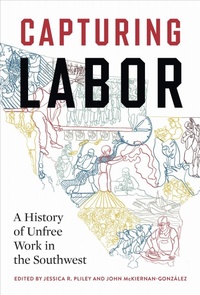
Capturing Labor
A History of Unfree Work in the Southwest
Published on 30. April 2026
Book
Hardback
280 pages
978-1-4773-3345-7 (ISBN)
Description
A collection of essays grappling with the many, often overlooked, forms of unfree labor in the West.
When Americans think of unfree labor-coerced, extracted from workers unable to freely enter and exit contracts-what comes to mind is Black slavery and peonage in the South. But other forms of unfree labor also built the United States. Collecting a diverse range of sharply argued historical essays, Capturing Labor shares the story of unfree labor in the Southwest, affecting mainly Indigenous people, Mexican Americans, and people of color.
In Texas and elsewhere, state agents developed various methods for directing the movement of workers, seizing their time, and controlling the products of their efforts. Case studies highlight the detention during World War I of Indigenous children and unaccompanied women, who were placed in boarding schools, fined, and obligated to work off the resulting debt. Other essays expose authorities forcing workers to break strikes and jailing Americans who supported labor uprisings in rural Mexico and the United States. Prisons and asylums supplied coerced agricultural workers and musicians who were never compensated for their labor or by the labels that took their recordings.
Editors Jessica Pliley and John Mckiernan-GonzAlez contend that unfree labor continues to shape American life, and is all around us today. Understanding its history aids us in recognizing and bringing attention to the grim realities of the present.
When Americans think of unfree labor-coerced, extracted from workers unable to freely enter and exit contracts-what comes to mind is Black slavery and peonage in the South. But other forms of unfree labor also built the United States. Collecting a diverse range of sharply argued historical essays, Capturing Labor shares the story of unfree labor in the Southwest, affecting mainly Indigenous people, Mexican Americans, and people of color.
In Texas and elsewhere, state agents developed various methods for directing the movement of workers, seizing their time, and controlling the products of their efforts. Case studies highlight the detention during World War I of Indigenous children and unaccompanied women, who were placed in boarding schools, fined, and obligated to work off the resulting debt. Other essays expose authorities forcing workers to break strikes and jailing Americans who supported labor uprisings in rural Mexico and the United States. Prisons and asylums supplied coerced agricultural workers and musicians who were never compensated for their labor or by the labels that took their recordings.
Editors Jessica Pliley and John Mckiernan-GonzAlez contend that unfree labor continues to shape American life, and is all around us today. Understanding its history aids us in recognizing and bringing attention to the grim realities of the present.
Reviews / Votes
"Remarkable in its scope, analysis, and ambition, Capturing Labor sheds new light on systems of coerced labor and how central they have been to the histories of race, politics, and capitalism in the American Southwest. Not a specialist in the history of the American Southwest? You will still want to read the essays contained in this volume, as each, in its own way, challenges us to think about the history of coerced labor in new, fascinating, and important ways." - Stephen C. Beda, University of Oregon, author of Strong Winds and Widow Makers: Workers, Nature, and Environmental Conflict in Pacific Northwest Timber Country"Capturing a persistent history of unfree labor, this outstanding collection questions triumphalist interpretations of freedom by documenting slavery, peonage, indentured, contract, unpaid, and carceral arrangements well into the twentieth century. The Southwest emerges as central to capital accumulation through the bodies of Black, Mexican, Indigenous, and poor white workers. The brothel, "Native" boarding school, "feebleminded" asylum, and the prison join fields, restaurants, and factories as sites of coercion and exploitation, reinforced by law but subject to the struggles of working people themselves. In the process, Pliley and Mckiernan-Gonzalez powerfully demonstrate the ways that reproductive labor feeds into racial capitalism." - Eileen Boris, UC Santa Barbara, author of Making the Woman Worker: Precarious Labor and the Fight for Global Standards, 1919-2019
More details
Language
English
Place of publication
Austin, TX
United States
Target group
College/higher education
Product notice
sewn/stitched
Cloth over boards
Illustrations
12 b&w illus.
Dimensions
Height: 232 mm
Width: 154 mm
Thickness: 30 mm
Weight
567 gr
ISBN-13
978-1-4773-3345-7 (9781477333457)
Copyright in bibliographic data and cover images is held by Nielsen Book Services Limited or by the publishers or by their respective licensors: all rights reserved.
Schweitzer Classification
Persons
Jessica R. Pliley is a professor of women's and gender history at Texas State University. She is the author of Policing Sexuality: The Mann Act and the Making of the FBI and the coeditor of Fighting Modern Slavery and Human Trafficking: History and Contemporary Policy and Global Anti-Vice Activism, 1890-1950: Fighting Drinks, Drugs, and "Immorality."
John Mckiernan-Gonzalez is the director of the Center for the Study of the Southwest and an associate professor of history at Texas State University. He is the author of Fevered Measures: Public Health and Race at the Texas-Mexico Border, 1848-1942 and coeditor of Precarious Prescriptions: Contested Histories of Race and Health in North America.
John Mckiernan-Gonzalez is the director of the Center for the Study of the Southwest and an associate professor of history at Texas State University. He is the author of Fevered Measures: Public Health and Race at the Texas-Mexico Border, 1848-1942 and coeditor of Precarious Prescriptions: Contested Histories of Race and Health in North America.
Content
Introduction (Jessica R. Pliley and John Mckiernan-GonzAlez)
I. Troubling Contracts: Limiting Worker Mobility in the Labor Market
1. Constructing Coercion: Labor Regimes and Sex Workers at the US-Mexico Borderlands (Erik Bernardino)
2. Cotton's Paradise: Coerced Labor and the Right to Live During the Great Depression in El Paso, Texas, 1931-1933 (Yolanda ChAvez Leyva)
3. "We Never Had No Payday Here": Folk Song, Forced Labor and the Carceral State in Texas (Jason Mellard)
4. Mario CantU and the Struggle Against Unfree Labor in San Antonio, Tejas, and Mexico, 1969-1984 (Jerry GonzAlez)
II. Imprisoning Housework: (Re)producing Unfreedom
5. The Curse of Cane: Sugar, Race, and the Bittersweet Legacy of Prison Segregation in Texas, 1871-1926 (Jermaine Thibodeaux)
6. The Carceral Rescue Industry: World War I-Era Anti-Prostitution Campaigns in Texas (Anh Adams and Jessica R. Pliley)
7. Native Women and Unfree Labor: The Haskell Indian Boarding School Experience (Bethany Eby)
8. "Nobody Paid Me Anything": Forced Labor in California Institutions for the Feebleminded (Natalie Lira)
Epilogue: Chasing (and Being Chased by) Slavery-A Borderlands Journey (Luis C. de Baca)
Acknowledgments
Index
I. Troubling Contracts: Limiting Worker Mobility in the Labor Market
1. Constructing Coercion: Labor Regimes and Sex Workers at the US-Mexico Borderlands (Erik Bernardino)
2. Cotton's Paradise: Coerced Labor and the Right to Live During the Great Depression in El Paso, Texas, 1931-1933 (Yolanda ChAvez Leyva)
3. "We Never Had No Payday Here": Folk Song, Forced Labor and the Carceral State in Texas (Jason Mellard)
4. Mario CantU and the Struggle Against Unfree Labor in San Antonio, Tejas, and Mexico, 1969-1984 (Jerry GonzAlez)
II. Imprisoning Housework: (Re)producing Unfreedom
5. The Curse of Cane: Sugar, Race, and the Bittersweet Legacy of Prison Segregation in Texas, 1871-1926 (Jermaine Thibodeaux)
6. The Carceral Rescue Industry: World War I-Era Anti-Prostitution Campaigns in Texas (Anh Adams and Jessica R. Pliley)
7. Native Women and Unfree Labor: The Haskell Indian Boarding School Experience (Bethany Eby)
8. "Nobody Paid Me Anything": Forced Labor in California Institutions for the Feebleminded (Natalie Lira)
Epilogue: Chasing (and Being Chased by) Slavery-A Borderlands Journey (Luis C. de Baca)
Acknowledgments
Index