

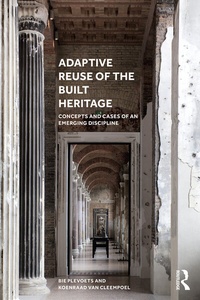
Adaptive Reuse of the Built Heritage
Concepts and Cases of an Emerging Discipline
1st Edition
Published on 8. May 2019
Book
Hardback
256 pages
978-1-138-06275-7 (ISBN)
Description
Adaptive reuse - the process of repairing and restoring existing buildings for new or continued use - is becoming an essential part of architectural practice. As mounting demographic, economic, and ecological challenges limit opportunities for new construction, architects increasingly focus on transforming and adapting existing buildings.
This book introduces adaptive reuse as a new discipline. It provides students and professionals with the understanding and the tools they need to develop innovative and creative approaches, helping them to rethink and redesign existing buildings - a skill which is becoming more and more important. Part I outlines the history of adaptive reuse and explains the concepts and methods that lie behind new design processes and contemporary practice. Part II consists of a wide range of case studies, representing different time periods and strategies for intervention. Iconic adaptive reuse projects such as the Caixa Forum in Madrid and the Rijksmuseum in Amsterdam are discussed alongside less famous and spontaneous transformations such as the Kunsthaus Tacheles in Berlin, in addition to projects from Italy, Spain, Croatia, Belgium, Poland, and the USA.
Featuring over 100 high-quality color illustrations, Adaptive Reuse of the Built Heritage is essential reading for students and professionals in architecture, interior design, heritage conservation, and urban planning.
This book introduces adaptive reuse as a new discipline. It provides students and professionals with the understanding and the tools they need to develop innovative and creative approaches, helping them to rethink and redesign existing buildings - a skill which is becoming more and more important. Part I outlines the history of adaptive reuse and explains the concepts and methods that lie behind new design processes and contemporary practice. Part II consists of a wide range of case studies, representing different time periods and strategies for intervention. Iconic adaptive reuse projects such as the Caixa Forum in Madrid and the Rijksmuseum in Amsterdam are discussed alongside less famous and spontaneous transformations such as the Kunsthaus Tacheles in Berlin, in addition to projects from Italy, Spain, Croatia, Belgium, Poland, and the USA.
Featuring over 100 high-quality color illustrations, Adaptive Reuse of the Built Heritage is essential reading for students and professionals in architecture, interior design, heritage conservation, and urban planning.
Reviews / Votes
"Retrofitting of the built environment is one of the most significant challenges for a sustainable future. This book is the result of a long-time effort to establish adaptive reuse as a discipline in its own right. Working with existing buildings has too often been regarded as a second-rate architectural task, the authors show compellingly that this is not the case.Adaptive Reuse of the Built Heritage differs positively from most other books on the subject. Where others are, most often, best-practice-oriented, technical or theoretical, this book combines theoretical approaches with practical tools, it covers philosophical and ethical questions and spans from conservation and restoration perspectives to design and aesthetics. I can heartily recommend this to anybody interested in the field."
Professor Ola Wetterberg, Department of Conservation, University of Gothenburg. and Director of the Centre for Critical Heritage Studies
"The book investigates a vibrant intersection of fields related to the reuse and re-imagination of our existing built environment. Insight, intangible and tangible analysis, strategies, synthesis, and poetry are drawn from and connected to various fields such as Interior Design, Architecture, Conservation, Planning, Philosophy, and History to allow a holistic remaking based on embedded potentials of a host site."
Markus Berger, Associate Professor, Graduate Program Director, Department of Interior Architecture, Rhode Island School of Design
More details
Language
English
Place of publication
London
United Kingdom
Publishing group
Taylor & Francis Ltd
Target group
College/higher education
Professional and scholarly
Postgraduate, Professional, Professional Practice & Development, and Undergraduate
Illustrations
27 s/w Abbildungen, 106 farbige Abbildungen, 19 s/w Photographien bzw. Rasterbilder, 92 Farbfotos bzw. farbige Rasterbilder, 8 s/w Zeichnungen, 14 farbige Zeichnungen
14 Line drawings, color; 8 Line drawings, black and white; 92 Halftones, color; 19 Halftones, black and white; 106 Illustrations, color; 27 Illustrations, black and white
Dimensions
Height: 234 mm
Width: 156 mm
Weight
678 gr
ISBN-13
978-1-138-06275-7 (9781138062757)
Copyright in bibliographic data and cover images is held by Nielsen Book Services Limited or by the publishers or by their respective licensors: all rights reserved.
Schweitzer Classification
Other editions
Additional editions
Bie Plevoets | Koenraad Van Cleempoel
Adaptive Reuse of the Built Heritage
Concepts and Cases of an Emerging Discipline
Book
05/2019
1st Edition
Routledge
€56.00
Shipment within 10-20 days
Bie Plevoets | Koenraad Van Cleempoel
Adaptive Reuse of the Built Heritage
Concepts and Cases of an Emerging Discipline
E-Book
04/2019
Routledge
€59.49
Available for download
Bie Plevoets | Koenraad Van Cleempoel
Adaptive Reuse of the Built Heritage
Concepts and Cases of an Emerging Discipline
E-Book
04/2019
1st Edition
Routledge
€59.49
Available for download
Persons
Bie Plevoets holds a PhD in architecture and works on theory of adaptive reuse in the research group Trace - Adaptive Reuse and Heritage in the Faculty of Architecture and Arts at Hasselt University, Belgium. She teaches courses on adaptive reuse at BA and MA levels.
Koenraad Van Cleempoel is Professor of Art History in the Faculty of Architecture and Arts at Hasselt University, Belgium, where he is also a member of the research group Trace. He was previously holder of the Pieter Paul Rubens Chair at the University of California, Berkeley, USA.
Koenraad Van Cleempoel is Professor of Art History in the Faculty of Architecture and Arts at Hasselt University, Belgium, where he is also a member of the research group Trace. He was previously holder of the Pieter Paul Rubens Chair at the University of California, Berkeley, USA.
Content
Introduction. Part 1. 1. Historical Background. 2. Intervention Strategies. 3. Adaptive Reuse for Urban. Regeneration. 4. Genius Loci. 5. Concluding reflections. Part 2. 1. Diocletian Palace, Split (vernacular transformation from the 7th century onwards). 2. Santa Maria degli Angeli e dei Martiri, Rome (Michelangelo, 1553-1556). 3. Castelvecchio Museum, Verona (Scarpa, 1959-1973). 4. SESC Pompeia, Sao Paulo (Lina Bo Bardi, 1977-1986). 5. Attocha Station, Madrid (Moneo, 1984 - 1992). 6. Kunsthaus Tacheles, Berlin (squatter community, 1990-2014). 7. Palais de Tokyo, Paris (Lacaton & Vassal, 2000-2002 and 2012-2014). 8. Library Escuelas Pias San Fernando, Madrid (Jose Ignacio Linazasoro, 1996-2004). 9. Kolumba Art Museum, Cologne (Zumthor, 2003-2007). 10. Neues Museum, Berlin (David Chipperfield & Julian Harrap, 1997-2009). 11. C-Mine, Genk (51N4E, 2011). 12. Park Spoor Noord, Antwerp (2006-2011). 13. Park Avenue Armory, New York (Herzog & De Meuron, 2006 - ungoing). 14. Sir John Soan Museum, London (Caruso St John, 2009-2012). 15. Former Prison, Hasselt (NoAarchitecten, 2008-2012). 16. OFF Piotrkowka, Lodz (2011-ungoing). 17. Rijksmuseum, Amsterdam (Cruz y Ortiz Arquitectos, 2000-2013). 18. Fondaco Dei Tedeschi, Venice (OMA, 2009-2016). 19. De Flat Kleiburg, Amsterdam (NL Architect & XVW architectuur, 2012-2016). 20. St Joseph church, Ghent (TV TRACE, feasibility study 2017). Index.