

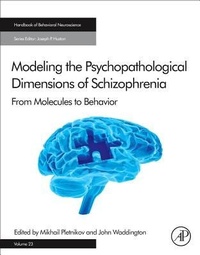
Modeling the Psychopathological Dimensions of Schizophrenia: Volume 23
From Molecules to Behavior
Published on 16. November 2015
Book
Hardback
548 pages
978-0-12-800981-9 (ISBN)
Description
Modeling the Psychopathological Dimensions of Schizophrenia: From Molecules to Behavior is the first book to offer a comprehensive review of the new theoretical, clinical, and basic research framework that considers psychotic illness as a group of dimensional representations of psychopathology rather than as traditional distinct categorical diagnoses. Psychotic illness, typified by schizophrenia, is a devastating condition increasingly recognized as a disorder of abnormal brain development and dysconnectivity. Its complex etiology involves both genetic and environmental factors, as well as the interplay among them.
This book describes the current understanding of the clinical and pathological features of schizophrenia, with a particular focus on the evolving conceptualization of schizophrenia and related diagnostic categories of psychotic illness as combinations of dimensional abnormalities. It provides an overview of modern strategies for generating cellular and whole animal models of schizophrenia as well as detailed reviews of the specific experimental preparations and paradigms aimed at molecular, developmental, and brain-network mechanisms that are the underlying aspects of abnormal behavior and various aspects of schizophrenia.
This groundbreaking book is an authoritative overview of the translational impact of emerging clinical insights on basic research approaches in schizophrenia that will advance the reader's understanding of the five major dimensions of psychopathology in schizophrenia and related psychoses and resolve the genetic and neurobiological underpinnings of these dimensions.
This book describes the current understanding of the clinical and pathological features of schizophrenia, with a particular focus on the evolving conceptualization of schizophrenia and related diagnostic categories of psychotic illness as combinations of dimensional abnormalities. It provides an overview of modern strategies for generating cellular and whole animal models of schizophrenia as well as detailed reviews of the specific experimental preparations and paradigms aimed at molecular, developmental, and brain-network mechanisms that are the underlying aspects of abnormal behavior and various aspects of schizophrenia.
This groundbreaking book is an authoritative overview of the translational impact of emerging clinical insights on basic research approaches in schizophrenia that will advance the reader's understanding of the five major dimensions of psychopathology in schizophrenia and related psychoses and resolve the genetic and neurobiological underpinnings of these dimensions.
More details
Series
Language
English
Place of publication
San Diego
United States
Publishing group
Elsevier Science Publishing Co Inc
Target group
Professional and scholarly
Researchers and graduate students in clinical neuroscience, translational neuroscience, behavioral neuroscience, neurobiology, clinical psychiatry, and pharmaceutical science
Product notice
sewn/stitched
Cloth over boards
Dimensions
Height: 282 mm
Width: 217 mm
Thickness: 35 mm
Weight
1754 gr
ISBN-13
978-0-12-800981-9 (9780128009819)
Copyright in bibliographic data and cover images is held by Nielsen Book Services Limited or by the publishers or by their respective licensors: all rights reserved.
Schweitzer Classification
Other editions
Additional editions
Mikhail Pletnikov | John Waddington
Modeling the Psychopathological Dimensions of Schizophrenia
From Molecules to Behavior
E-Book
11/2015
Academic Press
€125.00
Available for download
Persons
Mikhail V. Pletnikov, M.D., Ph.D. is Professor in Department of Psychiatry at Johns Hopkins University School of Medicine. He received his M.D. in 1986 from I.M. Sechenov Moscow Medical Academy, Moscow, Russia and his Ph.D. in Normal Physiology in 1990 from P.K. Anokhin Institute of Normal Physiology, Moscow, Russia. He did his post-doctoral training under Dr Timothy H. Moran (1996-1999) at the Department of Psychiatry and Behavioral Sciences, Johns Hopkins University School of Medicine and under Dr Kathryn M. Carbone (1996-1999) at the laboratory of pediatric and respiratory viral infections, the Center for Biologics Evaluation and Research (CBER), the U.S. Food and Drug Administration. He joined faculty in Department of Psychiatry at Johns Hopkins University in 1999. His current research interests focus on understanding pathogenesis of human psychiatric disease with neurodevelopmental origin, e.g., schizophrenia and autism with particular emphasis on a role of gene-environment interactions and the neuro-immune interplay in the complex pathogenesis of psychiatric conditions. Dr Pletnikov is also Director of the Behavioral Core at the School of Medicine. John Waddington is currently Professor of Neuroscience in Molecular and Cellular Therapeutics at the Royal College of Surgeons in Ireland (RCSI), Dublin. He received a BA in Natural Sciences from the University of Cambridge, and a PhD in Neuropharmacology followed by a DSc in Neuroscience from the University of London. After working with the UK Medical Research Council in the Division of Psychiatry at their Clinical Research Centre, he joined RCSI and became Chairman of Clinical Pharmacology in 2004. In 2003, he became the first person from RCSI to be elected to membership of the Royal Irish Academy; he has received the Lilly Neuroscience Award from the International College of Neuropsychopharmacology and the Award for Outstanding Achievement in Basic Science from the Schizophrenia International Research Society. His research is focused on the pathobiology and psychopharmacology of psychotic illness, mutant models of schizophrenia and other psychoses, and the pathobiology, psychopharmacology and mutant modelling of movement disorder.
John Waddington is currently Professor of Neuroscience in Molecular and Cellular Therapeutics at the Royal College of Surgeons in Ireland (RCSI), Dublin. He received a BA in Natural Sciences from the University of Cambridge, and a PhD in Neuropharmacology followed by a DSc in Neuroscience from the University of London. After working with the UK Medical Research Council in the Division of Psychiatry at their Clinical Research Centre, he joined RCSI and became Chairman of Clinical Pharmacology in 2004. In 2003, he became the first person from RCSI to be elected to membership of the Royal Irish Academy; he has received the Lilly Neuroscience Award from the International College of Neuropsychopharmacology and the Award for Outstanding Achievement in Basic Science from the Schizophrenia International Research Society. His research is focused on the pathobiology and psychopharmacology of psychotic illness, mutant models of schizophrenia and other psychoses, and the pathobiology, psychopharmacology and mutant modelling of movement disorder.
John Waddington is currently Professor of Neuroscience in Molecular and Cellular Therapeutics at the Royal College of Surgeons in Ireland (RCSI), Dublin. He received a BA in Natural Sciences from the University of Cambridge, and a PhD in Neuropharmacology followed by a DSc in Neuroscience from the University of London. After working with the UK Medical Research Council in the Division of Psychiatry at their Clinical Research Centre, he joined RCSI and became Chairman of Clinical Pharmacology in 2004. In 2003, he became the first person from RCSI to be elected to membership of the Royal Irish Academy; he has received the Lilly Neuroscience Award from the International College of Neuropsychopharmacology and the Award for Outstanding Achievement in Basic Science from the Schizophrenia International Research Society. His research is focused on the pathobiology and psychopharmacology of psychotic illness, mutant models of schizophrenia and other psychoses, and the pathobiology, psychopharmacology and mutant modelling of movement disorder.
Content
Part I: From Clinical Dimensions to Animal Models
Clinical and Pathological Aspects
1. Overview of Schizophrenia: Dimensions of Psychopathology
2. Overview of Schizophrenia: Epidemiology and Pathobiology
Animal Models of Psychotic Disorders: Dimensional Approach
3. Overview of the Dimensional Approach in Basic Research
4. Modeling Positive Symptoms
5. Modeling Negative Symptoms
6. Modeling Cognitive Impairment
7. Modeling Affective Symptoms
Part II: Neurobiology of Psychotic Disorders
Non-Genetic Models
8. MAM-Related Models
9. Social Isolation Models
10. Pharmacological/Substance Abuse Models
11a. Etiological Environmental Models: Maternal Immune Activation
11b. Etiological Environmental Models: Viral Infection Models
11c. Etiological Environmental Models: Stress Models
12. Toxoplasma Models
13. Nutritional Alterations
Genetic Models
14a. Mouse Models: Risk Genes
14b. Mouse Models: CNV Models
15. Rat Models
Gene-Gene and Gene-Environment Models
16. Gene-Gene Models
17. Gene-Environmental Models
18. Rodent Models of Multiple Environmental Exposures with Relevance to Schizophrenia
Cell Models
19. Synaptic Abnormalities and Neuroplasticity
20. iPS Models
21. Olfactory Epithelium and iN Models
22. Neuron-Glia Interaction
Molecular Studies
23. Intracellular Signaling
24. Hormones
25. Oxidative Stress
26. Immune Dysregulation; Autoantibodies
27. Future Directions
Clinical and Pathological Aspects
1. Overview of Schizophrenia: Dimensions of Psychopathology
2. Overview of Schizophrenia: Epidemiology and Pathobiology
Animal Models of Psychotic Disorders: Dimensional Approach
3. Overview of the Dimensional Approach in Basic Research
4. Modeling Positive Symptoms
5. Modeling Negative Symptoms
6. Modeling Cognitive Impairment
7. Modeling Affective Symptoms
Part II: Neurobiology of Psychotic Disorders
Non-Genetic Models
8. MAM-Related Models
9. Social Isolation Models
10. Pharmacological/Substance Abuse Models
11a. Etiological Environmental Models: Maternal Immune Activation
11b. Etiological Environmental Models: Viral Infection Models
11c. Etiological Environmental Models: Stress Models
12. Toxoplasma Models
13. Nutritional Alterations
Genetic Models
14a. Mouse Models: Risk Genes
14b. Mouse Models: CNV Models
15. Rat Models
Gene-Gene and Gene-Environment Models
16. Gene-Gene Models
17. Gene-Environmental Models
18. Rodent Models of Multiple Environmental Exposures with Relevance to Schizophrenia
Cell Models
19. Synaptic Abnormalities and Neuroplasticity
20. iPS Models
21. Olfactory Epithelium and iN Models
22. Neuron-Glia Interaction
Molecular Studies
23. Intracellular Signaling
24. Hormones
25. Oxidative Stress
26. Immune Dysregulation; Autoantibodies
27. Future Directions