

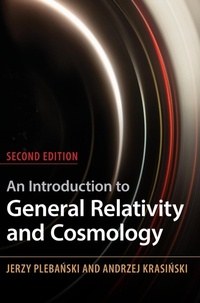
An Introduction to General Relativity and Cosmology
2nd Edition
Published on 6. June 2024
Book
Hardback
578 pages
978-1-009-41562-0 (ISBN)
Description
Experts Plebanski and Krasinski provide a thorough introduction to the tools of general relativity and relativistic cosmology. Assuming familiarity with advanced calculus, classical mechanics, electrodynamics and special relativity, the text begins with a short course on differential geometry, taking a unique top-down approach. Starting with general manifolds on which only tensors are defined, the covariant derivative and affine connection are introduced before moving on to geodesics and curvature. Only then is the metric tensor and the (pseudo)-Riemannian geometry introduced, specialising the general results to this case. The main text describes relativity as a physical theory, with applications to astrophysics and cosmology. It takes the reader beyond traditional courses on relativity through in-depth descriptions of inhomogeneous cosmological models and the Kerr metric. Emphasis is given to complete and clear derivations of the results, enabling readers to access research articles published in relativity journals.
Reviews / Votes
'Both authors are well known for their highly mathematical approach to General Relativity (GR) ... no prior knowledge of GR or differential geometry is assumed, though knowledge of calculus, Special Relativity, classical mechanics, and electrodynamics is assumed ... it is a good book if one wants to learn GR in some detail with applications to many fields presented in a uniform notation ... apart from worked examples in the main text, there are exercises at the end of most chapters ... it is very well written ... I also enjoyed the footnotes, which are often comments on the history of the topic.' Phillip Helbig, The ObservatoryMore details
Edition
2nd Revised edition
Language
English
Place of publication
Cambridge
United Kingdom
Target group
College/higher education
Edition type
Revised edition
Illustrations
Worked examples or Exercises
Dimensions
Height: 250 mm
Width: 175 mm
Thickness: 35 mm
Weight
1164 gr
ISBN-13
978-1-009-41562-0 (9781009415620)
Copyright in bibliographic data and cover images is held by Nielsen Book Services Limited or by the publishers or by their respective licensors: all rights reserved.
Schweitzer Classification
Other editions
Additional editions
Jerzy Plebanski | Andrzej Krasinski
An Introduction to General Relativity and Cosmology
E-Book
05/2024
2nd Edition
Cambridge University Press
€86.49
Available for download
Previous edition
Jerzy Plebanski | Andrzej Krasinski
An Introduction to General Relativity and Cosmology
Book
08/2006
Cambridge University Press
€90.37
Article exhausted; check for reprint
Persons
Jerzy Plebäski (1928-2005) was a Polish theoretical physicist best known for his extensive research into general relativity, nonlinear electrodynamics and mathematical physics. He split his time between Warsaw, Poland, and Mexico, his permanent residence from the mid-1970s onwards. He is remembered, among other things, for defining the algebraic classification of the tensor of matter, for finding new solutions of the Einstein equations (for example, the Plebäski-Demiäski metric), formulation of the heavenly equations and the effective field theory relating GR and supergravity, known as Plebäski action. The first part of the book is developed from Plebäski's lecture notes.
Content
The scope of this text; Preface to the second edition; Acknowledgements; 1. How the theory of relativity came into being (a brief historical sketch); Part I. Elements of Differential Geometry: 2. A short sketch of 2-dimensional differential geometry; 3. Tensors, tensor densities; 4. Covariant derivatives; 5. Parallel transport and geodesic lines; 6. The curvature of a manifold; flat manifolds; 7. Riemannian geometry; 8. Symmetries of Riemann spaces, invariance of tensors; 9. Methods to calculate the curvature quickly: differential forms and algebraic computer programs; 10. The spatially homogeneous Bianchi-type spacetimes; 11. The Petrov classification by the spinor method; Part II. The Theory of Gravitation: 12. The Einstein equations and the sources of a gravitational field; 13. The Maxwell and Einstein-Maxwell equations and the Kaluza-Klein theory; 14. Spherically symmetric gravitational fields of isolated objects; 15. Relativistic hydrodynamics and thermodynamics; 16. Relativistic cosmology I: general geometry; 17. Relativistic cosmology II: the Robertson-Walker geometry; 18. Relativistic cosmology III: the Lemaitre-Tolman geometry; 19. Relativistic cosmology IV: Simple generalisations of L-T and related geometries; 20. Relativistic cosmology V: the Szekeres geometries; 21. The Kerr metric; 22 Relativity enters technology: the Global Positioning System; 23. Subjects omitted from this book; 24. Comments to selected exercises and calculations; References; Index.