

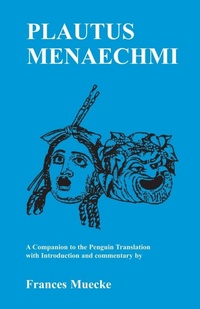
Menaechmi
Menaechmi: A Companion to the Penguin Translation
Published on 1. January 1998
Book
Paperback/Softback
80 pages
978-0-86292-239-9 (ISBN)
Description
Menaechmi is a broad farce that makes use of the comic possibilities of mistaken identity. Shakespeare adapted the plot for his Comedy of Errors, but his is not the only adaptation made since the Renaissance. Its neat plot and witty, fast-moving dialogue often speak for themselves.
This is a Companion to E. F. Watling's translation of The Brothers Menaechmus, from Plautus: The Pot of Gold and Other Plays, published in the Penguin Classics. It concentrates on the finer points of detail and is particularly useful in its discussion of the dramatic and literary characteristics of Plautine comedy. It includes an introduction to the author, his work, with reference to scholarly views; a commentary providing historical background, discussion of difficult passages, summaries of content, a bibliography and glossary.
This edition is a companion to .
More details
Series
Language
English
Place of publication
London
United Kingdom
Publishing group
Bloomsbury Publishing PLC
Target group
College/higher education
Professional and scholarly
Product notice
Paperback (trade)
Illustrations
black & white illustrations
Dimensions
Height: 216 mm
Width: 140 mm
Thickness: 5 mm
Weight
114 gr
ISBN-13
978-0-86292-239-9 (9780862922399)
Copyright in bibliographic data and cover images is held by Nielsen Book Services Limited or by the publishers or by their respective licensors: all rights reserved.
Schweitzer Classification
Persons
Plautus, Titus Maccius (254-184 BC) was a Roman playwright, whose comedies were the most popular dramatic works of their day. He was originally an actor or clown. Twenty-one of his 130 plays survive, revealing his theatrical craftsmanship and total mastery of farce. Although his works were palliata, adaptations of Greek new comedy originals now lost, he shifted the scene to Rome and based much of the humour on Roman manners and customs. His comedy, which was broader than that of Terence, still works today. Stock characters of Plautus's plays include the bragging soldier, the miser, the old man in love, the parasite, identical twins, the wily slave, and the courtesan. Later European dramatists influenced by Plautus include Shakespeare, Jonson, Dryden, and Molière. His comedy was often based on disguises and mistaken identities; Shakespeare's The Comedy of Errors (1592) was based on Plautus's Menaechmi, about the confusions caused by a pair of long-separated identical twins. Several of his plays were combined for Stephen Sondheim's 1962 Broadway musical A Funny Thing Happened on the Way to the Forum (although only one line from Plautus was retained: "I am a parade"). Plautus was eventually forced to work in a grain mill after losing most of his theatrical earnings in unsuccessful business ventures.
Content
Preface
Introduction
1. Plautus and the New Comedy
2. 'The Menaechmi' Influences
3. The play
4. The characters and their names
5. Staging and performance
Commentary
Appendix: The Doctor Scenes
Bibliography
Glossary
Map