

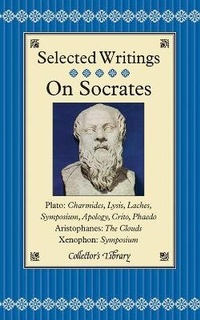
On Socrates
Selections from Plato: Charmides, Lysis, Laches, Symposium, Apology, Crito, Phaedo; Aristophanes: The Clouds; Xenophon: Symposium
Published on 1. September 2009
Book
Hardback
496 pages
978-1-905716-72-2 (ISBN)
Description
For Socrates, as for Jesus Christ, we have few biographical details, and of those we do have nearly all come from Plato, his greatest admirer. But it is clear that Socrates contributed three new ideas to the development of philosophy: that goodness consists not in helping friends and harming enemies, but in not harming anyone at all; that goodness and knowledge are one and the same thing; and that for progress to be made in argument, there must be step-by-step agreement between those arguing. Like Jesus, Socrates too was put to death for defying the conventions of his day, and by the manner of his life and death he, too, sets an example which is at the same time an inspiration and an impossible ideal.
All the Plato dialogues are translated by Benjamin Jowett. The Aristophanes is B. B. Rogers, and the Xenophon is H. G. Dakyns.
With an Introduction by Tom Griffith.
All the Plato dialogues are translated by Benjamin Jowett. The Aristophanes is B. B. Rogers, and the Xenophon is H. G. Dakyns.
With an Introduction by Tom Griffith.
More details
Language
English
Place of publication
London
United Kingdom
Publishing group
Pan Macmillan
Dimensions
Height: 156 mm
Width: 102 mm
Thickness: 23 mm
Weight
268 gr
ISBN-13
978-1-905716-72-2 (9781905716722)
Copyright in bibliographic data and cover images is held by Nielsen Book Services Limited or by the publishers or by their respective licensors: all rights reserved.
Schweitzer Classification
Other editions
Previous edition

Socrates
Selected Writings
Book
09/2004
Macmillan Collector's Library
€32.37
Article exhausted; check for reprint
Persons
Plato, born in 427BCE, was a young man when Athens surrendered to Sparta at the end of the Peloponnesian War, and when his mentor Socrates was put to death by the Athenians. He founded the Academy in 387BCE, and was head of it until his death in 347BCE, venturing briefly into politics on two visits as tutor and adviser to the young tyrant Dionysius II of Syracuse.
Content
Plato: Charmides; Plato: Lysis; Plato: Laches; Plato: Symposium; Plato: Apology; Plato: Crito; Plato: Phaedo; Aristophanes: The Clouds; Xenophon: Symposium.