

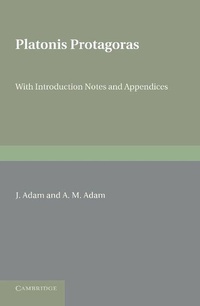
Platonis Protagoras
With Introduction, Notes and Appendices
Published on 1. August 2013
Book
Paperback/Softback
252 pages
978-1-107-68032-6 (ISBN)
Description
Originally published in in 1893, this book contains the text of the Socratic dialogue Protagoras, which discusses a variety of Sophistic and Socratic tenets, including the teachability of virtue. The dialogue also provides an interesting view on the connection between pederasty and education in ancient Athens. Notable Plato scholars James and Adele Adams present an introduction addressing the purpose and themes of the dialogue; a biography of Protagoras and extant fragments of his works are also included. This book will be of value to anyone with an interest in the Platonic, Socratic or Sophistic philosophies.
More details
Language
Other
Place of publication
Cambridge
United Kingdom
Target group
Professional and scholarly
Product notice
Paperback (trade)
Dimensions
Height: 198 mm
Width: 129 mm
Thickness: 14 mm
Weight
272 gr
ISBN-13
978-1-107-68032-6 (9781107680326)
Copyright in bibliographic data and cover images is held by Nielsen Book Services Limited or by the publishers or by their respective licensors: all rights reserved.
Schweitzer Classification
Persons
Plato (428/427 or 424/423 - 348/347 BC) was an Athenian philosopher during the Classical period in Ancient Greece, founder of the Platonist school of thought, and the Academy, the first institution of higher learning in the Western world.
He is widely considered the pivotal figure in the history of Ancient Greek and Western philosophy, along with his teacher, Socrates, and his most famous student, Aristotle.[a] Plato has also often been cited as one of the founders of Western religion and spirituality.[4] The so-called Neoplatonism of philosophers like Plotinus and Porphyry influenced Saint Augustine and thus Christianity. Alfred North Whitehead once noted: "the safest general characterization of the European philosophical tradition is that it consists of a series of footnotes to Plato."[5]
Plato was the innovator of the written dialogue and dialectic forms in philosophy. Plato is also considered the founder of Western political philosophy. His most famous contribution is the theory of Forms known by pure reason, in which Plato presents a solution to the problem of universals known as Platonism (also ambiguously called either Platonic realism or Platonic idealism). He is also the namesake of Platonic love and the Platonic solids.
His own most decisive philosophical influences are usually thought to have been along with Socrates, the pre-Socratics Pythagoras, Heraclitus and Parmenides, although few of his predecessors' works remain extant and much of what we know about these figures today derives from Plato himself.[b] Unlike the work of nearly all of his contemporaries, Plato's entire body of work is believed to have survived intact for over 2,400 years.[7] Although their popularity has fluctuated over the years, the works of Plato have never been without readers since the time they were written
Content
Preface; Introduction; Text; Notes; Appendix I. The poem of Simonides; Appendix II. Protagoras' life and fragments; Indices.