

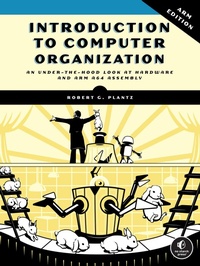
Introduction to Computer Organization: ARM Edition
Published on 28. January 2025
Book
Paperback/Softback
520 pages
978-1-7185-0274-1 (ISBN)
Description
All high-level languages are ultimately translated into machine instructions that control a computer's hardware. Introduction to Computer Organization: ARM reveals exactly how that hardware works 'under the hood.' Written for anyone familiar with basic programming concepts, the reader is taken through the machine's architecture from the bottom up and the software on down - with a special focus on the ARM instruction set commonly found in smartphones, laptops, and tablets. Beginning with an exploration of modern computing's mathematical foundations - including the binary system and Boolean algebra - the book introduces hardware components such as circuits, CPU, and memory. Later chapters discuss how software controls hardware, providing an in-depth look at the basic programming constructs in low-level languages like C and C++. Finally, readers are shown how the computer's compiler translates code into assembly language that can directly access the instruction set architecture.
Reviews / Votes
"Forged in the furnace of the classroom, this book enables students to synthesize, comprehend and create their own assembler programs. The process [Robert Plantz] leads them though is quite elegant, building from the basics . . . to infinity and beyond.There are 10 kinds of people who understand binary. When finished with this book you will know what camp you are in."
-Dale Phillips, Professor of Computer Science at Modesto Junior College
"Provides an excellent introduction to the ARM assembly language. It contains the perfect mix of theory and examples to help students understand and apply the concepts. I highly recommend this book."
- Duy Nguyen, Professor of Computer Science at Palomar College
More details
Language
English
Place of publication
San Francisco
United States
Product notice
Paperback (trade)
Dimensions
Height: 233 mm
Width: 176 mm
Thickness: 31 mm
Weight
972 gr
ISBN-13
978-1-7185-0274-1 (9781718502741)
Copyright in bibliographic data and cover images is held by Nielsen Book Services Limited or by the publishers or by their respective licensors: all rights reserved.
Schweitzer Classification
Other editions
Additional editions
Robert Plantz
Introduction to Computer Organization: ARM Edition
E-Book
01/2025
No Starch Press
€46.99
Available for download
Person
Robert G. Plantz started his career designing electronics for the Gemini spacecraft and Apollo Lunar Module. Plantz earned his PhD in electrical engineering at UC Berkeley and was a professor of computer science at Sonoma State University for 21 years.
Content
Acknowledgments
Introduction
Chapter 1: Setting the Stage
Chapter 2: Data Storage Formats
Chapter 3: Computer Arithmetic
Chapter 4: Boolean Algebra
Chapter 5: Logic Gates
Chapter 6: Combinational Logic Circuits
Chapter 7: Sequential Logic Circuits
Chapter 8: Memory
Chapter 9: Central Processing Unit
Chapter 10: Programming in Assembly Language
Chapter 11: Inside the main Function
Chapter 12: Instruction Details
Chapter 13: Control Flow Constructs
Chapter 14: Inside Subfunctions
Chapter 15: Special Uses of Subfunctions
Chapter 16: Bitwise Logic, Multiplication, and Division Instructions
Chapter 17: Data Structures
Chapter 18: Object-Oriented Programming
Chapter 19: Fractional Numbers
Chapter 20: Input/Output
Chapter 21: Exceptions and Interrupts
Index
Introduction
Chapter 1: Setting the Stage
Chapter 2: Data Storage Formats
Chapter 3: Computer Arithmetic
Chapter 4: Boolean Algebra
Chapter 5: Logic Gates
Chapter 6: Combinational Logic Circuits
Chapter 7: Sequential Logic Circuits
Chapter 8: Memory
Chapter 9: Central Processing Unit
Chapter 10: Programming in Assembly Language
Chapter 11: Inside the main Function
Chapter 12: Instruction Details
Chapter 13: Control Flow Constructs
Chapter 14: Inside Subfunctions
Chapter 15: Special Uses of Subfunctions
Chapter 16: Bitwise Logic, Multiplication, and Division Instructions
Chapter 17: Data Structures
Chapter 18: Object-Oriented Programming
Chapter 19: Fractional Numbers
Chapter 20: Input/Output
Chapter 21: Exceptions and Interrupts
Index