

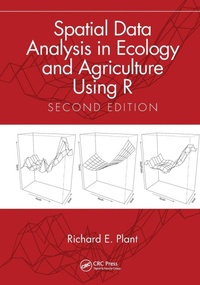
Spatial Data Analysis in Ecology and Agriculture Using R
2nd Edition
Published on 18. December 2020
Book
Paperback/Softback
684 pages
978-0-367-73232-5 (ISBN)
Description
Key features:
Unique in its combination of serving as an introduction to spatial statistics and to modeling agricultural and ecological data using R
Provides exercises in each chapter to facilitate the book's use as a course textbook or for self-study
Adds new material on generalized additive models, point pattern analysis, and new methods of Bayesian analysis of spatial data.
Includes a completely revised chapter on the analysis of spatiotemporal data featuring recently introduced software and methods
Updates its coverage of R software including newly introduced packages
Spatial Data Analysis in Ecology and Agriculture Using R, 2nd Edition provides practical instruction on the use of the R programming language to analyze spatial data arising from research in ecology, agriculture, and environmental science. Readers have praised the book's practical coverage of spatial statistics, real-world examples, and user-friendly approach in presenting and explaining R code, aspects maintained in this update. Using data sets from cultivated and uncultivated ecosystems, the book guides the reader through the analysis of each data set, including setting research objectives, designing the sampling plan, data quality control, exploratory and confirmatory data analysis, and drawing scientific conclusions.
Additional material to accompany the book, on both analyzing satellite data and on multivariate analysis, can be accessed at https://www.plantsciences.ucdavis.edu/plant/additionaltopics.htm.
Unique in its combination of serving as an introduction to spatial statistics and to modeling agricultural and ecological data using R
Provides exercises in each chapter to facilitate the book's use as a course textbook or for self-study
Adds new material on generalized additive models, point pattern analysis, and new methods of Bayesian analysis of spatial data.
Includes a completely revised chapter on the analysis of spatiotemporal data featuring recently introduced software and methods
Updates its coverage of R software including newly introduced packages
Spatial Data Analysis in Ecology and Agriculture Using R, 2nd Edition provides practical instruction on the use of the R programming language to analyze spatial data arising from research in ecology, agriculture, and environmental science. Readers have praised the book's practical coverage of spatial statistics, real-world examples, and user-friendly approach in presenting and explaining R code, aspects maintained in this update. Using data sets from cultivated and uncultivated ecosystems, the book guides the reader through the analysis of each data set, including setting research objectives, designing the sampling plan, data quality control, exploratory and confirmatory data analysis, and drawing scientific conclusions.
Additional material to accompany the book, on both analyzing satellite data and on multivariate analysis, can be accessed at https://www.plantsciences.ucdavis.edu/plant/additionaltopics.htm.
More details
Edition
2nd edition
Language
English
Place of publication
London
United Kingdom
Publishing group
Taylor & Francis Ltd
Target group
College/higher education
Edition type
New edition
Product notice
Paperback (trade)
Unsewn / adhesive bound
Dimensions
Height: 254 mm
Width: 178 mm
Thickness: 37 mm
Weight
1268 gr
ISBN-13
978-0-367-73232-5 (9780367732325)
Copyright in bibliographic data and cover images is held by Nielsen Book Services Limited or by the publishers or by their respective licensors: all rights reserved.
Schweitzer Classification
Other editions
New editions
Richard E. Plant
Spatial Data Analysis in Ecology and Agriculture Using R
Book
approx. 01/2026
3rd Edition
CRC Press
€127.50
Not yet published
Additional editions
Richard E. Plant
Spatial Data Analysis in Ecology and Agriculture Using R
Book
12/2018
2nd Edition
CRC Press
€159.50
Shipment within 15-20 days
Person
Richard E. Plant received his Ph.D. in Theoretical and Applied Mechanics from Cornell University in 1975. After receiving his Ph.D., he joined the Mathematics Department at the University of California, Davis. Recognizing the opportunity to work with researchers at one of the world's leading agricultural institutions, he transferred his research effort from nerve membrane modeling to problems in agriculture.
He has received awards from the Division of Agriculture and Natural Resources of the University of California and hte American Society of Agronomy for his work in the application of academic research methods to the resolution of important agricultural problems. He was awarded a Fulbright Fellowship to carry out research in rice production in Uruguay, some of which serves as one of the case studies in his book. He is a Professor Emeritus of Biological and Agricultural Engineering and Plant Sciences at the University of California, Davis. His research interests include the application of systems analysis, geographic information systems, and statistical models to landscape level problems in crop production and resource management.
He has received awards from the Division of Agriculture and Natural Resources of the University of California and hte American Society of Agronomy for his work in the application of academic research methods to the resolution of important agricultural problems. He was awarded a Fulbright Fellowship to carry out research in rice production in Uruguay, some of which serves as one of the case studies in his book. He is a Professor Emeritus of Biological and Agricultural Engineering and Plant Sciences at the University of California, Davis. His research interests include the application of systems analysis, geographic information systems, and statistical models to landscape level problems in crop production and resource management.
Content
Working with Spatial Data. R Programming Environment. Statistical Properties of Spatially Autocorrelated Data. Measures of Spatial Autocorrelation. Sampling and Data Collection. Preparing Spatial Data for Analysis. Preliminary Exploration of Spatial Data. Using Non-Spatial Methods to Explore Spatial Data. Variance Estimation, the Effective Sample Size, and the Bootstrap. Measures of Bivariate Association between Two Spatial Variables. Mixed Model. Regression Models for Spatially Autocorrelated Data. Bayesian Analysis of Spatially Autocorrelated Data. Analysis of Spatiotemporal Data. Analysis of Data from Controlled Experiments. Assembling Conclusions. Appendices. Review of Mathematical Concepts. The Data Sets. An R Thesaurus. References.