


The Neo-liberal State
Published on 21. June 2012
Book
Paperback/Softback
294 pages
978-0-19-965057-6 (ISBN)
Description
The aim of the book is two-fold. First of all it is to provide a fair, complete and analytical account of the Neo-liberal conception of the role and function of the state in modern society. The second aim is to provide a critical assessment of some of the central elements of this conception. The book will look at the emphasis of Neo-liberals on procedural and rule governed approaches to the role of the state rather than outcome or end state views of the role of government and to consider how this conception of politics relates to issues such as the rule of law, freedom, justice, rights, the relationship to the market economy, to civil society and to look at the role of government in relation to the provision of welfare and public sector services more generally. It builds up the Neo-liberal case in respect of these aspects of modern society by drawing upon the works of central Neo-liberal thinkers such as Hayek, Mises, Menger, as well as thinkers such as Oakeshott, Nozick and Rotbard who are not directly Neo-liberals but whose works have been important for the development of central Neo-liberal themes. The second part of the book provides what might be regarded as an immanent critique of the Neo-liberal case built up in the first part of the study. It takes Neo-liberal ideas very seriously and shows how incoherences arise within and between those ideas such that a plausible form of Neo-liberalism as opposed to Libertarianism on the one hand and Social Democracy on the other is very difficult to state. The theme of this book is very germane given the considerable debate which is now taking place in the context of the world financial crisis about the appropriate role for the state.
Reviews / Votes
Plant's critique of neo-liberalism, focused on showing the "intrinsic contradictions" of the neo-liberalist theories (or pseudo-theories)is...appropriate, well-documented and convincing. * Carlo Focarelli, IYIL *More details
Language
English
Place of publication
Oxford
United Kingdom
Target group
College/higher education
Dimensions
Height: 234 mm
Width: 156 mm
Thickness: 16 mm
Weight
450 gr
ISBN-13
978-0-19-965057-6 (9780199650576)
Copyright in bibliographic data and cover images is held by Nielsen Book Services Limited or by the publishers or by their respective licensors: all rights reserved.
Schweitzer Classification
Other editions
Additional editions
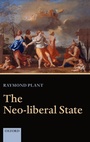
Raymond Plant
The Neo-liberal State
Book
10/2009
Oxford University Press
€155.20
Shipment within 15-20 days
Person
Raymond Plant born in 1945. Lecturer in Philosophy University of Manchester 1967; Senior Lecturer from 1974; Professor of Politics University of Southampton and subsequently Dean of Social Sciences between 1979 and 1994; Master of St. Catherine's College Oxford 1994-2000; Research professor of Modern European Political Thought University of Southampton 2000-2; Professor of Jurisprudence and Political Philosophy at King's College Law School from 2002 to the present; Dean and Head of the School between 2006-8; Vincent Wright Professor of Law and Political Philosophy at Sciences Po Paris in 2008. He is the author of 10 books on Political Philosophy. He has taught at the University of Frankfurt and Lisbon.
Content
Preface ; Introduction ; PART 1 THE BASIS OF THE NEO LIBERAL STATE ; 1. The Nature of the Neo Liberal State and the Rule of Law ; 2. The Foundations of the Rule of Law as a Moral Ideal ; 3. Freedom, Coercion and the Law ; 4. Social Justice: A Mirage ? ; 5. Neo Liberal Rights ; 6. The Welfare State and the Politics of Social Justice ; 7. Social Justice and the welfare State: Institutional Problems ; 8. Government and Markets ; 9. Government, Money and Taxation ; PART 2 NEO LIBERAL PRINCIPLES: A CRITICAL PERSPECTIVE ; 10. Freedom and Coercion: An Alternative Account ; 11. Social Justice and Neo Liberalism: A Critique ; 12. Neo Liberal Rights: A Wider Perspective ; 13. Concluding Reflections