

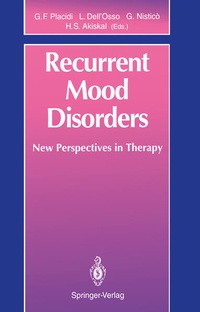
Recurrent Mood Disorders
New Perspectives in Therapy
Published on 23. December 2011
Book
Paperback/Softback
XVII, 304 pages
978-3-642-76648-0 (ISBN)
Description
Current evidence indicates that over two-thirds of mood
disorders pursue a recurrent or chronic course. Yet much of
the progress recorded in the field of mood disorders and
their treatment has been in research into the acute phase of
the illness. Hence there is a need for a volume that
specifically addresses the special clinical problems
encountered inthe recurrent forms of these disorders.
The various chapters of this book embrace a wide range of
topics, including etiology, course, and long-term treatment,
integrative reviews, results of recent investigations, and
clinical reports. In this respect, the contributions reflect
currentconcepts, research, and clinical practice. We have
endeavored to build a bridge between neurobiology and
psychology and have covered both the psychotherapeutic and
the psychopharmacologic aspects of mood disorders.
More details
Edition
Softcover reprint of the original 1st ed. 1993
Language
English
Place of publication
Berlin
Germany
Publishing group
Springer Berlin
Target group
Professional and scholarly
Research
Illustrations
XVII, 304 p.
Dimensions
Height: 235 mm
Width: 155 mm
Thickness: 18 mm
Weight
499 gr
ISBN-13
978-3-642-76648-0 (9783642766480)
DOI
10.1007/978-3-642-76646-6
Schweitzer Classification
Other editions
Additional editions
Gian F. Placidi | Liliana Dell'Osso | Giuseppe Nistico
Recurrent Mood Disorders
New Perspectives in Therapy
E-Book
12/2012
Springer
€96.29
Available for download
Gian F. Placidi | Liliana Dell'Osso | Giuseppe Nistico
Recurrent Mood Disorders
New Perspectives in Therapy
Book
06/1993
Springer
€85.55
Article exhausted; check different version
Persons
Content
Etiologic Aspects.- Toward a Psychobiology of Affective Recurrences: Interaction of Biological and Psychological Factors.- New Genetic Findings in Recurrent Mood Disorders.- Recent Findings on Thyroid Function in Depression.- Cognitive Aspects of Depression: An Experimental Study.- Variability of Cognitive Patterns in Subjects with Mood Disorder.- Personality and Depression.- Aggressive Behaviour and Hostility in Depression: Clinical Aspects.- Course and Outcome.- Course as Classifier for Depression.- Course and Outcome: Definitional Dilemmas.- Bipolar Disorders in Prepubertal Children.- Bipolar Disorder in Adolescence.- Diagnosis, Clinical Assessment, and Treatment of Late-Life Depression.- Recurrent Major Depression: Catamnestic Evaluation of Inpatients.- Psychotic Mixed State: Clinical-Anamnestic and Familial Comparisons with Nonpsychotic Mixed, Psychotic Manic, and Schizoaffective Disorders.- Heterogeneity of Course and Outcome in Subjects with a Cross-Sectional Diagnosis of Schizoaffective Disorder.- Old and New Treatments and Prophylaxis.- Testing Efficacy and Safety of Long-Term Treatment in Manic-Depressive Illness: Past and Present Problems.- The Prophylaxis of Unipolar Depression.- Maintenance Therapies in Recurrent Depression: Psychotherapy and Combined Treatment.- Lithium Treatment: Relationship Between Relapses and Personality Disorders.- Effects of Lithium on Information Processing: Evidence from Partial Responders and Nonresponders.- Chronic Lithium Salt Treatment and Calcium Metabolism.- Amiloride and Severe Lithium-Induced Nephrogenic Diabetes Insipidus.- New Pharmacological Aspects of Rubidium Salts.- Rubidium - 20 Years On.- Biochemical and Physiological Guidelines for Long-Term Rubidium Therapy.- Rubidium Shows Different Effects from Lithium onPhosphatidylinositol Metabolism in a Cell Line of Human Neuroblastoma.- Influences of Rubidium and Lithium on Cyclic AMP Formation in Rat Brain.- Electrolytes, Renal Function, and Rubidium Chloride Therapy Side Effects.- Antidepressive Action of Rubidium.- Treatment of Depressive Disorders with Rubidium Chloride.- Clinical Investigations on the Efficacy and Tolerability of Rubidium Chloride.- Rubidium Chloride in Recurrent Depression: Clinical and Biological Correlates.- Rubidium Chloride in Chronic Mood Disorders.- Rubidium Chloride Versus Imipramine: A Double-Blind Study.- Psychotherapeutic Problems in Chronic and Resistant Depressions.- Bright Light Treatment of Seasonal Affective Disorder and Nonseasonal Bipolar and Unipolar Affective Syndromes.