

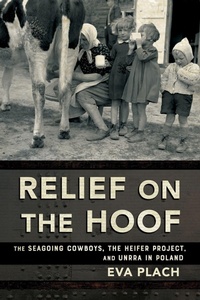
Relief on the Hoof
The Seagoing Cowboys, the Heifer Project, and UNRRA in Poland
Published on 15. November 2025
Book
Paperback/Softback
324 pages
978-1-5017-8464-4 (ISBN)
Description
Relief on the Hoof is about the thousands of horses and cattle that the United Nations Relief and Rehabilitation Administration (UNRRA) shipped as humanitarian aid in the immediate aftermath of WWII and about the "seagoing cowboys" who cared for the animals during their trans-Atlantic journeys. UNRRA contracted the Church of the Brethren to recruit almost 7,000 men to do this work, and in exchange provided free passage on its ships to the cattle that were part of the Brethren's own humanitarian initiative, the Heifer Project. The Heifer Project emerged from a conviction that cows and their milk offered the best value as relief commodities.
As Eva Plach shows, both UNRRA's animal aid program and the Heifer Project were responding to a crisis in postwar Europe. Millions of livestock were lost during the war, and contemporary experts warned that postwar recovery, food security, and the prevention of social and political unrest would be compromised without replenishing the lost herds.
Poland received more Heifer Project cattle than any other country and was the major recipient of UNRRA cattle and horses as well. Relief on the Hoof shows that Poland's special status, based on assessments of wartime destruction and postwar need, reflected its unique geopolitical importance as Cold War tensions mounted.
As Eva Plach shows, both UNRRA's animal aid program and the Heifer Project were responding to a crisis in postwar Europe. Millions of livestock were lost during the war, and contemporary experts warned that postwar recovery, food security, and the prevention of social and political unrest would be compromised without replenishing the lost herds.
Poland received more Heifer Project cattle than any other country and was the major recipient of UNRRA cattle and horses as well. Relief on the Hoof shows that Poland's special status, based on assessments of wartime destruction and postwar need, reflected its unique geopolitical importance as Cold War tensions mounted.
More details
Series
Language
English
Place of publication
United States
Publishing group
Cornell University Press
Target group
College/higher education
Product notice
Paperback (trade)
Illustrations
15 b&w halftones - 15 Halftones, black and white
Dimensions
Height: 227 mm
Width: 152 mm
Thickness: 25 mm
Weight
498 gr
ISBN-13
978-1-5017-8464-4 (9781501784644)
Copyright in bibliographic data and cover images is held by Nielsen Book Services Limited or by the publishers or by their respective licensors: all rights reserved.
Schweitzer Classification
Other editions
Additional editions
E-Book
11/2025
Northern Illinois University Press
€27.49
Available for download
Person
Eva Plach is a social and cultural historian specializing in the history of twentieth-century Poland. She teaches modern European history, concentrating on the history of the Holocaust.
Content
Introduction: Global Agents of Humanitarian Aid
1. UNRRA, Food, and Winning the Peace
2. The UNRRA-Brethren Service Committee Partnership
3. On Becoming a Seagoing Cowboy
4. Working Animals as Humanitarian Aid
5. The Making of "Relief Animals"
6. Cowboys and Animals at Sea
7. Bovines, Equines, and Humans in Poland
8. UNRRA and Animal Politics in Poland
9. Heifer Project Animals in Poland
Conclusion: Humanitarian Imaginaries
1. UNRRA, Food, and Winning the Peace
2. The UNRRA-Brethren Service Committee Partnership
3. On Becoming a Seagoing Cowboy
4. Working Animals as Humanitarian Aid
5. The Making of "Relief Animals"
6. Cowboys and Animals at Sea
7. Bovines, Equines, and Humans in Poland
8. UNRRA and Animal Politics in Poland
9. Heifer Project Animals in Poland
Conclusion: Humanitarian Imaginaries