

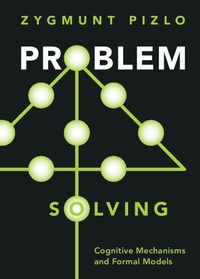
Problem Solving
Cognitive Mechanisms and Formal Models
Published on 7. July 2022
Book
Hardback
208 pages
978-1-009-20556-6 (ISBN)
Description
Intelligent mental representations of physical, cognitive and social environments allow humans to navigate enormous search spaces, whose sizes vastly exceed the number of neurons in the human brain. This allows us to solve a wide range of problems, such as the Traveling Salesperson Problem, insight problems, as well as mathematics and physics problems. As an area of research, problem solving has steadily grown over time. Researchers in Artificial Intelligence have been formulating theories of problem solving for the last 70 years. Psychologists, on the other hand, have focused their efforts on documenting the observed behavior of subjects solving problems. This book represents the first effort to merge the behavioral results of human subjects with formal models of the causative cognitive mechanisms. The first coursebook to deal exclusively with the topic, it provides a main text for elective courses and a supplementary text for courses such as cognitive psychology and neuroscience.
More details
Language
English
Place of publication
Cambridge
United Kingdom
Illustrations
Worked examples or Exercises
Dimensions
Height: 260 mm
Width: 183 mm
Thickness: 16 mm
Weight
596 gr
ISBN-13
978-1-009-20556-6 (9781009205566)
Copyright in bibliographic data and cover images is held by Nielsen Book Services Limited or by the publishers or by their respective licensors: all rights reserved.
Schweitzer Classification
Other editions
Additional editions
Book
07/2022
Cambridge University Press
€44.00
Shipment within 15-20 days
E-Book
07/2022
Cambridge University Press
€31.49
Available for download
E-Book
06/2022
Cambridge University Press
€31.49
Available for download
Person
Zygmunt Pizlo is Professor and Falmagne Endowed Chair in Mathematical Psychology in the Department of Cognitive Sciences, University of California at Irvine. He is the author of 3D Shape: Its Unique Place in Visual Perception (2008) and co-author of Making a Machine That Sees Like Us (2014).
Content
Preface; 1. Problem solving - definition of the main concepts; 2. Animal problem solving: innovative use of tools; 3. Modern research on the human's ability to solve problems that have large spaces; 4. The exponential pyramid representation that compensates for the exponentially-large problem spaces; 5. Heuristic function, distance and direction in solving problems; 6. Insight and creative thinking; 7. Inference in perception. Perceptual representation: a rejoinder to insight; 8. Cognitive inference. Mental representations; 9. Theory of Mind (ToM); 10. Solving problems in physics and mathematics; 11. Summary and conclusions.