

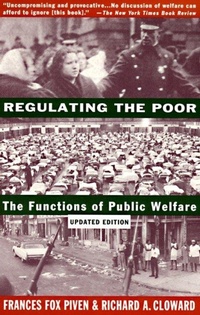
Regulating the Poor
The Functions of Public Welfare
Published on 28. September 1993
Book
Paperback/Softback
544 pages
978-0-679-74516-7 (ISBN)
Description
Piven and Cloward have updated their classic work on the history and function of welfare to cover the American welfare state's massive erosion during the Reagan, Bush, and Clinton years. The authors present a boldly comprehensive, brilliant new theory to explain the comparative underdevelopment of the U.S. welfare state among advanced industrial nations. Their conceptual framework promises to shape the debate within current and future administrations as they attempt to rethink the welfare system and its role in American society.
"Uncompromising and provocative. . . . By mixing history, political interpretation and sociological analysis, Piven and Cloward provide the best explanation to date of our present situation . . . no future discussion of welfare can afford to ignore them."
-Peter Steinfels, The New York Times Book Review
"Uncompromising and provocative. . . . By mixing history, political interpretation and sociological analysis, Piven and Cloward provide the best explanation to date of our present situation . . . no future discussion of welfare can afford to ignore them."
-Peter Steinfels, The New York Times Book Review
More details
Language
English
Place of publication
New York
United States
Publishing group
Random House USA Inc
Target group
College/higher education
Product notice
Paperback (trade)
Dimensions
Height: 204 mm
Width: 134 mm
Thickness: 25 mm
Weight
441 gr
ISBN-13
978-0-679-74516-7 (9780679745167)
Copyright in bibliographic data and cover images is held by Nielsen Book Services Limited or by the publishers or by their respective licensors: all rights reserved.
Schweitzer Classification
Other editions
Additional editions
E-Book
02/2012
Vintage
€5.49
Available for download
Previous edition

Richard A. Cloward
Regulating the Poor
Book
03/1972
Vintage Books
€29.20
Article exhausted; check for reprint
Persons
Frances Fox Piven is Distinguished Professor of Political Science, Graduate School and University Center, City University of New York.
Richard A. Cloward was a social worker and sociologist, and was a faculty member at the Columbia University School of Social Work from 1954 until his death in 2001.
They co-authored: The Politics of Turmoil, Poor People's Movements, The New Class War, and Why Americans Don't Vote. They won the C. Wright Mills Award and various international and national awards.
Richard A. Cloward was a social worker and sociologist, and was a faculty member at the Columbia University School of Social Work from 1954 until his death in 2001.
They co-authored: The Politics of Turmoil, Poor People's Movements, The New Class War, and Why Americans Don't Vote. They won the C. Wright Mills Award and various international and national awards.
Content
1. Relief, Labor, and Civil Disorder: An Overview
Part I: Relief and the Great Depression
2. Economic Collapse, Mass Unemployment, and the Rise of Disorder
3. The New Deal and Relief
Part II: Relief and the Years of Stability: 1940–1960
4. Enforcing Low-Wage Work: Statutory Methods
5. Enforcing Low Wage Work: Administrative Methods
Part III: Relief and the Urban Crisis
6. The Welfare Explosion of the 1960s
7. Agricultural Modernization and Mass Unemployment
8. Migration and the Rise of Disorder in the Cities
9. The Great Society and Relief: Federal Intervention
10. The Great Society: Local Consequences
Part IV: Relief, Deindustrialization, and the War Against Labor: 1970–1990
11. Poor Relief and the Dramaturgy of Work
12. Poor Relief and Theories of the Welfare State
Part I: Relief and the Great Depression
2. Economic Collapse, Mass Unemployment, and the Rise of Disorder
3. The New Deal and Relief
Part II: Relief and the Years of Stability: 1940–1960
4. Enforcing Low-Wage Work: Statutory Methods
5. Enforcing Low Wage Work: Administrative Methods
Part III: Relief and the Urban Crisis
6. The Welfare Explosion of the 1960s
7. Agricultural Modernization and Mass Unemployment
8. Migration and the Rise of Disorder in the Cities
9. The Great Society and Relief: Federal Intervention
10. The Great Society: Local Consequences
Part IV: Relief, Deindustrialization, and the War Against Labor: 1970–1990
11. Poor Relief and the Dramaturgy of Work
12. Poor Relief and Theories of the Welfare State