

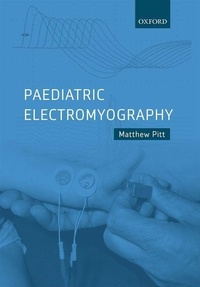
Paediatric Electromyography
Published on 26. October 2017
Book
Hardback
320 pages
978-0-19-875459-6 (ISBN)
Description
Electromyography (EMG) is a diagnostic modality that offers enormous value to the investigation of neuromuscular disease. It is able to quickly identify abnormalities which, if they have to be identified by other means, require more expensive or more painful methods of investigation, such as muscle biopsy. However, despite its diagnostic/prognostic value, electromyography is often avoided in children, often due to the misconception that the investigation is too painful or too difficult to be performed in paediatric patients.
Paediatric Electromyography will attempt to dispel many of the misconceptions about paediatric EMG by drawing on the author's extensive experience in treating patients using this technique at the Great Ormond Street Hospital for Children. The book includes a very clear and well illustrated description of the basic neurophysiology essential to any person practising EMG, and the differences in the performance and interpretation of the tests in children are highlighted.
Paediatric Electromyography will attempt to dispel many of the misconceptions about paediatric EMG by drawing on the author's extensive experience in treating patients using this technique at the Great Ormond Street Hospital for Children. The book includes a very clear and well illustrated description of the basic neurophysiology essential to any person practising EMG, and the differences in the performance and interpretation of the tests in children are highlighted.
More details
Language
English
Place of publication
Oxford
United Kingdom
Target group
Professional and scholarly
Product notice
sewn/stitched
Cloth over boards
Dimensions
Height: 249 mm
Width: 173 mm
Thickness: 20 mm
Weight
816 gr
ISBN-13
978-0-19-875459-6 (9780198754596)
Copyright in bibliographic data and cover images is held by Nielsen Book Services Limited or by the publishers or by their respective licensors: all rights reserved.
Schweitzer Classification
Other editions
Additional editions
Matthew Pitt
Paediatric Electromyography
E-Book
10/2017
1st Edition
OUP eBook
€112.99
Available for download
Person
Dr Matthew Pitt has been a Consultant Clinical Neurophysiologist at Great Ormond Street Hospital since 1990. He is responsible for all aspects of neurophysiological testing and has a particular specialist interest in paediatric electromyography (EMG). He has been lead clinician for the last seven years. Dr Pitt is acknowledged as one of the leading exponents of paediatric EMG, a specialist branch of electromyography, both nationally and internationally. Working at Great Ormond Street for many years, he has become an expert on the use in children of stimulation single fibre electromyography used in the diagnosis of myasthenic syndromes. This is acknowledged nationally and internationally.
Content
1: Introduction
2: Basic physiology
3: Nerve physiology
4: Pathophysiological correlations in neuropathies
5: Nerve damage and entrapment syndromes
6: Motor unit anatomy and physiology
7: Needle EMG findings in different pathologies
8: Investigation of channelopathies
9: Techniques used to test the NMJ in children
10: Pathophysiological associations in paediatric neuromuscular junction disorders
11: The results of clinical application of SPACE in suspected disorder of the neuromuscular junction
12: More advanced techniques
Appendix 1
Appendix 2
Appendix 3
2: Basic physiology
3: Nerve physiology
4: Pathophysiological correlations in neuropathies
5: Nerve damage and entrapment syndromes
6: Motor unit anatomy and physiology
7: Needle EMG findings in different pathologies
8: Investigation of channelopathies
9: Techniques used to test the NMJ in children
10: Pathophysiological associations in paediatric neuromuscular junction disorders
11: The results of clinical application of SPACE in suspected disorder of the neuromuscular junction
12: More advanced techniques
Appendix 1
Appendix 2
Appendix 3