

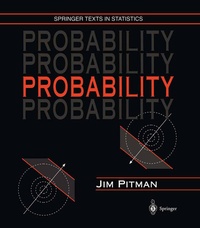
Probability
Published on 12. May 1993
Book
Hardback
XI, 560 pages
978-0-387-97974-8 (ISBN)
Description
This is a text for a one-quarter or one-semester course in probability, aimed at students who have done a year of calculus. The book is organised so a student can learn the fundamental ideas of probability from the first three chapters without reliance on calculus. Later chapters develop these ideas further using calculus tools. The book contains more than the usual number of examples worked out in detail.
The most valuable thing for students to learn from a course like this is how to pick up a probability problem in a new setting and relate it to the standard body of theory. The more they see this happen in class, and the more they do it themselves in exercises, the better. The style of the text is deliberately informal. My experience is that students learn more from intuitive explanations, diagrams, and examples than they do from theorems and proofs. So the emphasis is on problem solving rather than theory.
The most valuable thing for students to learn from a course like this is how to pick up a probability problem in a new setting and relate it to the standard body of theory. The more they see this happen in class, and the more they do it themselves in exercises, the better. The style of the text is deliberately informal. My experience is that students learn more from intuitive explanations, diagrams, and examples than they do from theorems and proofs. So the emphasis is on problem solving rather than theory.
More details
Series
Edition
1st ed 1993. Corr. 7th printing 1999
Language
English
Place of publication
New York
United States
Target group
Upper undergraduate
Illustrations
XI, 560 p.
Dimensions
Height: 240 mm
Width: 208 mm
Thickness: 37 mm
Weight
1330 gr
ISBN-13
978-0-387-97974-8 (9780387979748)
DOI
10.1007/978-1-4612-4374-8
Schweitzer Classification
Other editions
Additional editions
Jim Pitman
Probability
Book
04/1997
1st Edition
Springer
€86.62
Article exhausted; check different version
Person
Jim Pitman is a Professor in the Departments of Statistics and Mathematics in the University of California at Berkeley, USA.
Content
1 Introduction.- 1.1 Equally Likely Outcomes.- 1.2 Interpretations.- 1.3 Distributions.- 1.4 Conditional Probability and Independence.- 1.5 Bayes' Rule.- 1.6 Sequences of Events.- Summary.- Review Exercises.- 2 Repeated Trials and Sampling.- 2.1 The Binomial Distribution.- 2.2 Normal Approximation: Method.- 2.3 Normal Approximation: Derivation (Optional).- 2.4 Poisson Approximation.- 2.5 Random Sampling.- Summary.- Review Exercises.- 3 Random Variables.- 3.1 Introduction.- 3.2 Expectation.- 3.3 Standard Deviation and Normal Approximation.- 3.4 Discrete Distributions.- 3.5 The Poisson Distribution.- 3.6 Symmetry (Optional).- Summary.- Review Exercises.- 4 Continuous Distributions.- 4.1 Probability Densities.- 4.2 Exponential and Gamma Distributions.- 4.3 Hazard Rates (Optional).- 4.4 Change of Variable.- 4.5 Cumulative Distribution Functions.- 4.6 Order Statistics (Optional).- Summary.- Review Exercises.- 5 Continuous Joint Distributions.- 5.1 Uniform Distributions.- 5.2 Densities.- 5.3Independent Normal Variables.- 5.4 Operations (Optional).- Summary.- Review Exercises.- 6 Dependence.- 6.1 Conditional Distributions: Discrete Case.- 6.2 Conditional Expectation: Discrete Case.- 6.3 Conditioning: Density Case.- 6.4 Covariance and Correlation.- 6.5 Bivariate Normal.- Summary.- Review Exercises.- Distribution Summaries.- Discrete.- Continuous.- Beta.- Binomial.- Exponential.- Gamma.- Geometric and Negative Binomial.- Hypergeometrie.- Normal.- Poisson.- Uniform.- Examinations.- Solutions to Examinations.- Appendices.- 1 Counting.- 2 Sums.- 3 Calculus.- 4 Exponents and Logarithms.- 5 Normal Table.- Brief Solutions to Odd-Numbered Exercises.