

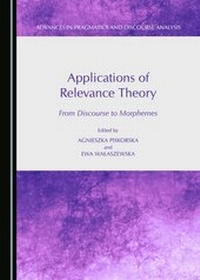
Applications of Relevance Theory
From Discourse to Morphemes
Published on 5. May 2017
Book
Hardback
345 pages
978-1-4438-7280-5 (ISBN)
Description
The collection of papers discusses various applications of Relevance Theory within several areas of pragmatics and discourse analysis. It covers an array of topics, including the treatment of figurative language, pragmatic markers and lexical pragmatics within Relevance Theory. It also discusses relevance-theoretic analyses of special kinds of discourse, such as discourse emerging from the internet or from psychotherapeutic sessions. The volume will primarily interest relevance theorists and scholars working on the subjects addressed by particular chapters.
More details
Series
Edition
Unabridged edition
Language
English
Place of publication
Newcastle upon Tyne
United Kingdom
Target group
Professional and scholarly
Edition type
Unabridged edition
Product notice
With dust jacket
Dimensions
Height: 212 mm
Width: 148 mm
ISBN-13
978-1-4438-7280-5 (9781443872805)
Copyright in bibliographic data and cover images is held by Nielsen Book Services Limited or by the publishers or by their respective licensors: all rights reserved.
Schweitzer Classification
Other editions
Additional editions
Unknown | Agnieszka Piskorska | Ewa Walaszewska
Applications of Relevance Theory
From Discourse to Morphemes
E-Book
05/2017
1st Edition
Cambridge Scholars Publishing
€240.99
Available for download
Persons
Agnieszka Piskorska is a post-doctoral researcher at the Institute of English Studies, University of Warsaw, Poland. She applies Relevance Theory to the study of interpersonal and affective aspects of human communication, including the use of humour and irony.Ewa Walaszewska is a post-doctoral researcher at the Institute of English Studies, University of Warsaw, Poland. Her research interests lie within semantics and pragmatics, and they particularly focus on Relevance Theory and its application to the study of particular linguistic phenomena, as well as its theoretical implications for the investigation of human communication and cognition.