

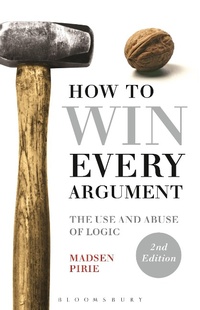
How to Win Every Argument
The Use and Abuse of Logic
2nd Edition
Published on 12. March 2015
Book
Paperback/Softback
240 pages
978-1-4725-2912-1 (ISBN)
Description
In the second edition of this witty and infectious book, Madsen Pirie builds upon his guide to using - and indeed abusing - logic in order to win arguments. By including new chapters on how to win arguments in writing, in the pub, with a friend, on Facebook and in 140 characters (on Twitter), Pirie provides the complete guide to triumphing in altercations ranging from the everyday to the downright serious.
He identifies with devastating examples all the most common fallacies popularly used in argument. We all like to think of ourselves as clear-headed and logical - but all readers will find in this book fallacies of which they themselves are guilty. The author shows you how to simultaneously strengthen your own thinking and identify the weaknesses in other people arguments. And, more mischievously, Pirie also shows how to be deliberately illogical - and get away with it. This book will make you maddeningly smart: your family, friends and opponents will all wish that you had never read it.
Publisher's warning: In the wrong hands this book is dangerous. We recommend that you arm yourself with it whilst keeping out of the hands of others. Only buy this book as a gift if you are sure that you can trust the recipient.
He identifies with devastating examples all the most common fallacies popularly used in argument. We all like to think of ourselves as clear-headed and logical - but all readers will find in this book fallacies of which they themselves are guilty. The author shows you how to simultaneously strengthen your own thinking and identify the weaknesses in other people arguments. And, more mischievously, Pirie also shows how to be deliberately illogical - and get away with it. This book will make you maddeningly smart: your family, friends and opponents will all wish that you had never read it.
Publisher's warning: In the wrong hands this book is dangerous. We recommend that you arm yourself with it whilst keeping out of the hands of others. Only buy this book as a gift if you are sure that you can trust the recipient.
Reviews / Votes
A highly thought provoking, enjoyable and entertaining read -- Zoe Page * The BookBag *More details
Edition
2nd edition
Language
English
Place of publication
London
United Kingdom
Publishing group
Bloomsbury Publishing PLC
Dimensions
Height: 198 mm
Width: 128 mm
Thickness: 17 mm
Weight
286 gr
ISBN-13
978-1-4725-2912-1 (9781472529121)
DOI
CBID182914
Copyright in bibliographic data and cover images is held by Nielsen Book Services Limited or by the publishers or by their respective licensors: all rights reserved.
Schweitzer Classification
Other editions
Additional editions
E-Book
03/2015
2nd Edition
Bloomsbury Academic
€25.49
Available for download
E-Book
03/2015
2nd Edition
Bloomsbury Academic
€25.49
Available for download
Previous edition
Book
09/2007
Continuum International Publishing Group Ltd.
€34.84
Article exhausted; check for reprint
Person
Madsen Pirie is President of the Adam Smith Institute, UK and author of numerous books including Boost Your IQ and The Sherlock Holmes IQ Book. He was formerly Distinguished Visiting Professor of Philosophy and Logic at Hillsdale College, Michigan, USA. He appears regularly as an expert on CNN and BBC television.
Content
Introduction
1. What is an Argument
2. What does a Successful Argument Look Like?
3. What counts as Evidence?
4. Oral Arguments
a) arguing with a friend
b) arguing in a group
c) arguing in a formal debate
d) Presenting your case in a meeting
5. Written Arguments
a) arguing in a letter, article of newspaper
b) arguing on the internet
c) how to argue on facebook
d) winning an argument in 140 characters (arguing on twitter)
79 A-Z entries, including:
Abusive analogy
Blinding with science
The complex question
Damning the alternatives
Exclusive premises
The gambler's fallacy
Hedging Irrelevent humour
Loaded words
The red herring
Shifting ground Trivial objections
Wishful thinking
1. What is an Argument
2. What does a Successful Argument Look Like?
3. What counts as Evidence?
4. Oral Arguments
a) arguing with a friend
b) arguing in a group
c) arguing in a formal debate
d) Presenting your case in a meeting
5. Written Arguments
a) arguing in a letter, article of newspaper
b) arguing on the internet
c) how to argue on facebook
d) winning an argument in 140 characters (arguing on twitter)
79 A-Z entries, including:
Abusive analogy
Blinding with science
The complex question
Damning the alternatives
Exclusive premises
The gambler's fallacy
Hedging Irrelevent humour
Loaded words
The red herring
Shifting ground Trivial objections
Wishful thinking