

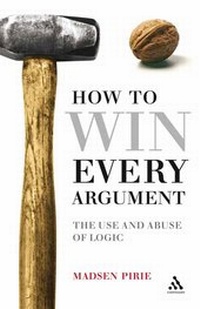
How to Win Every Argument
The Use and Abuse of Logic
Published on 2. April 2006
Book
Hardback
192 pages
978-0-8264-9006-3 (ISBN)
Description
This is the book your friends will wish you hadn't read, a witty and infectious guide to arguing successfully. Each entry deals with one fallacy, explaining what the fallacy is, giving and analysing an example, outlining when/where/why the particular fallacy tends to occur and finally showing how you can perpetrate the fallacy on other people in order to win an argument. Originally published to great acclaim in 1985 as "The Book of Fallacy", this is a classic brought up-to-date for a whole new generation.
More details
Edition
Revised edition
Language
English
Place of publication
London
United Kingdom
Publishing group
Bloomsbury Publishing PLC
Edition type
Revised edition
Dimensions
Height: 198 mm
Width: 129 mm
ISBN-13
978-0-8264-9006-3 (9780826490063)
Copyright in bibliographic data and cover images is held by Nielsen Book Services Limited or by the publishers or by their respective licensors: all rights reserved.
Schweitzer Classification
Person
Madsen Pirie is President of the Adam Smith Institute and author of numerous books including Boost Your IQ and The Sherlock Holmes IQ Book. He was formerly Distinguished Visiting Professor of Philosophy and Logic at Hillsdale College, Michigan.
Content
Acknowledgements; Introduction; Abusive analogy; Accent; Accident; Affirming the consequent; Amphiboly; The analogical fallcy; Antiquitam, argumentum ad; Apriorism; Baculum, argumentum ad; Bifurcation; Blinding with science; The bogus dilemma; Circulus in probando; The complex question (plurium interrogationum); Composition; Concealed quantification; Conclusion which denies premises. Contradictory premises; Crumenam, argumentum ad; Cum hoc ergo propter hoc; Damining the alternatives; Definitional retreat; Denying the antecedent; Dicto simpliciter; Division; Emotional appeals; Equivocation; Every schoolboy knows; The exception that proves the rule; Exclusive premises; The existential fallacy; Ex post facto statistics; Extensional pruning; False conversion; False precision; The gambler's Fallacy; The genetic Fallacy; Half-concealed qualification; Hedging; Hominem (abusive), argumentum ad; Hominem (circumstantial), argumentum ad; Ignoratio elenchi; Illicit process; Irrelevant humour; Lapidem, argumentum ad; Lazarum, argumentum ad; Loaded words; Misericordiam, argumentum ad; Nauseam, argumentum ad; Non-anticipation; Novitam, argumentum ad; Numeram, argumentum ad; One-sided assessment; Petitio principii; Poisoning the well; Populam, argumentum ad; Positive conclusion from negative premise; Post hoc ergo propter hoc; Quaternio terminorum; The red herring; Refuting the example; Reification; Secundum quid; Shifting ground; Shifting the burden of proof; Special pleading; The straw man; Temperantiam, argumentum ad; Trivial questions; Tu quoque; Unaccepted enthymemes; The undistributed middle; Unobtainable perfection; Verecundiam, argumentum ad; Wishful thinking; Classification of fallacies; Suggested reading.