

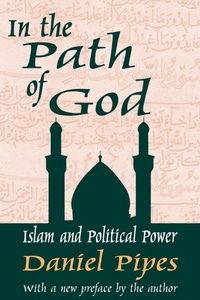
In the Path of God
Islam and Political Power
1st Edition
Published on 31. August 2002
Book
Paperback/Softback
391 pages
978-0-7658-0981-0 (ISBN)
Description
Americans' awareness of Islam and Muslims rose to seemingly unprecedented heights in the immediate aftermath of September 11, 2001, but this is not the first time they have dominated American public life. Once before, during the period of the Iranian revolution and hostage crisis of 1979 to 1981, Americans found themselves targeted as a consequence of a militant interpretation of Islam. Daniel Pipes wrote In the Path of God in response to those events, and the heightened interest in Islam they generated. His objective was to present an overview of the connection between in Islam and political power through history in a way that would explain the origins of hostility to Americans and the West. Its relevance to our understanding of contemporary events is self evident.
Muslim antagonism toward the West is deeply rooted in historical experience. In premodern times, the Islamic world enjoyed great success, being on the whole more powerful and wealthier than their neighbors. About two hundred years ago, a crisis developed, as Muslims became aware of the West's overwhelming force and economic might. While they might have found these elements attractive, Muslims found European culture largely alien and distasteful. The resulting resistance to Westernization by Muslims has deep roots, has been more persistent than that of other peoples, and goes far to explain the deep Muslim reluctance to accept modern ways. In short, Muslims saw what the West had and wanted it too, but they rejected the methods necessary to achieve this. This, the Muslim trauma, has only worsened over the years.
Muslim antagonism toward the West is deeply rooted in historical experience. In premodern times, the Islamic world enjoyed great success, being on the whole more powerful and wealthier than their neighbors. About two hundred years ago, a crisis developed, as Muslims became aware of the West's overwhelming force and economic might. While they might have found these elements attractive, Muslims found European culture largely alien and distasteful. The resulting resistance to Westernization by Muslims has deep roots, has been more persistent than that of other peoples, and goes far to explain the deep Muslim reluctance to accept modern ways. In short, Muslims saw what the West had and wanted it too, but they rejected the methods necessary to achieve this. This, the Muslim trauma, has only worsened over the years.
More details
Language
English
Place of publication
Somerset
United Kingdom
Publishing group
Taylor & Francis Inc
Target group
College/higher education
Professional and scholarly
Dimensions
Height: 229 mm
Width: 152 mm
Thickness: 23 mm
Weight
635 gr
ISBN-13
978-0-7658-0981-0 (9780765809810)
Copyright in bibliographic data and cover images is held by Nielsen Book Services Limited or by the publishers or by their respective licensors: all rights reserved.
Schweitzer Classification
Other editions
Additional editions
Book
11/2017
1st Edition
Routledge
€206.60
Shipment within 10-20 days
E-Book
09/2017
Routledge
€67.49
Available for download
E-Book
09/2017
Routledge
€67.49
Available for download
Person
Daniel Pipes is director of the Middle East Forum and a columnist for the New York Post and the Jerusalem Post. Among his books are The Long Shadow: Culture and Politics in the Middle East (available from Transaction), Greater Syria: The History of an Ambition, Friendly Tyrants: An American Dilemma, and The Rushdie Affair: The Novel, the Aftermath and the West.
Content
1: Understanding Islam in Politics; I: The Premodern Legacy; 2: Islamic Sacred Law and Politics; 3: The Medieval Synthesis; 4: Relations with Non-Muslims; Conclusion: The Civilization of Islam; II: Encountering the West; 5: Western Armies and Civilization; 6: New Attitudes toward the Sacred Law; 7: Responses to Western Political Ideologies; 8: Muslim Anomie; Conclusion: Muslim Ambivalence; III: Islam in Current Affairs; 9: The Islamic Revival: A Survey of Countries; 10: The Great Oil Boom; Conclusion: The Revival and Future Choices