

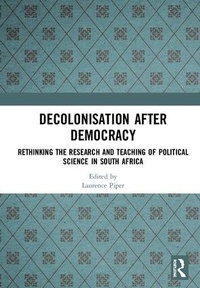
Decolonisation after Democracy
Rethinking the Research and Teaching of Political Science in South Africa
1st Edition
Published on 6. November 2018
Book
Hardback
156 pages
978-1-138-35086-1 (ISBN)
Description
Decolonisation after Democracy addresses the provocative idea that we need to rid higher education of lingering forms of colonial knowledge. This matters because in the colonial era much knowledge was put to the service of subjugating indigenous peoples, and the assumptions from this era may linger into the present. Examples of deep-rooted and 'foundational' forms of knowledge that carry colonial traits are normative binaries such as 'civilised and backward', 'modern and traditional' and 'rational and superstitious'. In addition, some accounts of positive values like freedom, equality, justice and democracy may hide the assumption that the western experience is the norm, from which other kinds are rendered imitations, deviations or pathologies.
In this collection, some of South Africa's leading political scientists and academics engage with the challenge of decolonising knowledge in the research and teaching of politics. It includes new insights about the state, international relations, clientelism, statesociety relations and land reform; and introduces new ways to engage the colonial library, curriculum reform, and the marginality of historically black institutions. Finally, the contributors deal with the decolonial challenge posed by the #FeesMustFall student movements, reflecting on issues of revolutionary politics and gender and sexual violence.
This book was originally published as a special issue of Politikon.
In this collection, some of South Africa's leading political scientists and academics engage with the challenge of decolonising knowledge in the research and teaching of politics. It includes new insights about the state, international relations, clientelism, statesociety relations and land reform; and introduces new ways to engage the colonial library, curriculum reform, and the marginality of historically black institutions. Finally, the contributors deal with the decolonial challenge posed by the #FeesMustFall student movements, reflecting on issues of revolutionary politics and gender and sexual violence.
This book was originally published as a special issue of Politikon.
More details
Language
English
Place of publication
London
United Kingdom
Publishing group
Taylor & Francis Ltd
Target group
College/higher education
Dimensions
Height: 246 mm
Width: 174 mm
Weight
453 gr
ISBN-13
978-1-138-35086-1 (9781138350861)
Copyright in bibliographic data and cover images is held by Nielsen Book Services Limited or by the publishers or by their respective licensors: all rights reserved.
Schweitzer Classification
Other editions
Additional editions
Laurence Piper
Decolonisation after Democracy
Rethinking the Research and Teaching of Political Science in South Africa
Book
06/2020
1st Edition
Routledge
€64.70
Shipment within 15-20 days
Laurence Piper
Decolonisation after Democracy
Rethinking the Research and Teaching of Political Science in South Africa
E-Book
05/2020
1st Edition
Routledge
€59.49
Available for download
Laurence Piper
Decolonisation after Democracy
Rethinking the Research and Teaching of Political Science in South Africa
E-Book
05/2020
1st Edition
Routledge
€59.49
Available for download
Person
Laurence Piper is Professor of Political Science at the University of the Western Cape, South Africa, and the University West, Sweden. His research focus is on urban politics in the Global South.
Content
Introduction 1. #EndRapeCulture Campaign in South Africa: Resisting Sexual Violence Through Protest and the Politics of Experience 2. Decolonising International Relations and Its Theory: A Critical Conceptual Meditation 3. Thinking the State from Africa: Political Theory, Eurocentrism and Concrete Politics 4. Confronting the Colonial Library: Teaching Political Studies Amidst Calls for a Decolonised Curriculum 5. What Would the Decolonisation of a Political Science Curriculum Entail? Lessons to be Learnt From the East African Experience at the Federal University of East Africa 6. The Need for a New Language? How Historically Disadvantaged Institutions Grapple with the Effects of Labelling in Higher Education: The Case of the University of the Western Cape 7. Decolonising Clientelism: 'Re-centring' Analyses of Local State-Society Relations in South Africa 8. On Decolonisation and Revolution: A Kristevan Reading on the Hashtags Student Movements and Fallism 9. Land Redistribution in South Africa: Towards Decolonisation or Recolonisation?