

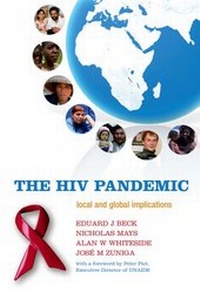
The HIV Pandemic
Local and global implications
Published on 18. May 2006
Book
Hardback
840 pages
978-0-19-852843-2 (ISBN)
Description
As we approach the 25th anniversary of the first recognition of HIV/AIDS in 1981, this book reflects on the international impact of the disease. It has persistently remained a global issue, with more than 50 million people worldwide estimated to have been infected since that date. This ambitious book, written by 165 authors from 30 countries, offers a multi-country comparative study that examines how the response to the common, global threat of HIV is shaped by the history, culture, institutions and health systems of the individual countries affected.
Increasingly the shift of health systems has been from prevention only as the main containment strategy, to a strategy that includes scaling up HIV treatment, and care and prevention services, including antiretroviral therapy. Thus, all parts of the health system must be involved; policy makers, healthcare professionals and users of the services have been forced to think differently about how services are financed, how resources are allocated, how systems are structured and organized, how services are delivered to patients, and how the resulting activity is monitored and evaluated in order to improve the effectiveness, efficiency, equity and acceptability of the response.
This book is unique in attempting to describe and assess a range of responses across the globe by situating them within the characteristics of each country and its health system. Most chapters combine a health policy expert with an HIV specialist, allowing both a 'top down' health system approach and a 'bottom up' HIV-specific perspective. There are thematic and analytical sections, which provide an overview and some suggestions for solutions to the most serious outstanding issues, and chapters which analyse specific country and organisational responses. There is no perfect health system, but the evidence provided here allows the sharing of knowledge, and a opportunity to assess the impact and reactions, to an epidemic that must be considered a long term issue.
Increasingly the shift of health systems has been from prevention only as the main containment strategy, to a strategy that includes scaling up HIV treatment, and care and prevention services, including antiretroviral therapy. Thus, all parts of the health system must be involved; policy makers, healthcare professionals and users of the services have been forced to think differently about how services are financed, how resources are allocated, how systems are structured and organized, how services are delivered to patients, and how the resulting activity is monitored and evaluated in order to improve the effectiveness, efficiency, equity and acceptability of the response.
This book is unique in attempting to describe and assess a range of responses across the globe by situating them within the characteristics of each country and its health system. Most chapters combine a health policy expert with an HIV specialist, allowing both a 'top down' health system approach and a 'bottom up' HIV-specific perspective. There are thematic and analytical sections, which provide an overview and some suggestions for solutions to the most serious outstanding issues, and chapters which analyse specific country and organisational responses. There is no perfect health system, but the evidence provided here allows the sharing of knowledge, and a opportunity to assess the impact and reactions, to an epidemic that must be considered a long term issue.
Reviews / Votes
Overall, this is an informative and interesting book, with the case studies from the different countries being particularly interesting. It will serve as a valuable resource to individuals working for international agencies, donors and researchers in providing important background information on the HIV pandemic. * WHO Bulletin * A particular strength of the book is the contributions of a diverse range of experts from across the globe and the structure and organization of the chapters. This is a timely and useful text for donors, policy makers, program managers, students and public health practitioners. * HIV Clinical Trials * ...once I plunged in, I was hooked. The book is well structured, readable, informative and challenging. * Nursing Standard * This book is timely for framing the first 26 years of the epidemic from a perspetive that encompasses policy and the delivery of medical care...The in-depth, well-organised country reports provide a baseline that will serve particularly well for those interested in international policy issues in public health...this book is important, and perhaps the best of its kind. * Lancet, Vol. 368 *More details
Language
English
Place of publication
Oxford
United Kingdom
Target group
College/higher education
Professional and scholarly
Illustrations
80 line drawings, numerous tables and boxes
Dimensions
Height: 253 mm
Width: 175 mm
Thickness: 49 mm
Weight
1579 gr
ISBN-13
978-0-19-852843-2 (9780198528432)
Copyright in bibliographic data and cover images is held by Nielsen Book Services Limited or by the publishers or by their respective licensors: all rights reserved.
Schweitzer Classification
Other editions
Additional editions
Edited By Eduard J. Beck ... [et Al.] | Lynn-Marie Holland Managing Editor
HIV Pandemic
Local and Global Implications
E-Book
12/2007
1st Edition
Oxford University Press
€800.91
Available for download
Book
12/2007
Oxford University Press
€60.80
Shipment within 15-20 days
Persons
Alan W Whiteside is an elected Member of Governing Council of the International AIDS Society, a member of the Governing Council of Waterford Kamhlaba College, and one of the Commissioners of the UN Commission on HIV/AIDS and Governance in Africa. He has written the forthcoming OUP book HIV/AIDS: A Very Short Introduction.
Nicholas Mays has served as Director of Health Services Research at the King's Fund, the UK's leading independent health policy and management foundation. He has also acted as principal adviser in the Social Policy Branch of the New Zealand Treasury. Professor Mays is editor of the Journal of Health Services Research and Policy, published by the Royal Society of Medicine Press.
Eduard Beck has recently taken up a post in the HIV Department of the World Health Organisation in Geneva.
Nicholas Mays has served as Director of Health Services Research at the King's Fund, the UK's leading independent health policy and management foundation. He has also acted as principal adviser in the Social Policy Branch of the New Zealand Treasury. Professor Mays is editor of the Journal of Health Services Research and Policy, published by the Royal Society of Medicine Press.
Eduard Beck has recently taken up a post in the HIV Department of the World Health Organisation in Geneva.
Author
, Executive Director, UNAIDS
Editor
, Associate Professor of Epidemiology, McGill University, Canada
, Professor of Health Policy, London School of Hygiene and Tropical Medicine, UK
, Professor and Director, Health Economics and HIV/AIDS Research Division, University of KwaZulu-Natal, South Africa
, President and Chief Executive Officer, International Association of Physicians in AIDS Care, Chicago, USA
Content
THE PANDEMIC; PREVENTION, TREATMENT AND CARE: ADVANCES IN KNOWLEDGE; COUNTRY RESPONSES; GLOBAL AND NATIONAL RESPONSES; STRENGTHENING THE RESPONSE