

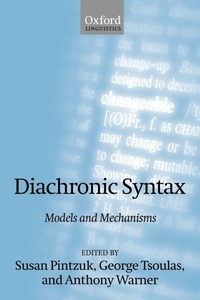
Diachronic Syntax
Models and Mechanisms
Published on 8. February 2001
Book
Paperback/Softback
392 pages
978-0-19-825027-2 (ISBN)
Description
This collection of new writing on grammatical change advances research in the field and shows its breadth and liveliness. The study of how and why syntax changes occupies a pivotal position in research into the nature, use, and acquisition of language. It is responsive to theoretical advances in linguistic theory, language acquisition, and theories of language use as well as to less adjacent fields such as statistical techniques and evolutionary biology. Chomsky's Minimalist Programme and Kayne's theories of antisymmetry and overt movement have brought into sharper focus questions concerning the architecture of linguistic theory, and this has had a direct impact on the understanding of the processes of change. Optimality Theory has also begun to raise new questions as it is applied to syntax and historical change. The sociolinguistic causes and consequences of syntactic change have also become newly prominent. These are among the many issues and themes discussed and explored by the authors.
The book's fourteen chapters exemplify work in a wide range of languages, including Germanic (Icelandic and Swedish, as well as Old and Middle English); Romance (Latin, Italian, Portuguese, Spanish); Slavonic; and Chinese. A substantial introduction provides a critical synthesis of the field and sets the following chapters in context. The book is then divided into parts dealing with theoretical frameworks, comparative change, features and categories, and movement. The single collated bibliography to the entire volume is a valuable research tool in itself.
Diachronic Syntax is innovative in both theory and method and makes a substantial contribution to its subject. It will be of interest to all those concerned to understand and explain the internal dynamics of language.
The book's fourteen chapters exemplify work in a wide range of languages, including Germanic (Icelandic and Swedish, as well as Old and Middle English); Romance (Latin, Italian, Portuguese, Spanish); Slavonic; and Chinese. A substantial introduction provides a critical synthesis of the field and sets the following chapters in context. The book is then divided into parts dealing with theoretical frameworks, comparative change, features and categories, and movement. The single collated bibliography to the entire volume is a valuable research tool in itself.
Diachronic Syntax is innovative in both theory and method and makes a substantial contribution to its subject. It will be of interest to all those concerned to understand and explain the internal dynamics of language.
Reviews / Votes
Review from hardback edition... provides an excellent survey of recent developments in the field ... The editors have assembled a collection of very substantial papers in which extensive databases, sophisticated statistical analyses, and clever theoretical interpretations are abundantly present. * Journal of Linguistics *
More details
Language
English
Place of publication
Oxford
United Kingdom
Target group
Professional and scholarly
Illustrations
linguistic tree diagrams
Dimensions
Height: 234 mm
Width: 156 mm
Thickness: 21 mm
Weight
600 gr
ISBN-13
978-0-19-825027-2 (9780198250272)
Copyright in bibliographic data and cover images is held by Nielsen Book Services Limited or by the publishers or by their respective licensors: all rights reserved.
Schweitzer Classification
Other editions
Additional editions
Book
02/2001
Oxford University Press
€347.70
Shipment within 15-20 days
Persons
Susan Pintzuk is Lecturer in Linguistics at the University of York. She has research interests in syntactic variation and change in the history of English and other Germanic languages. She is currently working on a research project on the syntax of Old English poetry and (with Anthony Warner and Ann Taylor) the York-Helsinki Parsed Corpus of Old English. She has published articles on Old English syntax; Phrase Structures in Competition: Variation and Change in Old English Word Order (Garland, 1999); and (with David Adger, Bernadette Plunkett, and George Tsoulas) Specifiers: Minimalist Approaches (OUP, 1999).
George Tsoulas is Lecturer in Linguistics at the University of York. He has published articles on the interpretation of pronouns and the syntax of non-finite sentential complementation. His recent research is concerned with the formal theory of quantification, the syntax and semantics of pronominal anaphora, and the syntax of scrambling and multiple subject constructions in Korean and Japanese. He has edited (with David Adger, Bernadette Plunkett, and Susan Pintzuk) Specifiers: Minimalist Approaches (OUP, 1999).
Anthony Warner is Professor of English Linguistics at the University of York. He has a major interest in variation and change in the history of English syntax. He is the author of papers in syntactic change and in phrase structure grammar, and of Complementation in Middle English and the Methodology of Historical Syntax (Croom Helm, 1982), and English Auxiliaries: Structure and History (CUP, 1993).
George Tsoulas is Lecturer in Linguistics at the University of York. He has published articles on the interpretation of pronouns and the syntax of non-finite sentential complementation. His recent research is concerned with the formal theory of quantification, the syntax and semantics of pronominal anaphora, and the syntax of scrambling and multiple subject constructions in Korean and Japanese. He has edited (with David Adger, Bernadette Plunkett, and Susan Pintzuk) Specifiers: Minimalist Approaches (OUP, 1999).
Anthony Warner is Professor of English Linguistics at the University of York. He has a major interest in variation and change in the history of English syntax. He is the author of papers in syntactic change and in phrase structure grammar, and of Complementation in Middle English and the Methodology of Historical Syntax (Croom Helm, 1982), and English Auxiliaries: Structure and History (CUP, 1993).
Editor
Edited byLecturer in Linguistics, Department of Language and Linguistic ScienceEdited byLecturer in Linguistics, Department of Language and Linguistic Science, University of York
Lecturer in Linguistics and French, Department of Language and Linguistic ScienceLecturer in Linguistics and French, Department of Language and Linguistic Science, University of York
Professor in the Department of Language and Linguistic ScienceProfessor in the Department of Language and Linguistic Science, University of York
Content
1. Syntactic Change: Theory and Method ; PART I: FRAMEWORKS FOR THE UNDERSTANDING OF CHANGE ; 2. Competition and Correspondence in Syntactic Change: Null Arguments in Latin and Romance ; 3. Jespersen's Cycle Revisited: Formal Properties of Grammaticalization ; 4. Evolutionary Perspectives on Diachronic Syntax ; PART II: THE COMPARATIVE BASIS OF DIACHRONIC SYNTAX ; 5. Adjuncts and the Syntax of Subjects in Old and Middle English ; 6. Verb-Object Order in Early Middle English ; 7. Null Subjects in Middle English Existentials ; PART III: MECHANISMS OF SYNTACTIC CHANGE ; 8. Polarity Items in Romance: Underspecification and Lexical Change ; 9. Relabelling ; 10. The Value of Definite Determiners from Old Spanish to Modern Spanish ; 11. From OV to VO in Swedish ; 12. The Evolution of Do-Support in English Imperatives ; 13. Interacting Movements in the History of Icelandic ; 14. Verb Movement in Slavonic Conditionals