

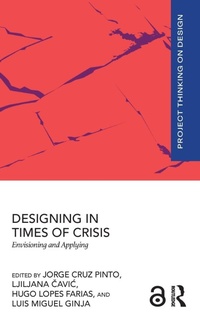
Designing in Times of Crisis
Envisioning and Applying
1st Edition
Published on 11. March 2025
Book
Hardback
176 pages
978-1-032-83498-6 (ISBN)
Description
Designing in Times of Crisis offers insights, visions, and strategies for architects and urban designers to question and respond to the crises and challenges of the contemporary anthropocentric world. The book highlights the urgency of addressing global crises and encourages architects and urban designers to consider new approaches related to gender equity, city ethics, and fundamental human rights. It promotes the adoption of sustainable practices that heed the social, economic, and environmental impacts of their work, particularly focusing on Portuguese and Brazilian contexts.
The book fosters new thinking and practices to provide a comprehensive overview of the challenges and opportunities facing contemporary architecture and urban design. It investigates how these disciplines can adapt to the fluidity of the digital age, respond to climate change, and embrace social justice, all while maintaining a commitment to innovation and sustainability. The book is divided into two parts: "Envisioning" and "Applying". The first explores various urban and architectural proposals triggered by climate change and contemporary social issues. The second focuses on different experimentations in architectural and urban design, building techniques, dwelling, and teaching during the COVID-19 pandemic, as well as citizenship formation.
This timely research is relevant for students, researchers, and practitioners interested in architecture, urban planning, and sustainable design.
The book fosters new thinking and practices to provide a comprehensive overview of the challenges and opportunities facing contemporary architecture and urban design. It investigates how these disciplines can adapt to the fluidity of the digital age, respond to climate change, and embrace social justice, all while maintaining a commitment to innovation and sustainability. The book is divided into two parts: "Envisioning" and "Applying". The first explores various urban and architectural proposals triggered by climate change and contemporary social issues. The second focuses on different experimentations in architectural and urban design, building techniques, dwelling, and teaching during the COVID-19 pandemic, as well as citizenship formation.
This timely research is relevant for students, researchers, and practitioners interested in architecture, urban planning, and sustainable design.
More details
Series
Language
English
Place of publication
London
United Kingdom
Publishing group
Taylor & Francis Ltd
Target group
College/higher education
Professional and scholarly
Academic, Postgraduate, and Undergraduate Advanced
Illustrations
65 s/w Abbildungen, 49 s/w Photographien bzw. Rasterbilder, 19 s/w Zeichnungen, 9 s/w Tabellen
9 Tables, black and white; 19 Line drawings, black and white; 46 Halftones, black and white; 65 Illustrations, black and white
Dimensions
Height: 240 mm
Width: 161 mm
Thickness: 15 mm
Weight
470 gr
ISBN-13
978-1-032-83498-6 (9781032834986)
Copyright in bibliographic data and cover images is held by Nielsen Book Services Limited or by the publishers or by their respective licensors: all rights reserved.
Schweitzer Classification
Other editions
Additional editions
Jorge Cruz Pinto | Ljiljana Cavic | Hugo Lopes Farias
Designing in Times of Crisis
Envisioning and Applying
Book
approx. 07/2026
1st Edition
Routledge
€57.00
Not yet published
Jorge Cruz Pinto | Ljiljana Cavic | Hugo Lopes Farias
Designing in Times of Crisis
Envisioning and Applying
E-Book
03/2025
1st Edition
Routledge
€0.00
Available for download
Jorge Cruz Pinto | Ljiljana Cavic | Hugo Lopes Farias
Designing in Times of Crisis
Envisioning and Applying
E-Book
03/2025
1st Edition
Routledge
€0.00
Available for download
Persons
Jorge Cruz Pinto is a Portuguese architect and visual artist. He is currently a Professor at the Lisbon School of Architecture, University of Lisbon, Portugal. He was president of the Scientific Council, former head of the Architectural Design Department, and founder and former president of the CIAUD - Research Centre for Architecture, Urbanism, and Design. He was also an invited professor at La Sapienza Universita di Roma and at the Facolta di Architettura di Matera. Pinto's publications include several books and scientific articles about architecture, aesthetics, architectural design works, and art works, namely para-architectures.
Ljiljana Cavic is a Serbian architect and Assistant Professor and Researcher at the Lisbon School of Architecture, University of Lisbon, where she earned her doctoral degree in 2018. She holds a master's degree from the Faculty of Architecture at the University of Belgrade. She is a member of CIAUD - Research Centre for Architecture, Urbanism, and Design and the architecture + design/drawing + art + project + theory/technology (ADAPT) group. Her research focuses on UrbArch Emptiness and the immaterial qualities of urban-architectural spaces. She is the co-author of Solid and Convex Voids, an analytic and representational method intended for investigating the unbuilt parts of urban-architectural spaces.
Hugo Lopes Farias is a Portuguese architect and a Professor in Architectural Design at the Lisbon School of Architecture, University of Lisbon, where he has been teaching since 1997. He has been the Coordinator of the Doctoral Program in Architecture since 2018, and the Architecture Cluster of CIAUD - Research Centre for Architecture, Urbanism, and Design since 2021. His research focuses on the architecture of dwelling across multiple scales, aiming to develop adequate, accessible, diverse, and higher-quality housing solutions for both the present and the future.
Luis Miguel Ginja is a Portuguese architect with a PhD from the Lisbon School of Architecture. He is an integrated researcher at CIAUD - Research Centre for Architecture, Urbanism, and Design and has coordinated the WATer project - Water, Architecture and Territory - since 2022, and participated in other research projects on territory and city subjects. He was an invited Assistant Professor for the Industrial Design course at the Universidade da Beira Interior. His research primarily explores design themes, with a focus on the relationship between the body and space, the hand and the design process, and the interaction between the city and the territory.
Ljiljana Cavic is a Serbian architect and Assistant Professor and Researcher at the Lisbon School of Architecture, University of Lisbon, where she earned her doctoral degree in 2018. She holds a master's degree from the Faculty of Architecture at the University of Belgrade. She is a member of CIAUD - Research Centre for Architecture, Urbanism, and Design and the architecture + design/drawing + art + project + theory/technology (ADAPT) group. Her research focuses on UrbArch Emptiness and the immaterial qualities of urban-architectural spaces. She is the co-author of Solid and Convex Voids, an analytic and representational method intended for investigating the unbuilt parts of urban-architectural spaces.
Hugo Lopes Farias is a Portuguese architect and a Professor in Architectural Design at the Lisbon School of Architecture, University of Lisbon, where he has been teaching since 1997. He has been the Coordinator of the Doctoral Program in Architecture since 2018, and the Architecture Cluster of CIAUD - Research Centre for Architecture, Urbanism, and Design since 2021. His research focuses on the architecture of dwelling across multiple scales, aiming to develop adequate, accessible, diverse, and higher-quality housing solutions for both the present and the future.
Luis Miguel Ginja is a Portuguese architect with a PhD from the Lisbon School of Architecture. He is an integrated researcher at CIAUD - Research Centre for Architecture, Urbanism, and Design and has coordinated the WATer project - Water, Architecture and Territory - since 2022, and participated in other research projects on territory and city subjects. He was an invited Assistant Professor for the Industrial Design course at the Universidade da Beira Interior. His research primarily explores design themes, with a focus on the relationship between the body and space, the hand and the design process, and the interaction between the city and the territory.
Content
List of figures
List of tables
List of maps
List of contributors
Preface
Acknowledgment
Introduction
Part 1: Envisioning
Chapter 1. From Solid Do Liquid Contemporary Architecture: A Crisis of Space and Time
Jorge David Morales Alvear
Chapter 2. Hacking Into Green Deal Neighbourhoods with City Ethics and Fundamental Human Rights
Alexander Matthias Gerner
Chapter 3. Project For the Environment: The Architecture of the Seven Elements
Jorge Cruz Pinto
Chapter 4. Rehearsals Of Shared Encounters for Improvising a Public Square
Alexander Matthias Gerner, Ljiljana Cavic
Chapter 5. Social Housing Projects in Brazil: Analytical Potentialities
Fabiano Sobreira, Maria Schulz
Chapter 6. One Piece of The Environmental Puzzle - The Relationship Between Architectural Practice And Climate Change
Juliane Freire, Paulo Pereira Almeida
Part 2: Applying
Chapter 7. Self-Construction with a Modular System of Small Wood Components and Gender Equity
Alanis Larissa Fernandes Boganika
Chapter 8. Experimentation with Building Techniques Using Earth in Professional Training: A Path for the Architecture of Response
Ana Valeria Soares Nunes, Ingrid Gomes Braga, Taynah Machado Pacifico de Sousa
Chapter 9. House, Body, And Windows: Space-Time Interferences During the Covid-19 Quarantine
Paula Gabbi Polli, Fabiana Ferreira Carvalho, Michele Baruffaldi
Chapter 10. Children's Mobility in the City: The Attachment to the Urban Environment as Formation for Citizenship in Quixada, Brazil
Diego Freire Martins, Veronica Maria Fernandes de Lima
Chapter 11. Teaching-Learning Spaces in Architecture and Urban Planning: A Challenge in Time
Lucimeire Pessoa de Lima, Helena Aparecida Ayoub Silva
Chapter 12. Adapt Cube - Conceptual and Material Narratives
Jorge Cruz Pinto, Ljiljana Cavic
Index
List of tables
List of maps
List of contributors
Preface
Acknowledgment
Introduction
Part 1: Envisioning
Chapter 1. From Solid Do Liquid Contemporary Architecture: A Crisis of Space and Time
Jorge David Morales Alvear
Chapter 2. Hacking Into Green Deal Neighbourhoods with City Ethics and Fundamental Human Rights
Alexander Matthias Gerner
Chapter 3. Project For the Environment: The Architecture of the Seven Elements
Jorge Cruz Pinto
Chapter 4. Rehearsals Of Shared Encounters for Improvising a Public Square
Alexander Matthias Gerner, Ljiljana Cavic
Chapter 5. Social Housing Projects in Brazil: Analytical Potentialities
Fabiano Sobreira, Maria Schulz
Chapter 6. One Piece of The Environmental Puzzle - The Relationship Between Architectural Practice And Climate Change
Juliane Freire, Paulo Pereira Almeida
Part 2: Applying
Chapter 7. Self-Construction with a Modular System of Small Wood Components and Gender Equity
Alanis Larissa Fernandes Boganika
Chapter 8. Experimentation with Building Techniques Using Earth in Professional Training: A Path for the Architecture of Response
Ana Valeria Soares Nunes, Ingrid Gomes Braga, Taynah Machado Pacifico de Sousa
Chapter 9. House, Body, And Windows: Space-Time Interferences During the Covid-19 Quarantine
Paula Gabbi Polli, Fabiana Ferreira Carvalho, Michele Baruffaldi
Chapter 10. Children's Mobility in the City: The Attachment to the Urban Environment as Formation for Citizenship in Quixada, Brazil
Diego Freire Martins, Veronica Maria Fernandes de Lima
Chapter 11. Teaching-Learning Spaces in Architecture and Urban Planning: A Challenge in Time
Lucimeire Pessoa de Lima, Helena Aparecida Ayoub Silva
Chapter 12. Adapt Cube - Conceptual and Material Narratives
Jorge Cruz Pinto, Ljiljana Cavic
Index