

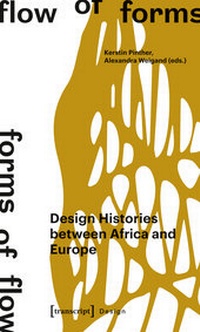
Flow of Forms / Forms of Flow
Design Histories between Africa and Europe
1st Edition
Published in April 2018
Book
Paperback/Softback
208 pages
978-3-8376-4201-8 (ISBN)
Description
As a teenager, I spent my time wondering why in sci-fi movies, every landscape, every object I could see was Western or Asian based. I've finally understood that somewhere our legacy had been locked in the past, that we couldn't be "futuristic" in the eyes of our fellow Europeans. We have to look behind our shoulders, get back to our traditions, seize the best of them and shape a future with it. This without forgetting we are part of the world, totally, unquestionably. The future is for me not only a matter of dialogue with the past, but and beyond everything a dialogue with the rest of the planet.
Kossi Aguessy
How is it possible to adequately capture histories of design in Africa, a continent with fifty-four countries? How can one avoid producing just another essentialising master narrative of "African Design"? How can one make sense of the many entangled yet often asymmetric and sometimes ambivalent histories of form-finding processes between Africa and Europe? In keeping with the premises of a global art and design history approach, the book offers a change of perspective: focusing on the mobility of people, objects and ideas - on flows between Africa and Europe as well as on a South-South axis - allows for multiple yet necessarily fragmented design histories to be identified and recognised. The contributors trace multi-faceted design case studies from a historical perspective, with attention to the present as well as towards possible futures.
Kossi Aguessy
How is it possible to adequately capture histories of design in Africa, a continent with fifty-four countries? How can one avoid producing just another essentialising master narrative of "African Design"? How can one make sense of the many entangled yet often asymmetric and sometimes ambivalent histories of form-finding processes between Africa and Europe? In keeping with the premises of a global art and design history approach, the book offers a change of perspective: focusing on the mobility of people, objects and ideas - on flows between Africa and Europe as well as on a South-South axis - allows for multiple yet necessarily fragmented design histories to be identified and recognised. The contributors trace multi-faceted design case studies from a historical perspective, with attention to the present as well as towards possible futures.
More details
Series
Language
English
Place of publication
Bielefeld
Germany
Target group
Professional and scholarly
Product notice
Unsewn / adhesive bound
Illustrations
17 SW-Abbildungen, 85 Farbabbildungen
Dimensions
Height: 21 cm
Width: 14 cm
Thickness: 15 mm
Weight
368 gr
ISBN-13
978-3-8376-4201-8 (9783837642018)
Schweitzer Classification
Other editions
Additional editions
Kerstin Pinther | Alexandra Weigand
Flow of Forms / Forms of Flow
Design Histories between Africa and Europe
E-Book
09/2019
1st Edition
transcript
€34.99
Available for download
Persons
Editor
Kerstin Pinther is professor for African Art History at the art history department of Ludwig-Maximilian University Munich, Germany. Her research focuses on contemporary art, architecture, urbanism and design in Africa and its diaspora. Her most recent publication looked at "New Spaces for Negotiating Art (and) Histories in Africa". As a curator, she organized the exhibition "Afropolis. City, Media, Art" (2010-2012).
Alexandra Weigand is a designer and art historian, who works interdisciplinarily as a curator, lecturer and researcher. Her exhibition projects include "Hit the Future_Design beyond the Borders" and "Hit the Future_Metropolitan Design" for Munich's design weeks in 2014 und 2015. She is currently a senior researcher at the art history department of Ludwig-Maximilian University Munich, Germany, with a focus on design and urbanism in Africa.
Content
Flow of Forms / Forms of Flow. Design Histories between Africa and Europe; Forms of Modernity; Transform(n)ation; Forms of Cooperation / Participation; Material Morphosis; Speculative Forms; Ladi Kwali, Michael Cardew and a Tangled Story of African Studio Pottery; Design, Development and its Legacies: A Perspective on 1970s Design Culture and its Anthropological Intents; Between Favela Chic and Autonomy. Design in Latin America; The Politics of Design in Postcolonial Kenya; On the Flows of Architectural Design: The Context and Making of an Exhibition; Jules Wokam's Aesthetics of Permeability; Tracing the Quiet Cultural Activism: Laduma Ngxokolo and Black Coffee; Cheick Diallo: Design between Politics and Poetics; Designers' and Artists' Biographies; Authors' Biographies.