

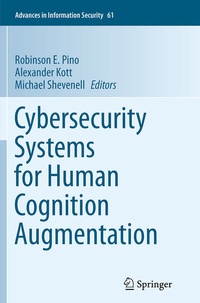
Cybersecurity Systems for Human Cognition Augmentation
Published on 10. September 2016
Book
Paperback/Softback
XVI, 209 pages
978-3-319-35222-0 (ISBN)
Description
This book explores cybersecurity research and development efforts, including ideas that deal with the growing challenge of how computing engineering can merge with neuroscience. The contributing authors, who are renowned leaders in this field, thoroughly examine new technologies that will automate security procedures and perform autonomous functions with decision making capabilities. To maximize reader insight into the range of professions dealing with increased cybersecurity issues, this book presents work performed by government, industry, and academic research institutions working at the frontier of cybersecurity and network sciences. Cybersecurity Systems for Human Cognition Augmentation is designed as a reference for practitioners or government employees working in cybersecurity. Advanced-level students or researchers focused on computer engineering or neuroscience will also find this book a useful resource.
More details
Series
Edition
Softcover reprint of the original 1st ed. 2014
Language
English
Place of publication
Cham
Switzerland
Publishing group
Springer International Publishing
Target group
Professional and scholarly
Illustrations
113 s/w Abbildungen
XVI, 209 p. 113 illus.
Dimensions
Height: 235 mm
Width: 155 mm
Thickness: 13 mm
Weight
353 gr
ISBN-13
978-3-319-35222-0 (9783319352220)
DOI
10.1007/978-3-319-10374-7
Schweitzer Classification
Other editions
Additional editions
Robinson E. Pino | Alexander Kott | Michael Shevenell
Cybersecurity Systems for Human Cognition Augmentation
Book
10/2014
Springer
€106.99
Shipment within 10-15 days
Content
Situational awareness, sensemaking, and situation understanding in cyber warfare.- Neuromorphic Computing for Cognitive Augmentation in Cyber Defense.- Automated Cyber Situation Awareness Tools and Models for Improving Analyst Performance.- Data Mining in Cyber Operations.- Trusted Computation through Biologically Inspired Processes.- Dynamic Logic Machine Learning for Cybersecurity.- Towards Neural Network Based Malware Detection on Android Mobile Devices.- Sustainability Problems and a Novelty in the Concept of Energy.- Memristors as Synapses in Artificial Neural Networks: Biomimicry Beyond Weight Change.- Low Power Neuromorphic Architectures to Enable Pervasive Deployment of Intrusion Detection Systems.- Memristor SPICE Model Simulation and Device Hardware Correlation.- Reconfigurable Memristor Based Computing Logic.- Cyber Security Considerations for Reconfigurable Systems.