

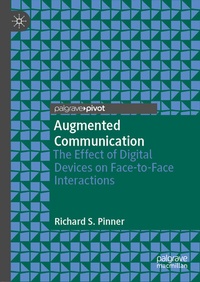
Augmented Communication
The Effect of Digital Devices on Face-to-Face Interactions
Published on 28. January 2019
Book
Hardback
XII, 132 pages
978-3-030-02079-8 (ISBN)
Description
This book explores the ways in which handheld networked devices can be used to enhance and augment interpersonal communication. The author examines in depth how the addition of visual and multimodal input, access to online search engines and the inclusion of participants from distant geographical locations (either synchronously or asynchronously) affects our face to face interactions. Presenting research data from several years of autoethnographic observation, this balanced work reveals the consequences, both positive and negative, of technology-dependent forms of discourse. In doing so, this sociolinguistic perspective fills a gap in the current literature and indicates possible future directions for the study of augmented communication. It will appeal in particular to students and scholars of sociolinguistics, applied linguistics and digital humanities.
More details
Edition
2019 ed.
Language
English
Place of publication
Cham
Switzerland
Publishing group
Springer International Publishing
Target group
Professional and scholarly
Illustrations
1 s/w Abbildung, 12 farbige Abbildungen
XII, 132 p. 13 illus., 12 illus. in color.
Dimensions
Height: 216 mm
Width: 153 mm
Thickness: 13 mm
Weight
308 gr
ISBN-13
978-3-030-02079-8 (9783030020798)
DOI
10.1007/978-3-030-02080-4
Schweitzer Classification
Other editions
Additional editions
E-Book
12/2018
1st Edition
Palgrave Pivot
€58.84
Available for download
Person
Richard S. Pinner is Associate Professor in the Department of English Literature at Sophia University, Japan.
Content
Chapter 1: Introduction.- Chapter 2: History of Augmented Communication: technology and disability.- Chapter 3: Augmented Communication as a modern phenomenon in ordinary speech.- Chapter 4: Types of Augmented Communication.- Chapter 5: Stepping Back: Analysis and Discussion of ICT and language change.- Chapter 6: Conclusion.