

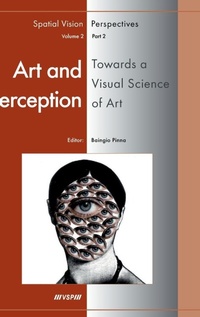
Art and Perception. Towards a Visual Science of Art, Part 2
Published on 29. October 2008
Book
Hardback
418 pages
978-90-04-16630-1 (ISBN)
Description
This volume is a collection of articles which explore the relations between modern and classical visual art on the one hand and what is currently known or believed about visual perception, visual exploration, the eye, and the visual brain. The book includes speculative as well as firmly-grounded theories and approaches.
Articles have been chosen for their scholarly value, their scientific approach as far as possible, and their intrinsic interest.
Articles have been chosen for their scholarly value, their scientific approach as far as possible, and their intrinsic interest.
More details
Series
Language
English
Place of publication
Leiden
Netherlands
Target group
Professional and scholarly
Product notice
sewn/stitched
Cloth over boards
Dimensions
Height: 240 mm
Width: 160 mm
Thickness: 24 mm
Weight
812 gr
ISBN-13
978-90-04-16630-1 (9789004166301)
Copyright in bibliographic data and cover images is held by Nielsen Book Services Limited or by the publishers or by their respective licensors: all rights reserved.
Schweitzer Classification
Other editions
Complete work / Part of the work
Book
01/1990
Brill
€484.50
Article is exhausted; no reprint
Person
Baingio Pinna, Ph.D. (1993) in Experimental Psychology, University of Padua, Italy, is Professor of Psychology and Perceptual Psychology at University of Sassari, Italy. He has published extensively on visual psychophysics and discovered several new visual illusions (Revolving Wheels, Watercolor, Discoloration, Flashing Color Contrast, etc.).
Content
Introduction
The illusion of Art
How do painters represent motion in garments? Graphic invariants across centuries
Implicit and explicit features of paintings
Reflections in art
The incomplete angler: effects created by visual omission
Understanding 2D projections on mirrors and on windows
The aesthetic experience of 'contour binding'
The representation of time course events in visual arts and the development of the concept of time in children: a preliminary study
Self and world: large scale installations at science museums
The visual system as a constraint on the survival and success of specific
artworks
Spatial vision anomalies in Renaissance art: Raphael, Giorgione, Duerer
Towards a framework for the study of the neural correlates of aesthetic preference
Factors contributing to depth perception: behavioral studies on the reverse perspective illusion
Emmert's Law and the moon illusion
Aesthetic issues in spatial composition: effects of position and direction on framing single objects
Angle illusion on a picture's surface
The art of seeing and painting
Attentional vs computational complexity measures in observing paintings
Corner salience varies linearly with corner angle during flicker-augmented contrast: a general principle of corner perception based on Vasarely's artworks
From perception to art: how vision creates meanings
The illusion of Art
How do painters represent motion in garments? Graphic invariants across centuries
Implicit and explicit features of paintings
Reflections in art
The incomplete angler: effects created by visual omission
Understanding 2D projections on mirrors and on windows
The aesthetic experience of 'contour binding'
The representation of time course events in visual arts and the development of the concept of time in children: a preliminary study
Self and world: large scale installations at science museums
The visual system as a constraint on the survival and success of specific
artworks
Spatial vision anomalies in Renaissance art: Raphael, Giorgione, Duerer
Towards a framework for the study of the neural correlates of aesthetic preference
Factors contributing to depth perception: behavioral studies on the reverse perspective illusion
Emmert's Law and the moon illusion
Aesthetic issues in spatial composition: effects of position and direction on framing single objects
Angle illusion on a picture's surface
The art of seeing and painting
Attentional vs computational complexity measures in observing paintings
Corner salience varies linearly with corner angle during flicker-augmented contrast: a general principle of corner perception based on Vasarely's artworks
From perception to art: how vision creates meanings