

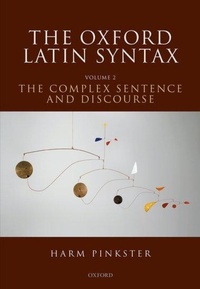
The Oxford Latin Syntax
Volume II: The Complex Sentence and Discourse
Published on 31. March 2021
Book
Hardback
1472 pages
978-0-19-923056-3 (ISBN)
Description
In this two-volume work, the first full-scale treatment of its kind in English, Harm Pinkster applies contemporary linguistic theories and the findings of traditional grammar to the study of Latin syntax. He takes a non-technical and principally descriptive approach, based on literary and non-literary texts dating from c.250 BC to c.450 AD. The volumes contain a wealth of examples to illustrate the grammatical phenomena under discussion, many of them from the works of Plautus and Cicero, alongside extensive references to other sources of examples such as the Oxford Latin Dictionary and the Thesaurus Linguae Latinae.
While the first volume explored the simple clause, this second volume focuses on the complex sentence and discourse. The first three chapters examine different types of subordinate clause; the following four then explore relative clauses, coordination, comparison, and secondary predicates. Later chapters investigate information structure and extraclausal expressions, word order, and discourse and related features. The Oxford Latin Syntax will be a valuable and up-to-date resource both for professional Latinists and all linguists with an interest in Classics.
While the first volume explored the simple clause, this second volume focuses on the complex sentence and discourse. The first three chapters examine different types of subordinate clause; the following four then explore relative clauses, coordination, comparison, and secondary predicates. Later chapters investigate information structure and extraclausal expressions, word order, and discourse and related features. The Oxford Latin Syntax will be a valuable and up-to-date resource both for professional Latinists and all linguists with an interest in Classics.
Reviews / Votes
Overall, the OLS is a monumental achievement, and such idiosyncrasies as there are do not detract from this. These volumes present a comprehensive unified account of the whole of Latin syntax, broadly conceived, and they are both a source of reference for the familiar and also an invitation to think about it anew. * RICHARD ASHDOWNE, University College, Oxford, THE CLASSICAL REVIEW * a stunning achievement * Anke Walter, Greece & Rome * Thought out to be the scientifically up-to-date replacement for the Ausfuerliche Grammatik der lateinischen Sprache: Satzlehre, the Oxford Latin Syntax (...), is a monument to the Latin language and contemporary linguistics that no Latinist can be indifferent to. * The Euphrosyne, Vol 50 *More details
Language
English
Place of publication
Oxford
United Kingdom
Target group
Professional and scholarly
Product notice
sewn/stitched
Cloth over boards
Dimensions
Height: 250 mm
Width: 174 mm
Thickness: 64 mm
Weight
2088 gr
ISBN-13
978-0-19-923056-3 (9780199230563)
Copyright in bibliographic data and cover images is held by Nielsen Book Services Limited or by the publishers or by their respective licensors: all rights reserved.
Schweitzer Classification
Other editions
Additional editions
E-Book
03/2021
1st Edition
OUP eBook
€181.99
Available for download
Person
Harm Pinkster is Emeritus Professor of Latin at the University of Amsterdam. He has held visiting professorships at the universities of Bologna, Aix-en-Provence, Penn State, Pavia, Venice, Oxford, and Chicago. His books include On Latin Adverbs (North-Holland, 1972; reprinted by Amsterdam University Press, 2005), Latin Linguistics and Linguistic Theory (John Benjamins, 1983), and Latin Syntax and Semantics (Routledge, 1990). He is also the co-author of four of the five volumes of a Commentary on Cicero's De Oratore (Winter Verlag, 1981-1996). He is a member of the Academia Europaea, a Corresponding Fellow of the British Academy, and a Foreign Member of the Finnish Academy of Science and Letters.
Content
14: Subordinate clauses: common properties and internal structure
15: Subordinate clauses filling an argument position
16: Subordinate clauses filling a satellite position
17: Subordinate clauses with nouns, adjectives, and adverbs
18: Relative clauses
19: Coordination
20: Comparison
21: Secondary predicates
22: Information structure and extraclausal expressions
23: Word order
24: Discourse
15: Subordinate clauses filling an argument position
16: Subordinate clauses filling a satellite position
17: Subordinate clauses with nouns, adjectives, and adverbs
18: Relative clauses
19: Coordination
20: Comparison
21: Secondary predicates
22: Information structure and extraclausal expressions
23: Word order
24: Discourse