

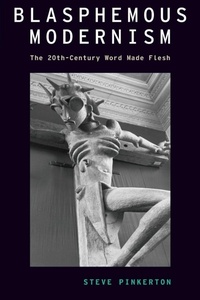
Blasphemous Modernism
The 20th-Century Word Made Flesh
Published on 22. June 2020
Book
Paperback/Softback
202 pages
978-0-19-752325-4 (ISBN)
Description
Scholars have long described modernism as "heretical" or "iconoclastic" in its assaults on secular traditions of form, genre, and decorum. Yet critics have paid surprisingly little attention to the related category of blasphemy--the rhetoric of religious offense--and to the specific ways this rhetoric operates in, and as, literary modernism. United by a shared commitment to "the word made flesh," writers such as James Joyce, Mina Loy, Richard Bruce Nugent, and Djuna Barnes made blasphemy a key component of their modernist practice, profaning the very scriptures and sacraments that fueled their art. In doing so they belied T. S. Eliot's verdict that the forces of secularization had rendered blasphemy obsolete in an increasingly godless century ("a world in which blasphemy is impossible"); their poems and fictions reveal how forcefully religion endured as a cultural force after the Death of God. More, their transgressions spotlight a politics of religion that has seldom engaged the attention of modernist studies. Blasphemy respects no division of church and state, and neither do the writers who wield it to profane all manner of coercive dogmas--including ecclesiastical as well as more worldly ideologies of race, class, nation, empire, gender, and sexuality. The late-century example of Salman Rushdie's The Satanic Verses affords, finally, a demonstration of how modernism persists in postwar anglophone literature and of the critical role blasphemy plays in that persistence. Blasphemous Modernism thus resonates with the broader cultural and ideological concerns that in recent years have enriched the scope of modernist scholarship.
Reviews / Votes
In its explorations of religion and blasphemy, Steve Pinkerton's Blasphemous Modernism: The 20th-Century Word Made Flesh interrogates and challenges common understandings of the period as uninterested in religion's primacy: it 'attends to the complex relationship in modernist texts between words, the Word, and the flesh'. Most compellingly, Pinkerton points to the ways that 'blasphemy is a barometer and a mechanism of power, a discourse governed by the powerful but also occasionally usurped by the marginalized in politically significant ways' * The Year's Work in English Studies * The author has done something undeniably important in explicating the blasphemous play of several important modernist artists. He has also opened the door for consideration of thenature and function of blasphemy in the work of authors who do sometimes validate the truth claims of religion - figures such as Flannery O'Connor, Graham Greene, Shusaku Endo, and Marilynne Robinson. One of the greatest accomplishments of Blasphemous Modernism is that it forces us to return to the scene of some of modernism's greatest crimes against God and ask, not for the first time, if any crime were actually committed. * Martin Lockerd, Modernism/Modernity * Pinkerton's study is textually focused and compiles a lively and readable collection of examples of blasphemy. ... an important contribution to rethinking the engagement of modernist writers with religion, and makes a persuasive case for the importance of blasphemy as a category of study in its own right. * Imogen Woodberry, Los Angeles Review of Books * Steve Pinkerton's Blasphemous Modernism is an important study of modernist writers' continuing engagement with religion in the early twentieth century * an era that is sometimes anachronistically treated as totally secularized. Pinkerton shows how writers from the mainstream and the margins of the modernist movement attacked religion because they took it so seriously. This impressive work has significant implications for our current cultural scene, in which accusations of blasphemy continue to have real-world consequences.Pericles Lewis, Yale University * At last! An intuitive and probing analysis of blasphemy and modernist writers, skillfully accomplished by exploring the real-world context of their works. This penetrating and lucid book pries apart the fundamental paradox of blasphemy within the modernist epoch * that the most forthright blasphemy effectively reinforces the power of the sacred over the imagination in a supposedly godless age.David Nash, Oxford Brookes University *
More details
Series
Language
English
Place of publication
New York
United States
Target group
Professional and scholarly
Illustrations
3 halftones
Dimensions
Height: 234 mm
Width: 156 mm
Thickness: 12 mm
Weight
353 gr
ISBN-13
978-0-19-752325-4 (9780197523254)
Copyright in bibliographic data and cover images is held by Nielsen Book Services Limited or by the publishers or by their respective licensors: all rights reserved.
Schweitzer Classification
Other editions
Additional editions
Book
04/2017
Oxford University Press Inc
€114.30
Shipment within 15-20 days
Person
Steve Pinkerton is a Lecturer in English at Case Western Reserve University.
Content
Introduction: "First-Rate Blasphemy"
1. "For This is My Body": James Joyce's Unholy Office
2. Blasphemy and the New Woman: Mina Loy's Profane Communions
3. Blasphemy and the New Negro: Black Christs,"Livid Tongues"
4. Go Down, Djuna: The Art of "Transcendence Downward"
Conclusion: To Be as Gods
Bibliography
1. "For This is My Body": James Joyce's Unholy Office
2. Blasphemy and the New Woman: Mina Loy's Profane Communions
3. Blasphemy and the New Negro: Black Christs,"Livid Tongues"
4. Go Down, Djuna: The Art of "Transcendence Downward"
Conclusion: To Be as Gods
Bibliography