

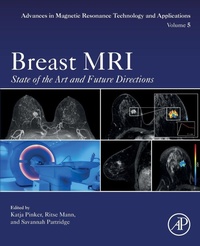
Breast MRI: Volume 5
State of the Art and Future Directions
Published on 22. September 2022
Book
Paperback/Softback
644 pages
978-0-12-822729-9 (ISBN)
Description
Breast MRI: State of the Art and Future Directions provides a comprehensive overview of the current applications of breast MRI, including abbreviated MRI, as well as presenting technical recommendations, practical implementation and associated challenges in clinical routine. In addition, the book introduces novel MRI techniques, multimodality imaging, and advanced image processing coupled with AI, reviewing their potential for impeding and future clinical implementation. This book is a complete reference on state-of-the-art breast MRI methods suitable for MRI researchers, radiographers and clinicians.
Breast cancer is one of the leading causes of death among women with early detection being the key to improved prognosis and survival. Magnetic resonance imaging (MRI) of the breast is undisputedly the most sensitive imaging method to detect cancer, with a higher detection rate than mammography, digital breast tomosynthesis, and ultrasound.
Breast cancer is one of the leading causes of death among women with early detection being the key to improved prognosis and survival. Magnetic resonance imaging (MRI) of the breast is undisputedly the most sensitive imaging method to detect cancer, with a higher detection rate than mammography, digital breast tomosynthesis, and ultrasound.
More details
Series
Language
English
Place of publication
San Diego
United States
Publishing group
Elsevier Science Publishing Co Inc
Target group
Professional and scholarly
MRI researchers with a background in physics, computer science, biomedical engineering, mathematics, biophysics
Radiologist, clinicians
Product notice
Paperback (trade)
Illustrations
105 illustrations (80 in full color); Illustrations
Dimensions
Height: 233 mm
Width: 189 mm
Thickness: 37 mm
Weight
1114 gr
ISBN-13
978-0-12-822729-9 (9780128227299)
Copyright in bibliographic data and cover images is held by Nielsen Book Services Limited or by the publishers or by their respective licensors: all rights reserved.
Schweitzer Classification
Other editions
Additional editions
E-Book
09/2022
Academic Press
€140.00
Available for download
Persons
Katja Pinker, MD, PhD, EBBI obtained her medical degree at the Medical University of Vienna in 2003. From 2005 until 2010 he was trained as a radiologist at the Department of Radiology at the Medical University of Vienna. Her focus on breast imaging began right after completing medical school in 2003 when she joined the research team of the Division of Molecular and Gender Imaging in Vienna, Austria. She benefitted from clinical research training in world-leading groups, including the Division of Molecular and Gender Imaging and the MR Centre of Excellence in the Department of Biomedical Imaging and Image-guided Therapy, the Breast Health Center at the Comprehensive Cancer Center, and the Pre-Clinical Imaging Laboratory, which endowed her with broad theoretical and practical knowledge in breast and cancer imaging, with a special focus on advanced magnetic resonance imaging (MRI). In 2008, she was awarded a European School of Radiology Visiting Scholarship at the Breast Unit, Barts and The London Cancer Centre, St. Bartholomew's Hospital, London in 2008, and consecutively was received as a research fellow at the London Breast Institute, Princess Grace Hospital, London, UK, in 2009. Ritse Mann MD, PhD, obtained his medical degree at the University of Utrecht in the Netherlands in 2004. In 2005 he started a PhD project to the value of breast MRI in invasive lobular carcinoma at the Radboud University Medical Centre in Nijmegen, where he was trained by the late prof. dr. Carla Boetes. From 2008 to 2013 he trained as a resident in radiology, followed by a fellowship in interventional radiology at the same institution, where he now works as breast and interventional radiologist. He is, since 2010, responsible for the clinical breast research at the radiology department of the Radboudumc. The breast imaging research group of the Radboudumc is one of the largest dedicated groups in Europe with large preclinical arms in x-ray development, ultrasound and artificial intelligence. Consequently, dr. Mann's research has a specific focus on the evaluation and implementation of novel breast imaging techniques. He also has a strong personal interest in breast MRI with a focus on the implementation of new sequences for breast screening. Savannah C. Partridge, Ph.D. is a Professor in the Departments of Radiology and Bioengineering, and the Research Director for Breast Imaging at the University of Washington School of Medicine. She is also the Associate Director of Cancer Imaging at the Seattle Cancer Care Alliance in Seattle, Washington, USA. Dr. Partridge is a leading expert in technique optimization and clinical validation of diffusion MRI of the breast. She is an active member in multiple international cancer and imaging cooperative groups and has led two large multi-institutional breast DWI clinical trials through the Eastern Cooperative Oncology Group - American College of Radiology Imaging Network (ECOG-ACRIN).
Editor
Associate Professor of Radiology and Faculty Member, Department of Biomedical Imaging and Image-guided Therapy, Division of Molecular and Gender Imaging, Medical University of Vienna, Austria
Department of Radiology, Radboud UMC, Nijmegen, The Netherlands
Professor, Department of Radiology, University of Washington, Seattle, WA, USA
Content
Section 1. Performance and Interpretation of Breast MRI
1. Breast Magnetic Resonance Imaging Protocols
i.Abbreviated and Ultrafast MRI
ii.Multiparametric MRI in clinical practice
2. Artifacts
3. BI-RADS
4. The Kaiser score: an evidence-based clinical decision rule for dynamic contrast-enhanced breast MRI
5. Background parenchymal enhancement
Section 2. MRI Characteristics of Common Breast Lesions
6. Benign
7. High-risk
8. DCIS
9. Invasive cancers
Section 3. Clinical Indications for Breast MRI
10. Screening
11. Staging and treatment planning
12. Response assessment to neoadjuvant therapy
13. Follow-up: Posttreatment changes and Recurrent Breast Cancer
14. Breast Augmentation and Post-mastectomy Autologous Breast Reconstruction
15. Problem Solving
16. Cancer of Unknown Primary including Imaging of the Axilla
Section 4: Breast Magnetic Resonance Imaging-guided Interventions and Therapy
17. Biopsy including MRI-directed US and rad-path correlation
18. Monitoring Therapy
Future Directons
Section 5. Advanced and Emerging Approaches
19. Non-contrast MRI
20. Ultra-high field magnets
21. Pharmacokinetic modelling
22. Diffusion MRI of the breast: standard and advanced techniques
23. Proton Magnetic Resonance Spectroscopy
24. Emerging MRI Techniques: CEST, BOLD, Sodium, Phospohorus MRS, Lipid MRS, HP MRI
Section 6: Hybrid Imaging and Alternative Techniques
25. PET/MRI hybrid imaging and targeted tracers
26. Alternative techniques: CEM and MBI
Section 7: Prognostic and Predictive MR imaging biomarkers
27. MRI Radiomics and Radiogenomics for Breast Cancer
28. Artificial Intelligence and Deep Learning
1. Breast Magnetic Resonance Imaging Protocols
i.Abbreviated and Ultrafast MRI
ii.Multiparametric MRI in clinical practice
2. Artifacts
3. BI-RADS
4. The Kaiser score: an evidence-based clinical decision rule for dynamic contrast-enhanced breast MRI
5. Background parenchymal enhancement
Section 2. MRI Characteristics of Common Breast Lesions
6. Benign
7. High-risk
8. DCIS
9. Invasive cancers
Section 3. Clinical Indications for Breast MRI
10. Screening
11. Staging and treatment planning
12. Response assessment to neoadjuvant therapy
13. Follow-up: Posttreatment changes and Recurrent Breast Cancer
14. Breast Augmentation and Post-mastectomy Autologous Breast Reconstruction
15. Problem Solving
16. Cancer of Unknown Primary including Imaging of the Axilla
Section 4: Breast Magnetic Resonance Imaging-guided Interventions and Therapy
17. Biopsy including MRI-directed US and rad-path correlation
18. Monitoring Therapy
Future Directons
Section 5. Advanced and Emerging Approaches
19. Non-contrast MRI
20. Ultra-high field magnets
21. Pharmacokinetic modelling
22. Diffusion MRI of the breast: standard and advanced techniques
23. Proton Magnetic Resonance Spectroscopy
24. Emerging MRI Techniques: CEST, BOLD, Sodium, Phospohorus MRS, Lipid MRS, HP MRI
Section 6: Hybrid Imaging and Alternative Techniques
25. PET/MRI hybrid imaging and targeted tracers
26. Alternative techniques: CEM and MBI
Section 7: Prognostic and Predictive MR imaging biomarkers
27. MRI Radiomics and Radiogenomics for Breast Cancer
28. Artificial Intelligence and Deep Learning