

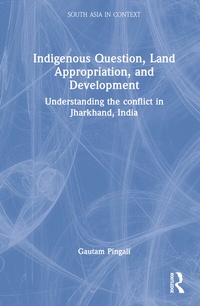
Indigenous Question, Land Appropriation, and Development
Understanding the Conflict in Jharkhand, India
1st Edition
Published on 27. December 2022
Book
Hardback
146 pages
978-1-032-32641-2 (ISBN)
Description
This book provides a first-hand account of land conflict and power relations in one of the most resource-rich states in India - Jharkhand. Through the eyes of the state, corporate, and indigenous actors, it reveals how conflict over land in Jharkhand is firmly embedded in the ideological foundations of the key actors in the region. Based on thorough research on the ground and interviews with state, corporate, and indigenous actors, the book explores a host of themes such as: the need and efficacy of state-led modernisation programmes, the market as the best regulator, and 'ideas' of development. The volume highlights how land conflicts in Jharkhand will persist until the ideological differences are recognised and welcomed in hopes of making way for collaborative governance.
This work will be a key intervention in the fields of area studies, especially South Asian studies, public policy, politics, and development studies.
This work will be a key intervention in the fields of area studies, especially South Asian studies, public policy, politics, and development studies.
Reviews / Votes
"This book focuses on the most pertinent issues in Jharkhand to analyse ongoing contests for control over and access to minerals, land, water and forests, between the Adivasis, corporates and the state. It is therefore essential reading for those interested in debates over ideas and practices of development in India and beyond."- Amit Prakash, Centre for the Study of Law and Governance, Jawaharlal Nehru University, India
"This book is a fascinating and poignant account of the encounter between a modernist postcolonial state and the Adivasi population of Jharkhand. It explores the crises that occur when development models, depending on resource extraction and favoured by both the state and corporations, ignore Adivasi rights and connections to their lands and forests. While Adivasis are protected by their special status of 'Scheduled Tribes' in the Indian constitution, paradoxically, this identification also constructs them as backward and ripe for modernist intervention, leading to various forms of overt and creative resistance."
- Devleena Ghosh, School of Communications, Faculty of Arts and Social Sciences, University of Technology Sydney, Australia
More details
Series
Language
English
Place of publication
London
United Kingdom
Publishing group
Taylor & Francis Ltd
Target group
College/higher education
Professional and scholarly
Postgraduate
Illustrations
8 s/w Abbildungen, 8 s/w Zeichnungen
8 Line drawings, black and white; 8 Illustrations, black and white
Dimensions
Height: 234 mm
Width: 156 mm
Weight
453 gr
ISBN-13
978-1-032-32641-2 (9781032326412)
Copyright in bibliographic data and cover images is held by Nielsen Book Services Limited or by the publishers or by their respective licensors: all rights reserved.
Schweitzer Classification
Other editions
Additional editions
Gautam Pingali
Indigenous Question, Land Appropriation, and Development
Understanding the Conflict in Jharkhand, India
Book
12/2022
1st Edition
Routledge India
€69.59
Shipment within 10-20 days
Peter J. Kitson
Indigenous Question, Land Appropriation, and Development
Understanding the Conflict in Jharkhand, India
E-Book
12/2022
1st Edition
Routledge India
€52.49
Available for download
Gautam Pingali
Indigenous Question, Land Appropriation, and Development
Understanding the Conflict in Jharkhand, India
E-Book
12/2022
1st Edition
Routledge India
€52.49
Available for download
Person
Gautam Pingali completed his doctoral dissertation at the University of Technology Sydney, with a specific focus on the impact of mining on indigenous communities. He grew up in Jharkhand, India and frequently witnessed first-hand indigenous protests resulting in city-wide 'bandhs' or strikes. As a social researcher, Gautam sought to develop a deeper understanding of the indigenous resistance movement in Jharkhand. His research findings shed light on the nature and dynamics of power relations at play between the state, corporations, and indigenous communities in Jharkhand. He currently works at Supply Nation in Sydney, Australia as a Program and Evaluation Manager focused on empowering indigenous businesses.
Content
Foreword by Kuntala Lahiri-Dutt. Preface. 1. Introducing the conflict 2. Adivasis in colonial and post-colonial India 3. Development in post-colonial India 4. Removing Adivasis from the Adivasi state 5. Agriculture - 'backward' economy in the eyes of the state 6. Corporations - pressures, threats, and ultimatums 7. Adivasis - the question of resistance versus persistence 8. Violent and bloodied realities of ideologies in Jharkhand 9. The way forward for Jharkhand 10. Closing remarks. References