

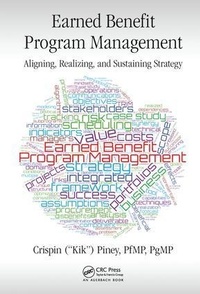
Earned Benefit Program Management
Aligning, Realizing, and Sustaining Strategy
1st Edition
Published on 5. October 2017
Book
Hardback
394 pages
978-1-138-03312-2 (ISBN)
Description
No one can disagree that benefits are good things. Whether you are responsible for projects, programs, or portfolios, you are increasingly expected to think-and act-in an appropriate benefits-driven way. However:
Do you understand that what may be appropriate for a project may be inapplicable for a program?
Can you avoid the trap of wishful thinking based on overinflated expectations and underestimated costs?
Can you manage your program or portfolio from inception to final delivery in a consistent, benefits-focused way based on a single, coherent model?
This book describes how Earned Benefit Program Management techniques provide an innovative, all-inclusive model and set of tools developed specifically to answer these questions. This model consolidates the key concepts of project, program, and portfolio management and ensures that all program and portfolio management steps are carried out based on a single, signed-off model in a consistent, verifiable manner within a consolidated life cycle. This approach guarantees alignment with strategic goals and constraints through every stage of a program.
Case studies highlight the key features of the approach and provide important lessons and insights for managing programs. Although the ideas and concepts for each topic are fully consistent with existing standards and other published material, they are based on new thinking and go beyond current practice. They provide a set of original and powerful techniques that are applicable to both programs and portfolios in a wide range of business environments.
Do you understand that what may be appropriate for a project may be inapplicable for a program?
Can you avoid the trap of wishful thinking based on overinflated expectations and underestimated costs?
Can you manage your program or portfolio from inception to final delivery in a consistent, benefits-focused way based on a single, coherent model?
This book describes how Earned Benefit Program Management techniques provide an innovative, all-inclusive model and set of tools developed specifically to answer these questions. This model consolidates the key concepts of project, program, and portfolio management and ensures that all program and portfolio management steps are carried out based on a single, signed-off model in a consistent, verifiable manner within a consolidated life cycle. This approach guarantees alignment with strategic goals and constraints through every stage of a program.
Case studies highlight the key features of the approach and provide important lessons and insights for managing programs. Although the ideas and concepts for each topic are fully consistent with existing standards and other published material, they are based on new thinking and go beyond current practice. They provide a set of original and powerful techniques that are applicable to both programs and portfolios in a wide range of business environments.
More details
Series
Language
English
Place of publication
London
United Kingdom
Publishing group
Taylor & Francis Ltd
Target group
Professional and scholarly
Product notice
sewn/stitched
Cloth over boards
Illustrations
100 s/w Abbildungen
100 Illustrations, black and white
Dimensions
Height: 257 mm
Width: 185 mm
Thickness: 25 mm
Weight
880 gr
ISBN-13
978-1-138-03312-2 (9781138033122)
Copyright in bibliographic data and cover images is held by Nielsen Book Services Limited or by the publishers or by their respective licensors: all rights reserved.
Schweitzer Classification
Other editions
Additional editions
Book
01/2023
1st Edition
Auerbach
€79.41
Shipment within 10-20 days
E-Book
10/2017
Auerbach
€62.99
Available for download
E-Book
10/2017
Auerbach
€63.49
Available for download
Person
Crispin Piney (known as "Kik") has been involved in the project world since joining the IT Group at CERN, the European Laboratory for Particle Physics, in the 1970s, working on cutting-edge development projects. He later moved to the Digital Equipment Corporation (DEC), initially in England, before relocating to DEC's European technical centre in the south of France. While he was with DEC, Kik gained a deeper understanding of the importance of methodology, business alignment, and stakeholder relationship management.
After the acquisition of DEC by Compaq, Kik left in 2000 and set up as an independent consultant and trainer in project management. He invested enthusiasm, time, and effort working as a volunteer with the Project Management Institute (PMI (R)) on the majority of their standardization efforts, from the Organizational Project Development Management Maturity Model (OPM3 (R)) through each the standards for projects, for programs, and for portfolio management (he was listed as a "significant contributor" for the first edition of both the program and the portfolio standards). He also contributed actively to the PMI competency development framework, the lexicon, and the Practice Guide for Scheduling. He is one of the three authors of PMI (R)'s Practice Guide for Project Risk Management. Kik gained his Project Management Professional (PMP (R)) certification with PMI prior to leaving DEC. He later became the first person in France to acquire the corresponding certifications for programs (PgMP (R)) and, when it became available, for portfolios (PfMP (R)).
He has published a number of articles ranging across all aspects of projects, programs, and portfolios. He has presented at most PMI (R) EMEA congresses since 2002, as well as at regional events. Additionally, Kik provides training on a wide range of topics in the project management space. He has developed and delivered courses across a broad range of industries including construction, perfumery, information technology, steelworks, aviation, packaging, electronics, and banking. His approach to understanding and expanding the field of knowledge in the area of project, program, and portfolio management is based on the following principles:
The need for alignment between all domains in order to ensure consistency
The need for clarity and precision in order to avoid misunderstandings
The willingness to generalize and expand valid concepts in order to increase their generality and potential value
The willingness to reject ideas and beliefs, however well established, that are based on false or doubtful premises, and to discover creative, verifiable alternatives with which to replace them
And, finally, the wish to share his enjoyment of the subject and, wherever possible, his sense of fun
After the acquisition of DEC by Compaq, Kik left in 2000 and set up as an independent consultant and trainer in project management. He invested enthusiasm, time, and effort working as a volunteer with the Project Management Institute (PMI (R)) on the majority of their standardization efforts, from the Organizational Project Development Management Maturity Model (OPM3 (R)) through each the standards for projects, for programs, and for portfolio management (he was listed as a "significant contributor" for the first edition of both the program and the portfolio standards). He also contributed actively to the PMI competency development framework, the lexicon, and the Practice Guide for Scheduling. He is one of the three authors of PMI (R)'s Practice Guide for Project Risk Management. Kik gained his Project Management Professional (PMP (R)) certification with PMI prior to leaving DEC. He later became the first person in France to acquire the corresponding certifications for programs (PgMP (R)) and, when it became available, for portfolios (PfMP (R)).
He has published a number of articles ranging across all aspects of projects, programs, and portfolios. He has presented at most PMI (R) EMEA congresses since 2002, as well as at regional events. Additionally, Kik provides training on a wide range of topics in the project management space. He has developed and delivered courses across a broad range of industries including construction, perfumery, information technology, steelworks, aviation, packaging, electronics, and banking. His approach to understanding and expanding the field of knowledge in the area of project, program, and portfolio management is based on the following principles:
The need for alignment between all domains in order to ensure consistency
The need for clarity and precision in order to avoid misunderstandings
The willingness to generalize and expand valid concepts in order to increase their generality and potential value
The willingness to reject ideas and beliefs, however well established, that are based on false or doubtful premises, and to discover creative, verifiable alternatives with which to replace them
And, finally, the wish to share his enjoyment of the subject and, wherever possible, his sense of fun
Content
1. De?ning the Domains. 2. Understanding the Problem. 3. A Life Cycle for Program Management, Bene?ts Management,. and Business Analysis. 4. Building an Integrated Business Model. 5. Calculating the Model. 6. Disbene?ts and Essential Links. 7. Applying the BRM Approach to the QERTS Example. 8. A Generalized Approach to Scheduling and Cash Flow. 9. Total Risk and Issue Management. 10 Resource Capacity Planning. 11. Procurement. 12. Implementation Tracking-Earned Bene?t. 13. Business Key Performance Indicators. 14. Stakeholder Analysis. 15. Communication-Why, How, and What. inale. Bene?t Mapping the Book. Appendix. Carrying Out the Calculations. Acronyms. Glossary. Bibliography.