

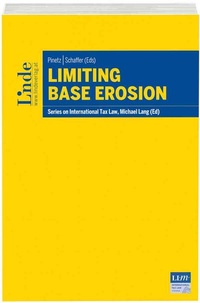
Limiting Base Erosion
Seris on International Tax Law, Volume 104
1st Edition
Published on 8. August 2017
Book
Paperback/Softback
568 pages
978-3-7073-3758-7 (ISBN)
Description
Limiting base erosion from different viewpoints
Hybrid mismatch arrangements, CFC rules, transfer pricing rules: "Limiting Base Erosion", the general topic for the master theses of the part-time LL.M. program 2015-2017, has been one of the most controversial topics in international tax law ever since the initiation of the OECD BEPS Project in 2013. Even though the final reports of the 15 BEPS Actions were released by the OECD in as early as October 2015, the question how to effectively target base erosion practices still has not lost any of its topicality. Following the efforts of the OECD in developing a new international tax environment, the focus of attention has now partly shifted to the OECD Member countries that have to properly implement the OECD recommendations in their domestic laws as well as in their tax treaty practice. In this respect, a comprehensive analysis in the literature of all the issues related to base erosion proves to be of the utmost importance in order to provide practical guidance to the Member countries during that the process of implementation.
This book deals especially with four key areas of interest:
Base erosion and the challenges they present: read more in "Limiting Base Erosion".
Hybrid mismatch arrangements, CFC rules, transfer pricing rules: "Limiting Base Erosion", the general topic for the master theses of the part-time LL.M. program 2015-2017, has been one of the most controversial topics in international tax law ever since the initiation of the OECD BEPS Project in 2013. Even though the final reports of the 15 BEPS Actions were released by the OECD in as early as October 2015, the question how to effectively target base erosion practices still has not lost any of its topicality. Following the efforts of the OECD in developing a new international tax environment, the focus of attention has now partly shifted to the OECD Member countries that have to properly implement the OECD recommendations in their domestic laws as well as in their tax treaty practice. In this respect, a comprehensive analysis in the literature of all the issues related to base erosion proves to be of the utmost importance in order to provide practical guidance to the Member countries during that the process of implementation.
This book deals especially with four key areas of interest:
- Limiting base erosion by neutralizing the effects of hybrid mismatch arrangements
- Limiting base erosion by strengthening CFC rules
- Measures against base erosion via interest deductions and other financial payments
- Limiting base erosion by improving transfer pricing rules.
Base erosion and the challenges they present: read more in "Limiting Base Erosion".
More details
Persons
Editor
ist als geschäftsführender Gesellschafter Rechtsanwalt und Steuerberater in Neusiedl am See. Der Schwerpunkt der Beratungs- und Berufstätigkeit liegt im Immobilien- und Immobiliensteuerrecht sowie im Bereich der damit verbundenen Rechtsverkehrssteuern. In diesen Bereichen ist Dr. Pinetz als Fachvortragender tätig und als Fachautor hat er an zahlreichen Publikationen mitgewirkt bzw. selbst veröffentlicht. Am Institut für österreichisches und internationales Steuerrecht der WU Wien ist er als Lehrbeauftragter tätig.
Steuerberater und Geschäftsführer der WTS Tax Service Steuerberatungsgesellschaft in Wien sowie Lehrbeauftragter am Institut für Österreichisches und Internationales Steuerrecht der WU Wien, Fachautor und Fachvortragender. Seine Beratungsschwerpunkte liegen in den Bereichen Konzernsteuerrecht, internationales Steuerrecht, Steuerfragen iZm Immobilien sowie Rechtsverkehrsteuern.