

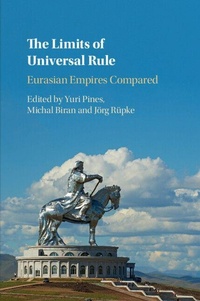
The Limits of Universal Rule
Eurasian Empires Compared
Published on 15. December 2022
Book
Paperback/Softback
412 pages
978-1-108-72682-5 (ISBN)
Description
All major continental empires proclaimed their desire to rule 'the entire world', investing considerable human and material resources in expanding their territory. Each, however, eventually had to stop expansion and come to terms with a shift to defensive strategy. This volume explores the factors that facilitated Eurasian empires' expansion and contraction: from ideology to ecology, economic and military considerations to changing composition of the imperial elites. Built around a common set of questions, a team of leading specialists systematically compare a broad set of Eurasian empires - from Achaemenid Iran, the Romans, Qin and Han China, via the Caliphate, the Byzantines and the Mongols to the Ottomans, Safavids, Mughals, Russians, and Ming and Qing China. The result is a state-of-the art analysis of the major imperial enterprises in Eurasian history from antiquity to the early modern that discerns both commonalities and differences in the empires' spatial trajectories.
Reviews / Votes
'By considering a range of factors that influenced the expansion and contraction of ancient Eurasian empires, including ideological, military, economic, political and ecological, this book offers fascinating new insights into the study of empires, and also points historians towards exciting new directions in the developing field of comparative imperial analysis.' Craig Benjamin, author of Empires of Ancient Eurasia: The First Silk Roads Era, 100 BCE - 250 CE 'Ranging across time and space, this volume offers a timely investigation of the limits of universal imperial claims and constitutes an especially valuable critical contribution to comparative imperial studies. These essays add vibrancy to an already exciting field and open new areas of discussion that will further stimulate historical research.' Nicola Di Cosmo, author of Ancient China and Its Enemies: The Rise of Nomadic Power in East Asian History 'A captivating collection of essays about empires of the past and the factors that determined their territorial extent. Alongside a few familiar examples, such as Rome and the Mongols, are many little-studied empires in the Islamic world, Russia, and China. Consistently compelling reading.' Valerie Hansen, author of The Year 1000: When Explorers Connected the Globe-and Globalization BeganMore details
Language
English
Place of publication
Cambridge
United Kingdom
Target group
Professional and scholarly
Product notice
Paperback (trade)
Illustrations
Worked examples or Exercises
Dimensions
Height: 225 mm
Width: 155 mm
Thickness: 23 mm
Weight
568 gr
ISBN-13
978-1-108-72682-5 (9781108726825)
Copyright in bibliographic data and cover images is held by Nielsen Book Services Limited or by the publishers or by their respective licensors: all rights reserved.
Schweitzer Classification
Other editions
Additional editions
Book
01/2021
Cambridge University Press
€105.50
Shipment within 15-20 days
Persons
Content
Foreword; Introduction. Empires and their Space Yuri Pines, with Michal Biran and Joerg Ruepke; 1. From the Mediterranean to the Indus Valley: Modalities and Limitations of the Achaemenid Imperial Space Pierre Briant; 2. Limits of All-under-Heaven: Ideology and Praxis of 'Great Unity' in Early Chinese Empire Yuri Pines; 3. The Roman Empire Wolfgang Spickermann; 4. The Medieval Roman Empire of the East as Spatial Phenomenon (300-1204 CE) Johannes Preiser-Kapeller; 5. Early Islamic Imperial Space A. C. S. Peacock; 6. The Mongol Imperial Space: From Universalism to Glocalization Michal Biran; 7. The Territories and Boundaries of Empires: Ottoman, Safavid and Mughal Stephen F. Dale; 8. Delimiting the Realm under the Ming Dynasty David M. Robinson; 9. The Expansion of the Qing Empire Before 1800 Matthew W. Mosca; 10. All under the Tsar: Russia's Eurasian Trajectory Jane Burbank.