

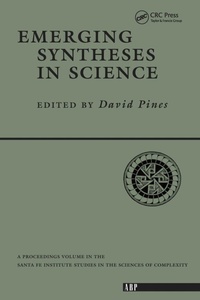
Emerging Syntheses In Science
Proceedings of the Founding Workshops of the Santa Fe Institute Santa Fe, New Mexico
1st Edition
Published on 22. January 1988
Book
Paperback/Softback
250 pages
978-0-201-15686-7 (ISBN)
Description
Evolution of self-replicating macromolecules through natural selection is a dynamically ordered process. Two concepts are introduced to describe the physical regularity of macromolecular evolution: sequence space and quasi-species. Natural selection means localization of a mutant distribution in sequence space. This localized distribution, called the quasi-species, is centered around a master sequence (or a degenerate set), that the biologist would call the wild-type. The self-ordering of such a system is an essential consequence of its formation through self-reproduction of its macromolecular consti tuents, a process that in the dynamical equations expresses itself by positive diagonal coefficients called selective values. The theory describes how population numbers of wild type and mutants are related to the distribution of selective values, that is to say, how value topography maps into population topography. For selectively (nearly) neutral mutants appearing in the quasi- species distribution, population numbers are greatly enhanced as compared to those of disadvantageous mutants, even more so in continuous domains of such selectively valuable mutants. As a consequence, mutants far distant from the wild type may occur because they are produced with the help of highly populated, less distant precursors. Since values are cohesively distributed, like mountains on earth, and since their positions are multiply connected in the high-dimensional sequence space, the overpopulation of (nearly) neural mutants provides guidance for the evolutionary process. Localization in sequence space, subject to a threshold in the fidelity of reproduction, is steadily challenged until an optimal state is reached. The model has been designed according to experimentally determined properties of self-replicating molecules. The conclusions reached from the theoretical models can be used to construct machines that provide optimal conditions for the evolution of functional macromolecules.
More details
Language
English
Place of publication
Oxford
United States
Publishing group
Taylor & Francis Inc
Target group
College/higher education
Professional and scholarly
Product notice
Paperback (UK-trade)
Dimensions
Height: 229 mm
Width: 152 mm
Thickness: 14 mm
Weight
368 gr
ISBN-13
978-0-201-15686-7 (9780201156867)
Copyright in bibliographic data and cover images is held by Nielsen Book Services Limited or by the publishers or by their respective licensors: all rights reserved.
Schweitzer Classification
Other editions
Additional editions

David Pines
Emerging Syntheses In Science
Proceedings of the Founding Workshops of the Santa Fe Institute Santa Fe, New Mexico
Book
09/2019
1st Edition
CRC Press
€132.50
Shipment within 15-20 days
David Pines
Emerging Syntheses In Science
E-Book
03/2018
1st Edition
CRC Press
€47.49
Available for download
Person
David Pines is research professor of physics at the University of Illinois at Urbana-Champaign. He has made pioneering contributions to an understanding of many-body problems in condensed matter and nuclear physics, and to theoretical astrophysics. Editor of Perseus' Frontiers in Physics series and former editor of American Physical Society's Reviews of Modern Physics, Dr. Pines is a member of the National Academy of Sciences, the American Philosophical Society, a foreign member of the USSR Academy of Sciences, a fellow of the American Academy of Arts and Sciences, and of the American Association for the Advancement of Science. Dr. Pines has received a number of awards, including the Eugene Feenberg Memorial Medal for Contributions to Many-Body Theory; the P.A.M. Dirac Silver Medal for the Advancement of Theoretical Physics; and the Friemann Prize in Condensed Matter Physics.
Content
"Foreword -- The Concept of the Institute 1 -- Spin Glass Hamiltonians: A Bridge Between Biology, Statistical Mechanics and Computer Science -- Macromolecular Evolution: Dynamical Ordering in Sequence Space -- Evolutionary Theory of Genotypes and Phenotypes: Towards a Mathematical Synthesis 1 -- Prospects for a Synthesis in the Human Behavioral Sciences -- The Emergence of Evolutionary Psychology -- War in Evolutionary Perspective -- The Relationship of Modern Archeology to Other Disciplines -- Reconstructing the Past through Chemistry -- The Conscious and Unconscious Stream of Thought -- Emerging Syntheses in Science: Conscious and Unconscious Processes -- Brain Mechanisms Underlying Visual Hallucinations -- Solitons in Biological Molecules 1 -- The New Biology and its Human Implications -- Biomolecules -- Computing With Attractors: From Self-repairing Computers, to Ultradiffusion, and the Application of Dynamical Systems to Human Behavior -- Fundamental Physics, Mathematics and Astronomy -- Complex Systems Theory
1 -- Mathematics and the Sciences -- Applications of Mathematics to Theoretical Computer Science -- Linguistics and Computing -- Dissipation, Information, Computational Complexity and the Definition of Organization -- Plans for the Future"
1 -- Mathematics and the Sciences -- Applications of Mathematics to Theoretical Computer Science -- Linguistics and Computing -- Dissipation, Information, Computational Complexity and the Definition of Organization -- Plans for the Future"