

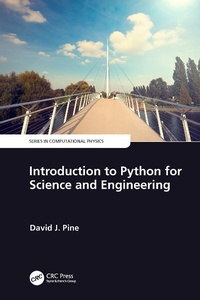
Introduction to Python for Science and Engineering
1st Edition
Published on 4. December 2018
Book
Hardback
388 pages
978-1-138-58390-0 (ISBN)
Description
Series in Computational Physics
Steven A. Gottlieb and Rubin H. Landau, Series Editors
Introduction to Python for Science and Engineering
This guide offers a quick and incisive introduction to Python programming for anyone. The author has carefully developed a concise approach to using Python in any discipline of science and engineering, with plenty of examples, practical hints, and insider tips.
Readers will see why Python is such a widely appealing program, and learn the basics of syntax, data structures, input and output, plotting, conditionals and loops, user-defined functions, curve fitting, numerical routines, animation, and visualization. The author teaches by example and assumes no programming background for the reader.
David J. Pine is the Silver Professor and Professor of Physics at New York University, and Chair of the Department of Chemical and Biomolecular Engineering at the NYU Tandon School of Engineering. He is an elected fellow of the American Physical Society and American Association for the Advancement of Science (AAAS), and is a Guggenheim Fellow.
Steven A. Gottlieb and Rubin H. Landau, Series Editors
Introduction to Python for Science and Engineering
This guide offers a quick and incisive introduction to Python programming for anyone. The author has carefully developed a concise approach to using Python in any discipline of science and engineering, with plenty of examples, practical hints, and insider tips.
Readers will see why Python is such a widely appealing program, and learn the basics of syntax, data structures, input and output, plotting, conditionals and loops, user-defined functions, curve fitting, numerical routines, animation, and visualization. The author teaches by example and assumes no programming background for the reader.
David J. Pine is the Silver Professor and Professor of Physics at New York University, and Chair of the Department of Chemical and Biomolecular Engineering at the NYU Tandon School of Engineering. He is an elected fellow of the American Physical Society and American Association for the Advancement of Science (AAAS), and is a Guggenheim Fellow.
Reviews / Votes
"A comprehensive introduction and a practical guide to the Python programming language for scientists and engineers. Chapters intuitively introduce programming concepts around scientific problems. This approach resonates with scientists and engineers and helps them understand programming paradigms faster." --Ana Bell, PhD, Electrical Engineering and Computer Science, Massachusetts Institute of TechnologyMore details
Series
Language
English
Place of publication
London
United Kingdom
Publishing group
Taylor & Francis Ltd
Target group
College/higher education
Professional and scholarly
Academic, Professional, Professional Practice & Development, and Undergraduate
Product notice
sewn/stitched
Cloth over boards
Illustrations
75 s/w Abbildungen, 15 s/w Photographien bzw. Rasterbilder, 59 s/w Zeichnungen, 12 s/w Tabellen
12 Tables, black and white; 59 Line drawings, black and white; 15 Halftones, black and white; 75 Illustrations, black and white
Dimensions
Height: 236 mm
Width: 160 mm
Thickness: 25 mm
Weight
680 gr
ISBN-13
978-1-138-58390-0 (9781138583900)
Copyright in bibliographic data and cover images is held by Nielsen Book Services Limited or by the publishers or by their respective licensors: all rights reserved.
Schweitzer Classification
Other editions
Additional editions
David J. Pine
Introduction to Python for Science and Engineering
Book
12/2018
1st Edition
CRC Press
€69.50
Article exhausted; check different version
Person
David J. Pine is the Silver Professor and Professor of Physics at New York University, as well as Chair of the Department of Chemical and Biomolecular Engineering at the NYU Tandon School of Engineering. He earned his PhD in physics from Cornell University and has been invited professor at ESPCI in Paris, France, and the University of Strasbourg. He has also served as a visiting scientist at Exxon Research and Engineering. He is recipient of numerous honors, including Fellow of the American Association for the Advancement of Science, Guggenheim Fellow, and Fellow of the American Physical Society.
Content
1. Introduction. 2. Launching Python. 3. Strings, Lists, Arrays, and Dictionaries. 4. Input and Output. 5. Conditionals and Loops. 6. Plotting 7. Functions. 8. Curve Fitting. 9. Numerical Routines: SciPy and NumPy. 10. Data Manipulation and Analysis: Pandas. 11. Animation. 12. Python Classes & GUIs Appendix A. Installing Python. Appendix B. Jupyter notebooks. Appendix C. Glossary Appendix D. Python Resources.