

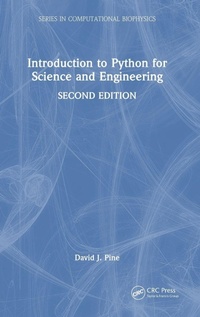
Introduction to Python for Science and Engineering
2nd Edition
Published on 23. September 2024
Book
Hardback
420 pages
978-1-032-65033-3 (ISBN)
Description
Introduction to Python for Science and Engineering offers a quick and incisive introduction to the Python programming language for use in any science or engineering discipline. The approach is pedagogical and "bottom up," which means starting with examples and extracting more general principles from that experience. No prior programming experience is assumed.
Readers will learn the basics of Python syntax, data structures, input and output, conditionals and loops, user-defined functions, plotting, animation, and visualization. They will also learn how to use Python for numerical analysis, including curve fitting, random numbers, linear algebra, solutions to nonlinear equations, numerical integration, solutions to differential equations, and fast Fourier transforms.
Readers learn how to interact and program with Python using JupyterLab and Spyder, two simple and widely used integrated development environments.
All the major Python libraries for science and engineering are covered, including NumPy, SciPy, Matplotlib, and Pandas. Other packages are also introduced, including Numba, which can render Python numerical calculations as fast as compiled computer languages such as C but without their complex overhead.
Readers will learn the basics of Python syntax, data structures, input and output, conditionals and loops, user-defined functions, plotting, animation, and visualization. They will also learn how to use Python for numerical analysis, including curve fitting, random numbers, linear algebra, solutions to nonlinear equations, numerical integration, solutions to differential equations, and fast Fourier transforms.
Readers learn how to interact and program with Python using JupyterLab and Spyder, two simple and widely used integrated development environments.
All the major Python libraries for science and engineering are covered, including NumPy, SciPy, Matplotlib, and Pandas. Other packages are also introduced, including Numba, which can render Python numerical calculations as fast as compiled computer languages such as C but without their complex overhead.
More details
Series
Edition
2nd edition
Language
English
Place of publication
London
United Kingdom
Publishing group
Taylor & Francis Ltd
Target group
College/higher education
Professional and scholarly
Professional Practice & Development and Undergraduate Advanced
Illustrations
24 s/w Abbildungen, 78 farbige Abbildungen, 10 s/w Photographien bzw. Rasterbilder, 10 Farbfotos bzw. farbige Rasterbilder, 14 s/w Zeichnungen, 68 farbige Zeichnungen, 14 s/w Tabellen
14 Tables, black and white; 68 Line drawings, color; 14 Line drawings, black and white; 10 Halftones, color; 10 Halftones, black and white; 78 Illustrations, color; 24 Illustrations, black and white
Dimensions
Height: 240 mm
Width: 161 mm
Thickness: 28 mm
Weight
828 gr
ISBN-13
978-1-032-65033-3 (9781032650333)
Copyright in bibliographic data and cover images is held by Nielsen Book Services Limited or by the publishers or by their respective licensors: all rights reserved.
Schweitzer Classification
Other editions
Additional editions
David J. Pine
Introduction to Python for Science and Engineering
E-Book
09/2024
2nd Edition
CRC Press
€73.99
Available for download
David J. Pine
Introduction to Python for Science and Engineering
Book
09/2024
2nd Edition
CRC Press
€80.90
Shipment within 10-20 days
David J. Pine
Introduction to Python for Science and Engineering
E-Book
09/2024
2nd Edition
CRC Press
€73.99
Available for download
Person
David J. Pine has taught physics and chemical engineering for over 40 years at four different institutions: Cornell University (as a graduate student), Haverford College, UCSB, and NYU, where he is a Professor of Physics, Mathematics, and Chemical & Biomolecular Engineering. He has taught a broad spectrum of courses, including numerical methods. He does research on optical materials and in experimental soft-matter physics, which is concerned with materials such as polymers, emulsions, and colloids.
Content
1. Introduction
2. Launching Python
3. Integrated Development Environments
4. Strings, Lists, Arrays, and Dictionaries
5. Input and Output
6. Conditionals and Loops
7. Functions
8. Plotting
9. Numerical Routines: SciPy and NumPy
10. Python Classes: Encapsulation
11. Data Manipulation and Analysis: Pandas
12. Animation
13. Speeding up numerical calculations
Appendix A Maintaining your installation Python
Appendix B Glossary
Appendix C Python Resources
Index Index
2. Launching Python
3. Integrated Development Environments
4. Strings, Lists, Arrays, and Dictionaries
5. Input and Output
6. Conditionals and Loops
7. Functions
8. Plotting
9. Numerical Routines: SciPy and NumPy
10. Python Classes: Encapsulation
11. Data Manipulation and Analysis: Pandas
12. Animation
13. Speeding up numerical calculations
Appendix A Maintaining your installation Python
Appendix B Glossary
Appendix C Python Resources
Index Index