

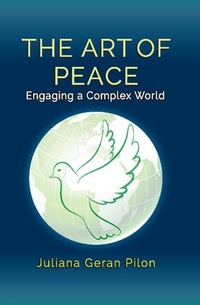
The Art of Peace
Engaging a Complex World
1st Edition
Published on 30. November 2016
Book
Hardback
414 pages
978-1-4128-6423-7 (ISBN)
Description
Sun Tzu, author of 'The Art of War', believed that the acme of leadership consists in figuring out how to subdue the enemy with the least amount of fighting-a fact that America's Founders also understood, and practiced with astonishing success. For it to work, however, a people must possess both the ability and the willingness to use all available instruments of power in peace as much as in war. US foreign policy has increasingly neglected the instruments of civilian power and become overly dependent on lethal solutions to conflict. The steep rise in unconventional conflict has increased the need for diplomatic and other non-hard power tools of statecraft. The United States can no longer afford to sit on the proverbial three-legged national security stool ("military, diplomacy, development"), where one leg is a lot longer than either of the other two, almost forgetting altogether the fourth leg-information, especially strategic communication and public diplomacy. The United States isn't so much becoming militarized as DE civilianized. According to Sun Tzu, self-knowledge is as important as knowledge of one's enemy: "if you know neither yourself nor the enemy, you will succumb in every battle." Alarmingly, the United States is deficient on both counts. And though we can stand to lose a few battles, the stakes of losing the war itself in this age of nuclear proliferation are too high to contemplate.
Reviews / Votes
"[A] compelling overview of the severe deficiencies in US national security strategy, policy, and operations - it is one of the strongest indictments I have seen of our total inability to wage peace instead of war... essential reading for the war colleges, business schools, and graduate programs that wish to offer their students material relevant to creating a prosperous world at peace." - Robert David Steele, Public Intelligence Blog "If I could recommend one book to the Trump Transition Team it would be Dr. Juliana Geran Pilon's The Art of Peace: Engaging in Complex World. I am partial to anyone who can write about Sun Tzu and apply the Art of War to contemporary strategy. However, most such attempts use Sun Tzu as a gimmick to gain attention. Not so with The Art of Peace. Dr. Pilon masterfully uses Sun Tzu to illustrate the problems we have with strategic thought and reminds us of the timeless elements of strategy that are arguably more relevant today than at any time in history. I am even more partial to anyone who can combine Sun Tzu and the Founding Fathers to discuss national security strategy and Dr. Pilon masterfully incorporates American history and political philosophy into her work." - David S. Maxwell, Small Wars JournalMore details
Language
English
Place of publication
New York
United States
Publishing group
Taylor & Francis Inc
Target group
Professional and scholarly
Dimensions
Height: 240 mm
Width: 161 mm
Thickness: 27 mm
Weight
784 gr
ISBN-13
978-1-4128-6423-7 (9781412864237)
Copyright in bibliographic data and cover images is held by Nielsen Book Services Limited or by the publishers or by their respective licensors: all rights reserved.
Schweitzer Classification
Other editions
Additional editions
E-Book
07/2017
Routledge
€65.99
Available for download
E-Book
07/2017
Routledge
€65.99
Available for download
Book
11/2016
1st Edition
Routledge
€73.60
Shipment within 10-15 days
Person
Juliana Geran Pilon is senior fellow at the Alexander Hamilton Institute for the Study of Western Civilization, USA. She has taught at several universities, managed two major nonprofit organisations, and authored several books.
Content
Foreword by Colonel Michael R. Eastman
Preface
Acknowledgments
Introduction: Peace and Strategy
I. Sun Tzu's Acme of Skill
1 Opposites Detract
2 The Art of Information
3 Shaking the Invisible Hand
4 Leadership
II. The Founders' Art of Peace
5 Sovereignty and Self-Government
6 Influencing
7 Diplomacy and Commerce
8 A Brave New World
III. Strategic Deficit Disorder
9 American Self-Ignorance
10 Intelligence Deficit
11 Soft Power for Softies
12 One-Hand Clapping
13 Communication-Challenged
IV. Rebalancing to Win the Peace
14 Strategic Dialogue
15 Development Engagement
16 Peace-Building Reboot
17 Exceptionalism as Realpolitik
Conclusion: Medicine for a Sick World
Bibliography
Index
About the Authors
Preface
Acknowledgments
Introduction: Peace and Strategy
I. Sun Tzu's Acme of Skill
1 Opposites Detract
2 The Art of Information
3 Shaking the Invisible Hand
4 Leadership
II. The Founders' Art of Peace
5 Sovereignty and Self-Government
6 Influencing
7 Diplomacy and Commerce
8 A Brave New World
III. Strategic Deficit Disorder
9 American Self-Ignorance
10 Intelligence Deficit
11 Soft Power for Softies
12 One-Hand Clapping
13 Communication-Challenged
IV. Rebalancing to Win the Peace
14 Strategic Dialogue
15 Development Engagement
16 Peace-Building Reboot
17 Exceptionalism as Realpolitik
Conclusion: Medicine for a Sick World
Bibliography
Index
About the Authors