

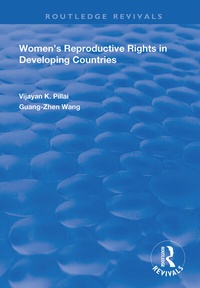
Women's Reproductive Rights in Developing Countries
1st Edition
Published on 26. February 2020
Book
Paperback/Softback
194 pages
978-1-138-35921-5 (ISBN)
Description
First published in 1999, this volume represents an empirical model of reproductive rights in developing countries. The model encompasses three explanations of reproductive rights. The first proposes that reproductive rights levels are negatively related to population growth. The second explanation argues that gender equality has a positive effect on reproductive rights. Finally, the authors propose that women's education has a positive effect on reproductive rights. The empirical model takes into account the effects of modernization, secularization, and family planning program effort on population growth, women's education, and gender equality.
More details
Series
Language
English
Place of publication
London
United Kingdom
Publishing group
Taylor & Francis Ltd
Target group
College/higher education
Dimensions
Height: 219 mm
Width: 152 mm
Weight
380 gr
ISBN-13
978-1-138-35921-5 (9781138359215)
Copyright in bibliographic data and cover images is held by Nielsen Book Services Limited or by the publishers or by their respective licensors: all rights reserved.
Schweitzer Classification
Other editions
Additional editions

Vijayan K. Pillai | Guang-Shen Wang
Women's Reproductive Rights in Developing Countries
Book
06/2019
1st Edition
Routledge
€163.42
Shipment within 10-20 days
Vijayan K. Pillai | Guang-Shen Wang
Women's Reproductive Rights in Developing Countries
E-Book
11/2018
1st Edition
Routledge
€47.49
Available for download
Vijayan K. Pillai | Guang-Shen Wang
Women's Reproductive Rights in Developing Countries
E-Book
11/2018
1st Edition
Routledge
€47.49
Available for download
Persons
Vijayan K Pillai, Guang-Shen Wang
Content
1. Introduction. 2. State Population Control Policies and Reproductive Rights. 3. Value Systems and Reproductive Rights. 4. Women's Health Movements and Reproductive Rights. 5. Overview of Rights in Classical and Contemporary Sociological Theories. 6. Explanations of Reproductive Rights. 7. Methodology. 8. Analyses and Results. 9. Post Hoc Modelling of Women's Reproductive Rights. 10. Discussion and Conclusion.