

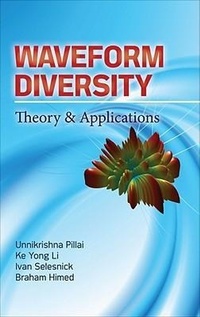
Waveform Diversity: Theory & Applications
Theory & Application
Published on 16. June 2011
Book
Hardback
320 pages
978-0-07-162289-9 (ISBN)
Description
Publisher's Note: Products purchased from Third Party sellers are not guaranteed by the publisher for quality, authenticity, or access to any online entitlements included with the product.
Cutting-edge transmitter and receiver waveform design techniquesOptimum design can improve signal direction, interference, and noise suppression across various disciplines that utilize waveforms, including radar, sonar, and communications. Waveform Diversity explains the role of transmitter and receiver waveform design to boost overall performance. Written by experts in the field, this monograph covers joint transmitter receiver design, optimum design methods, constant envelope transmit signals, and sparsity-based receivers. Proven methods for mitigating noise and clutter and maximizing output signal power are included in this practical guide.
Waveform Diversity covers:
Waveform design and matched filtering
New methods for optimum transmitter and receiver design
Transmitter threshold energy and energy-bandwidth tradeoff
Increasing transmit power efficiency with constant envelope transmit signals
Optimum waveform design to reduce noise and clutter
Discrete-time waveform design
Sparsity-based receiver design methods
Cutting-edge transmitter and receiver waveform design techniquesOptimum design can improve signal direction, interference, and noise suppression across various disciplines that utilize waveforms, including radar, sonar, and communications. Waveform Diversity explains the role of transmitter and receiver waveform design to boost overall performance. Written by experts in the field, this monograph covers joint transmitter receiver design, optimum design methods, constant envelope transmit signals, and sparsity-based receivers. Proven methods for mitigating noise and clutter and maximizing output signal power are included in this practical guide.
Waveform Diversity covers:
Waveform design and matched filtering
New methods for optimum transmitter and receiver design
Transmitter threshold energy and energy-bandwidth tradeoff
Increasing transmit power efficiency with constant envelope transmit signals
Optimum waveform design to reduce noise and clutter
Discrete-time waveform design
Sparsity-based receiver design methods
More details
Language
English
Place of publication
United States
Publishing group
McGraw-Hill Education - Europe
Target group
Professional and scholarly
Product notice
Unsewn / adhesive bound
Paper over boards
Illustrations
40 Illustrations
Dimensions
Height: 239 mm
Width: 157 mm
Thickness: 23 mm
Weight
404 gr
ISBN-13
978-0-07-162289-9 (9780071622899)
Copyright in bibliographic data and cover images is held by Nielsen Book Services Limited or by the publishers or by their respective licensors: all rights reserved.
Schweitzer Classification
Persons
S. Unnikrishna Pillai is a Professor of Electrical and Computer Engineering at Polytechnic Institute of NYU in Brooklyn, New York. His research interests include radar signal processing, blind identification, spectrum estimation, data recovery and wavform diversity. Dr. Pillai is the author of Array Signal Processign and co-author of Spectrum Estimation and system Identification, Prof. Papoulis' Probability, Random Variables and Stochastic processes (Fourth edition), and Space Based Radar - Theory & Applications.
Ke Yong Li is a senior engineer at C & P Technolliges, Inc. in Closter, New Jersey. His areas of research include Space-Time Adaptive processing (STAP), waveform diversity and radar signal processing. He is the coauthor of the book on Space Based Radar - Theory & Applications.
Ivan Selesnick is an Associated Provessor of Electrical and Computer engineering at Polytechnic Institute of NYU in Brooklyn, New York. His current research interests are in the areas of digital signal and image processing, wavelet and sparsity based methods for signal restoration, and biomedical signal processing.
Braham Himed is a Principal Electronics Engineer at the U.S. Air Force Research Laboratory, Radar Signal Processing Branch, Sensors Directorate, in Dayton, Ohio. His research interests include radar signal processing, detection, estimation, multichannel adaptive processing, time series analysis, and array processing. He is the coauthor of the book on Space Based Radar - Theory & Applications.
Ke Yong Li is a senior engineer at C & P Technolliges, Inc. in Closter, New Jersey. His areas of research include Space-Time Adaptive processing (STAP), waveform diversity and radar signal processing. He is the coauthor of the book on Space Based Radar - Theory & Applications.
Ivan Selesnick is an Associated Provessor of Electrical and Computer engineering at Polytechnic Institute of NYU in Brooklyn, New York. His current research interests are in the areas of digital signal and image processing, wavelet and sparsity based methods for signal restoration, and biomedical signal processing.
Braham Himed is a Principal Electronics Engineer at the U.S. Air Force Research Laboratory, Radar Signal Processing Branch, Sensors Directorate, in Dayton, Ohio. His research interests include radar signal processing, detection, estimation, multichannel adaptive processing, time series analysis, and array processing. He is the coauthor of the book on Space Based Radar - Theory & Applications.
Content
Chapter 1. Introduction
Chapter 2 Waveform Design and Matched Filtering
Chapter 3 New Methods for Optimum Transmitter and Receiver Design
Chapter 4 Constant Envelope Transmit Signals
Chapter 5 Optimum Waveform Design
Chapter 6 Discrete-Time Waveform Design
Chapter 7 Sparsity-Based Receivers
Index
Chapter 2 Waveform Design and Matched Filtering
Chapter 3 New Methods for Optimum Transmitter and Receiver Design
Chapter 4 Constant Envelope Transmit Signals
Chapter 5 Optimum Waveform Design
Chapter 6 Discrete-Time Waveform Design
Chapter 7 Sparsity-Based Receivers
Index