

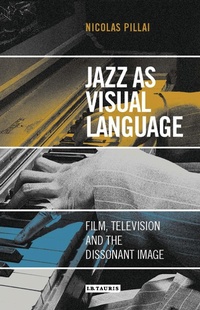
Jazz as Visual Language
Film, Television and the Dissonant Image
Published on 15. November 2016
Book
Hardback
192 pages
978-1-78453-344-1 (ISBN)
Description
This book provides a timely analysis of the relationship between jazz and recording and broadcast technologies in the early twentieth century. Jazz histories have traditionally privileged qualities such as authenticity, naturalness and spontaneity, but to do so overlooks jazz's status as a modernist, mechanised art form that evolved alongside the moving image and visual cultures. Jazz as Visual Language shows that the moving image is crucial to our understanding of what the materiality of jazz really is. Focusing on Len Lye's direct animation, Gjon Mili's experimental footage of musicians performing and the BBC's Jazz 625 series, this book places emphasis on film and television that conveys the 'sound of surprise' through formal innovation, rather than narrative structure. Nicolas Pillai seeks to refine a critical vocabulary of jazz and visual culture whilst arguing that jazz was never just a new sound; it was also a new way of seeing the world.
Reviews / Votes
This is a thought-provoking book that addresses a fascinating and still under-researched topic, and will be of great value to scholars working interested in film, television or jazz studies. More widely, though, it will be an engaging read for anybody with an interest in how jazz is represented in the broadcast media, and how this representation can influence our own definitions of jazz. * London Jazz News * A very interesting study that brings jazz studies and film studies together comfortably and in lucid language enlarges the range of both research fields. * Jive Talk * The final study on Jazz 625 is excellent ... Backed up by a full table of transmissions, and with intriguing and fascinating discussion [...] it picks a sensitive and delicate path through critical writing on the subject and explores the ground-breaking series in real depth. For this alone, the book is very valuable. * IASPM@ Journal * Jazz as Visual Language provides three strong case studies, demonstrating in a detailed and nuanced way three case-specific interactions between music on-screen and the different types of audio-visual media analysed here ... It brings together different angles and perspectives in an enriching and inspiring interdisciplinary approach. * H-Net Reviews * Jazz as Visual Language: Film, Television and the Dissonant Image [is] an especially pertinent and timely intervention into jazz scholarship and film theory simultaneously. [...] Pillai's written account of jazz and visual media proves transformative in its own right, contributing much to the study of jazz, television and film music studies. * Alphaville Journal of Film and Screen Media *More details
Language
English
Place of publication
United Kingdom
Publishing group
Bloomsbury Publishing PLC
Target group
College/higher education
Product notice
Laminated cover
Illustrations
20 bw integrated
Dimensions
Height: 223 mm
Width: 144 mm
Thickness: 22 mm
Weight
364 gr
ISBN-13
978-1-78453-344-1 (9781784533441)
Copyright in bibliographic data and cover images is held by Nielsen Book Services Limited or by the publishers or by their respective licensors: all rights reserved.
Schweitzer Classification
Other editions
Additional editions
E-Book
11/2016
1st Edition
I.B. Tauris
€144.99
Available for download
E-Book
11/2016
I.B. Tauris
€144.99
Available for download
Person
Nicolas Pillai is a research fellow in the School of Media at Birmingham City University, UK. He is the co-editor of Brilliant Corners: Approaches to Jazz & Comics (2016) and New Jazz Conceptions: History, Theory, Practice (2017). He has contributed chapters to Gender and Identity in Jazz (2016) and The Routledge Companion to Jazz Studies (2017), as well as articles in journals such as The Soundtrack and Movie: A Journal of Film Criticism. He has also written an essay for the booklet included in the BFI dual format Blu-ray/DVD release of Paris Blues (1961).
Content
1. Introduction
2. Len Lye
3. Gjon Mili
4. Jazz 625
Coda: Jazz in motion
2. Len Lye
3. Gjon Mili
4. Jazz 625
Coda: Jazz in motion