

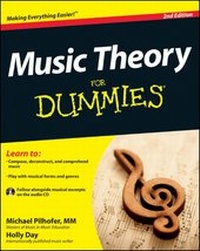
Music Theory For Dummies
with Audio CD
2nd Edition
Published on 1. November 2011
Book
Paperback/Softback
336 pages
978-1-118-09550-8 (ISBN)
Description
Grasp the concepts needed to compose, deconstruct, and comprehend music
Whether you're a student of music or a music lover, Music Theory For Dummies presents you with essential information on how to read, write, and understand music, as well as helpful hints on composing, arranging, and creating original melodies, harmonies, and chords.
Music Theory For Dummies gives you a friendly, unintimidating overview of the material covered in a typical college-level course and makes music theory easy to understand. It includes updated information on current teaching techniques; the newest music examples and genres; information on mastering major and minor scales, using intervals, and recognizing pitches and clefs; the lowdown on rhythms, tempo, dynamics, and navigation; how to transcribe the music you hear and transposing it to other keys; harmonizing and accompanying melodies; composing and arranging for voices and instruments; performing your own music; and much more.
* Audio CD includes musical excerpts played on a variety of instruments
* Makes learning music theory as enjoyable as it is useful
* Tracks to a typical college-level music theory course
Don't get discouraged by the seemingly complicated written structure of musical theory. With Music Theory For Dummies, understanding music has never been easier!
CD-ROM/DVD and other supplementary materials are not included as part of the e-book file, but are available for download after purchase.
Whether you're a student of music or a music lover, Music Theory For Dummies presents you with essential information on how to read, write, and understand music, as well as helpful hints on composing, arranging, and creating original melodies, harmonies, and chords.
Music Theory For Dummies gives you a friendly, unintimidating overview of the material covered in a typical college-level course and makes music theory easy to understand. It includes updated information on current teaching techniques; the newest music examples and genres; information on mastering major and minor scales, using intervals, and recognizing pitches and clefs; the lowdown on rhythms, tempo, dynamics, and navigation; how to transcribe the music you hear and transposing it to other keys; harmonizing and accompanying melodies; composing and arranging for voices and instruments; performing your own music; and much more.
* Audio CD includes musical excerpts played on a variety of instruments
* Makes learning music theory as enjoyable as it is useful
* Tracks to a typical college-level music theory course
Don't get discouraged by the seemingly complicated written structure of musical theory. With Music Theory For Dummies, understanding music has never been easier!
CD-ROM/DVD and other supplementary materials are not included as part of the e-book file, but are available for download after purchase.
More details
Edition
2. Auflage
Language
English
Place of publication
New York
United States
Target group
Adult education
Edition type
Revised edition
Illustrations
Illustrations
Dimensions
Height: 23.6 cm
Width: 18.7 cm
Thickness: 1.9 cm
Weight
512 gr
ISBN-13
978-1-118-09550-8 (9781118095508)
Schweitzer Classification
Other editions
New editions
Michael Pilhofer | Holly Day
Music Theory For Dummies
Book
02/2015
3rd Edition
Wiley
Unfortunately, price unknown
Article exhausted; check for reprint
Previous edition
Michael Pilhofer | Holly Day
Music Theory For Dummies
Book
04/2007
1st Edition
Wiley
€17.90
Article exhausted; check for reprint
Persons
Michael Pilhofer teaches music theory and percussions at McNally Smith College of Music in St. Paul, Minnesota. He's toured and recorded with Joe Lovano, Marian McPartland, Kenny Wheeler, and others.
Holly Day is a writing instructor at the Open Book Writing Collective in Minneapolis.
Holly Day is a writing instructor at the Open Book Writing Collective in Minneapolis.
Content
Introduction 1
Part I: Getting Started with Music Theory 7
Chapter 1: What Is Music Theory, Anyway? 9
Chapter 2: Determining What Notes Are Worth 15
Chapter 3: Giving It a Rest 29
Chapter 4: Introducing Time Signatures 37
Chapter 5: Playing with Beat 51
Part II: Putting Notes Together 59
Chapter 6: Music Notes (And Where to Find Them) 61
Chapter 7: Mastering the Major and Minor Scales 79
Chapter 8: Key Signatures and the Circle of Fifths 93
Chapter 9: Intervals: The Distance between Pitches 109
Chapter 10: Chord Building 133
Chapter 11: Chord Progressions 157
Part III: Musical Expression through Form, Tempo, Dynamics, and More 175
Chapter 12: The Building Blocks of Music: Rhythm, Melody, Harmony, and Song Form 177
Chapter 13: Relying on Classical Forms 189
Chapter 14: Tapping Into Popular Genres and Forms 199
Chapter 15: Creating Varied Sound through Tempo and Dynamics 207
Chapter 16: Instrument Tone Color and Acoustics 219
Part IV: The Part of Tens 225
Chapter 17: Ten Frequently Asked Questions about Music Theory 227
Chapter 18: Ten Valuable Music Resources 233
Chapter 19: Ten Music Theorists You Should Know About 239
Part V: Appendixes 247
Appendix A: On the CD 249
Appendix B: Chord Chart 255
Appendix C: Glossary 293
Index 297
Part I: Getting Started with Music Theory 7
Chapter 1: What Is Music Theory, Anyway? 9
Chapter 2: Determining What Notes Are Worth 15
Chapter 3: Giving It a Rest 29
Chapter 4: Introducing Time Signatures 37
Chapter 5: Playing with Beat 51
Part II: Putting Notes Together 59
Chapter 6: Music Notes (And Where to Find Them) 61
Chapter 7: Mastering the Major and Minor Scales 79
Chapter 8: Key Signatures and the Circle of Fifths 93
Chapter 9: Intervals: The Distance between Pitches 109
Chapter 10: Chord Building 133
Chapter 11: Chord Progressions 157
Part III: Musical Expression through Form, Tempo, Dynamics, and More 175
Chapter 12: The Building Blocks of Music: Rhythm, Melody, Harmony, and Song Form 177
Chapter 13: Relying on Classical Forms 189
Chapter 14: Tapping Into Popular Genres and Forms 199
Chapter 15: Creating Varied Sound through Tempo and Dynamics 207
Chapter 16: Instrument Tone Color and Acoustics 219
Part IV: The Part of Tens 225
Chapter 17: Ten Frequently Asked Questions about Music Theory 227
Chapter 18: Ten Valuable Music Resources 233
Chapter 19: Ten Music Theorists You Should Know About 239
Part V: Appendixes 247
Appendix A: On the CD 249
Appendix B: Chord Chart 255
Appendix C: Glossary 293
Index 297