

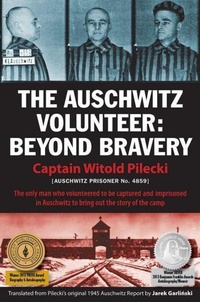
The Auschwitz Volunteer
Beyond Bravery
Published on 30. April 2012
Book
Hardback
460 pages
978-1-60772-009-6 (ISBN)
Description
WINNER of the PROSE AWARD for Biography & Autobiograpy from the Association of American Publishers
WINNER of the Benjamin Franklin SILVER AWARD for Autobiography/Memoir from the Independent Book Publishers Association
Featured Selection of the HISTORY BOOK CLUB
Selection of the BOOK OF THE MONTH CLUB and the MILITARY BOOK CLUB
"A historical document of the greatest importance." -- The New York Times, Editors' Choice
One of the "Five Best" books on wartime secret missions -- The Wall St. Journal
"Extraordinary memoir. Extraordinarily powerful prose. Deserves to be read alongside the accounts of Primo Levi and Elie Wiesel." The New Republic
"Remarkable revelations." -- Publishers Weekly
"A work of supreme importance." -- Tablet Magazine
"A fascinating first-hand account of virtually all aspects of life inside the camp." -- The Atlantic
"A shining example of heroism that transcends religion, race and time. Essential reading for anyone interested in the Holocaust." -- Rabbi Michael Schudrich, Chief Rabbi of Poland
"Extraordinary." -- Maclean's (Canada)
More at https://www.polandww2.com/books/auschwitz-volunteer/praise/
Book trailer at https://www.polandww2.com/books/auschwitz-volunteer/book-trailer/
In 1940, the Polish Underground wanted to know what was happening inside the recently opened Auschwitz concentration camp. Polish army officer Witold Pilecki volunteered to be arrested by the Germans and reported from inside the camp. His intelligence reports, smuggled out in 1941, were among the first eyewitness accounts of Auschwitz atrocities: the extermination of Soviet POWs, its function as a camp for Polish political prisoners, and the “final solution” for Jews. Pilecki received brutal treatment until he escaped in April 1943; soon after, he wrote a brief report. This book is the first English translation of a 1945 expanded version. In the foreword, Poland’s chief rabbi states, “If heeded, Pilecki’s early warnings might have changed the course of history.” Pilecki’s story was suppressed for half a century after his 1948 arrest by the Polish Communist regime as a “Western spy.” He was executed and expunged from Polish history. Pilecki writes in staccato style but also interjects his observations on humankind’s lack of progress: “We have strayed, my friends, we have strayed dreadfully... we are a whole level of hell worse than animals!” These remarkable revelations are amplified by 40 b&w photos, illus., and maps.
WINNER of the Benjamin Franklin SILVER AWARD for Autobiography/Memoir from the Independent Book Publishers Association
Featured Selection of the HISTORY BOOK CLUB
Selection of the BOOK OF THE MONTH CLUB and the MILITARY BOOK CLUB
"A historical document of the greatest importance." -- The New York Times, Editors' Choice
One of the "Five Best" books on wartime secret missions -- The Wall St. Journal
"Extraordinary memoir. Extraordinarily powerful prose. Deserves to be read alongside the accounts of Primo Levi and Elie Wiesel." The New Republic
"Remarkable revelations." -- Publishers Weekly
"A work of supreme importance." -- Tablet Magazine
"A fascinating first-hand account of virtually all aspects of life inside the camp." -- The Atlantic
"A shining example of heroism that transcends religion, race and time. Essential reading for anyone interested in the Holocaust." -- Rabbi Michael Schudrich, Chief Rabbi of Poland
"Extraordinary." -- Maclean's (Canada)
More at https://www.polandww2.com/books/auschwitz-volunteer/praise/
Book trailer at https://www.polandww2.com/books/auschwitz-volunteer/book-trailer/
In 1940, the Polish Underground wanted to know what was happening inside the recently opened Auschwitz concentration camp. Polish army officer Witold Pilecki volunteered to be arrested by the Germans and reported from inside the camp. His intelligence reports, smuggled out in 1941, were among the first eyewitness accounts of Auschwitz atrocities: the extermination of Soviet POWs, its function as a camp for Polish political prisoners, and the “final solution” for Jews. Pilecki received brutal treatment until he escaped in April 1943; soon after, he wrote a brief report. This book is the first English translation of a 1945 expanded version. In the foreword, Poland’s chief rabbi states, “If heeded, Pilecki’s early warnings might have changed the course of history.” Pilecki’s story was suppressed for half a century after his 1948 arrest by the Polish Communist regime as a “Western spy.” He was executed and expunged from Polish history. Pilecki writes in staccato style but also interjects his observations on humankind’s lack of progress: “We have strayed, my friends, we have strayed dreadfully... we are a whole level of hell worse than animals!” These remarkable revelations are amplified by 40 b&w photos, illus., and maps.
More details
Language
English
Place of publication
Los Angeles
United States
Product notice
sewn/stitched
Paper over boards
With dust jacket
Dimensions
Height: 235 mm
Width: 165 mm
Thickness: 43 mm
Weight
1002 gr
ISBN-13
978-1-60772-009-6 (9781607720096)
Copyright in bibliographic data and cover images is held by Nielsen Book Services Limited or by the publishers or by their respective licensors: all rights reserved.
Schweitzer Classification
Other editions
Additional editions
E-Book
05/2014
1st Edition
Aquila Polonica
€18.49
Available for download
Persons
CAPTAIN WITOLD PILECKI (1901–1948), a cavalry officer in the Polish Army, was one of the founders of a resistance organization in German-occupied Poland during World War II that quickly evolved into the Polish Underground Army.
Pilecki is the only man known to have volunteered to get himself arrested and sent to Auschwitz as a prisoner. His secret undercover mission for the Polish Underground: smuggle out intelligence about this new German concentration camp, and build a resistance organization among the inmates with the ultimate goal of liberating the camp.
Barely surviving nearly three years of starvation, disease and brutality, Pilecki accomplished his mission before escaping in April 1943. Soon after his escape, Pilecki wrote two relatively brief reports for his Polish Army superiors about his time in Auschwitz. In 1945 he wrote his most comprehensive report of more than one hundred single-spaced typed foolscap pages—it is this last, most comprehensive, report which Aquila Polonica is publishing in English for the first time.
Pilecki continued his work in the High Command of the Polish Underground Army, fought in the Warsaw Uprising (August–October 1944), was taken prisoner by the Germans, and ended the war in a German POW camp.
In late 1945, Pilecki, who was married and the father of two children, volunteered to return undercover to Poland where conditions were chaotic at war’s end as the communists were asserting control. His mission this time: liaise with anti-communist resistance organizations and report back on conditions within the country.
He was captured by the postwar Polish communist regime, tortured and executed in 1948 as a traitor and a "Western spy." Pilecki’s name was erased from Polish history until the collapse of communism in 1989.
Pilecki was fully exonerated posthumously in the 1990s. Today he is regarded as one of Poland’s heroes.
Pilecki is the only man known to have volunteered to get himself arrested and sent to Auschwitz as a prisoner. His secret undercover mission for the Polish Underground: smuggle out intelligence about this new German concentration camp, and build a resistance organization among the inmates with the ultimate goal of liberating the camp.
Barely surviving nearly three years of starvation, disease and brutality, Pilecki accomplished his mission before escaping in April 1943. Soon after his escape, Pilecki wrote two relatively brief reports for his Polish Army superiors about his time in Auschwitz. In 1945 he wrote his most comprehensive report of more than one hundred single-spaced typed foolscap pages—it is this last, most comprehensive, report which Aquila Polonica is publishing in English for the first time.
Pilecki continued his work in the High Command of the Polish Underground Army, fought in the Warsaw Uprising (August–October 1944), was taken prisoner by the Germans, and ended the war in a German POW camp.
In late 1945, Pilecki, who was married and the father of two children, volunteered to return undercover to Poland where conditions were chaotic at war’s end as the communists were asserting control. His mission this time: liaise with anti-communist resistance organizations and report back on conditions within the country.
He was captured by the postwar Polish communist regime, tortured and executed in 1948 as a traitor and a "Western spy." Pilecki’s name was erased from Polish history until the collapse of communism in 1989.
Pilecki was fully exonerated posthumously in the 1990s. Today he is regarded as one of Poland’s heroes.
Content
VII. Table of Contents
CONTENTS
Introduction by Norman Davies …………………………………………. xi
Foreword by Rabbi Michael Schudrich, Chief Rabbi of Poland …………. xv
Translator’s Introductory Note …………………………………………… xix
Publisher’s Note ………………………………………………………….. xxiii
Selected Highlights from Pilecki’s 1945 Report …………………………. xxix
List of Maps ………………………………………………………………. xxxi
Historical Horizon
Captain Witold Pilecki: The Report, the Mission, the Man ………. xxxiii
Captain Pilecki’s Covering Letter
to Major General Tadeusz Pelczynski …………………………… 1
Captain Witold Pilecki’s 1945 Auschwitz Report …….…………………. 5
Appendices
1 Glossary of English, German and Polish Terms
and Acronyms …………………………………………………...335
2 German-Language Positions and Ranks at Auschwitz
Mentioned by Pilecki …………………………………………….343
3 Index of People and Places Referred to by Pilecki
with Either a Code Number or Letter …………………….…...…345
4 Chronology of Pilecki’s 1945 Report …………………………...……355
Index ……………………………………………………….……………..365
Discussion Questions ……………………………………………………..397
LIST OF MAPS
Europe 1939 ……………………………………………... vi
Poland–September 1939 ……………………………….. ix
Occupied Poland 1939–1941 …………………………… x
Auschwitz and Environs–1944 …………………………. 9
KL Auschwitz 1 …………………………………………. 10
Pilecki’s Escape Route from Auschwitz …………………300
CONTENTS
Introduction by Norman Davies …………………………………………. xi
Foreword by Rabbi Michael Schudrich, Chief Rabbi of Poland …………. xv
Translator’s Introductory Note …………………………………………… xix
Publisher’s Note ………………………………………………………….. xxiii
Selected Highlights from Pilecki’s 1945 Report …………………………. xxix
List of Maps ………………………………………………………………. xxxi
Historical Horizon
Captain Witold Pilecki: The Report, the Mission, the Man ………. xxxiii
Captain Pilecki’s Covering Letter
to Major General Tadeusz Pelczynski …………………………… 1
Captain Witold Pilecki’s 1945 Auschwitz Report …….…………………. 5
Appendices
1 Glossary of English, German and Polish Terms
and Acronyms …………………………………………………...335
2 German-Language Positions and Ranks at Auschwitz
Mentioned by Pilecki …………………………………………….343
3 Index of People and Places Referred to by Pilecki
with Either a Code Number or Letter …………………….…...…345
4 Chronology of Pilecki’s 1945 Report …………………………...……355
Index ……………………………………………………….……………..365
Discussion Questions ……………………………………………………..397
LIST OF MAPS
Europe 1939 ……………………………………………... vi
Poland–September 1939 ……………………………….. ix
Occupied Poland 1939–1941 …………………………… x
Auschwitz and Environs–1944 …………………………. 9
KL Auschwitz 1 …………………………………………. 10
Pilecki’s Escape Route from Auschwitz …………………300